


Accuracy and Safety of Non-Image Guided Trigger Finger Injections: A Cadaveric Study
- PMID: 35656857
- PMCID: PMC10617481
- DOI: 10.1177/15589447221093676
Accuracy and Safety of Non-Image Guided Trigger Finger Injections: A Cadaveric Study
Abstract
Background: Stenosing flexor tenosynovitis is commonly treated by injection of corticosteroids into the flexor tendon sheath. However, there is no consensus in the literature regarding the optimal technique, specifically when not utilizing ultrasound guidance. Here, we present a cadaver study in which 3 common techniques of flexor sheath injection were compared with regard to their accuracy and safety profiles.
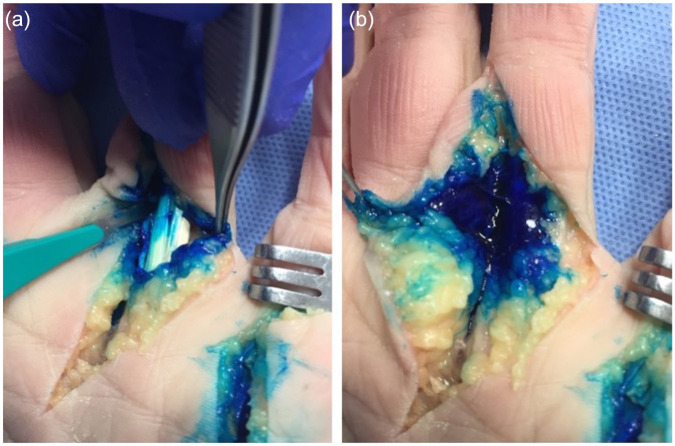
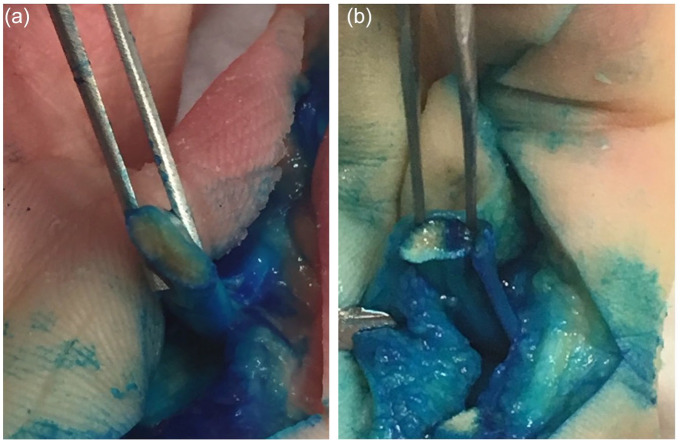
Methods: Fifteen fresh-frozen cadaver hands (60 digits) were evenly divided into 3 groups (20 digits per group). Digits in each group were injected with methylene blue dye using 1 of the 3 techniques (palmar-to-bone, palmar supra-tendinous, and mid-axial). The fingers were then dissected and were inspected for location of dye, as well as injury to tendon or digital nerves.
Results: The mid-axial technique demonstrated the greatest accuracy with the highest rate of all intra-sheath injection, 15 of 20 digits (75%), while the palmar-to-bone technique produced the most combined intra- and extra-sheath injections, 13 of 20 digits, (65%) and the palmar supra-tendinous technique resulted in the most all extra-sheath injections, 9 of 20 digits (45%). The difference in rates of all intra-sheath injection was significant (P = .01). The mid-axial technique also produced the fewest intra-tendinous injections 0 of 20, although this result did not reach statistical significance (P = .15).
Conclusions: Compared to other common non-image guided flexor tendon sheath injection techniques, the mid-axial injection technique was found to be the most accurate in producing all intra-sheath injection and least likely to result in intra-tendinous injection.
Keywords: anatomy; basic science; diagnosis; digits; pain; research & health outcomes; specialty; surgery; tendon; treatment.
Conflict of interest statement
Declaration of Conflicting InterestsThe author(s) declared no potential conflicts of interest with respect to the research, authorship, and/or publication of this article.
Figures




References
-
- Stahl S, Kanter Y, Karnielli E. Outcome of trigger finger treatment in diabetes. J Diabetes Complications. 1997;11(5):287-290. - PubMed
-
- Ryzewicz M, Wolf JM. Trigger digits: principles, management, and complications. J Hand Surg Am. 2006;31(1):135-146. - PubMed
-
- Patel MR, Bassini L. Trigger fingers and thumb: when to splint, inject, or operate. J Hand Surg Am. 1992;17(1):110-113. - PubMed
-
- Saldana MJ. Trigger digits: diagnosis and treatment. J Am Acad Orthop Surg. 2001;9(4):246-252. - PubMed
-
- Taras JS, Raphael JS, Pan WT, et al. Corticosteroid injections for trigger digits: is intrasheath injection necessary? J Hand Surg Am. 1998;23(4):717-722. - PubMed
MeSH terms
LinkOut - more resources
Full Text Sources
