


Prevalence of sarcopenia in women at stable weight phase after Roux-en-Y gastric bypass
- PMID: 35657128
- PMCID: PMC9832848
- DOI: 10.20945/2359-3997000000494
Prevalence of sarcopenia in women at stable weight phase after Roux-en-Y gastric bypass
Abstract
Objective: Evaluating the prevalence of sarcopenia in women submitted to bariatric surgery - Roux-en-Y gastric bypass. Design: Observational, cross-sectional study.
Subjects and methods: Women (18-65 years old) who underwent bariatric surgery (BG) ≥ 2 years and reached stable weight ≥ 6 months, were investigated. Control group (CG) comprised non-operated matched women with obesity. Body composition was determined through dual-energy X-ray absorptiometry. Low lean mass (LLM) was defined as appendicular lean mass index (ALM kg/height m2) < 5.5 kg/m2. Physical strength was assessed through dynamometer and sit-to-stand test (SST), whereas performance was assessed through 4-m gait speed and Short Physical Performance Battery Tests (SPPB). Sarcopenia was diagnosed in the presence of LLM and low strength.
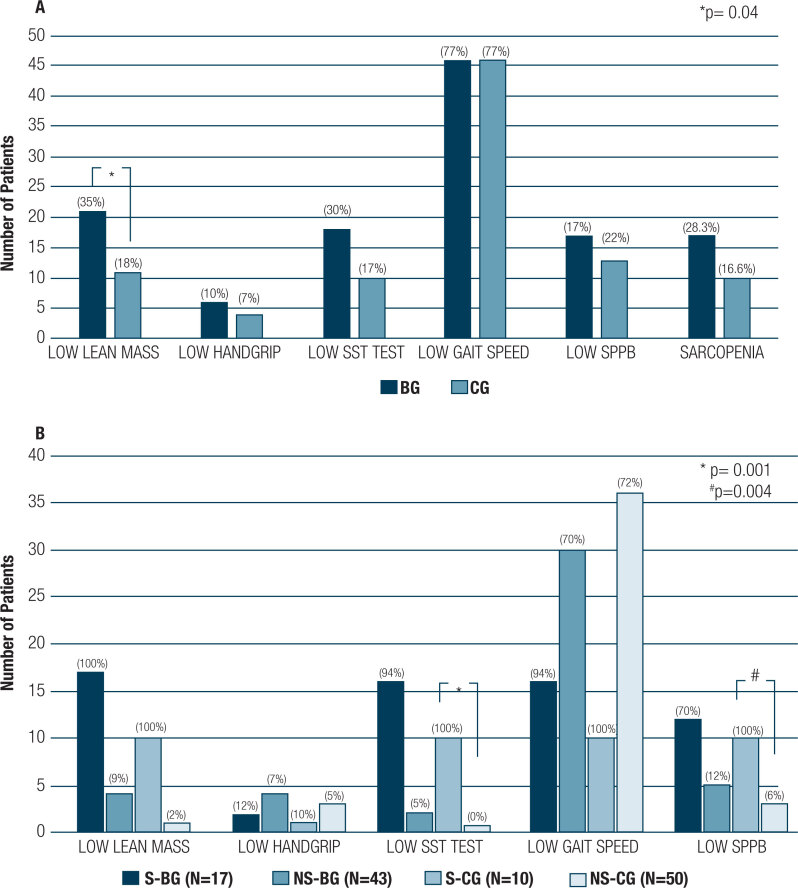
Results: One-hundred and twenty women (60 in each group, 50 ± 9.7 years old) were investigated. All anthropometric and body composition parameters were lower in BG than in CG, whereas strength and performance were similar between groups. Women with reduced strength presented high total fat mass and low physical activity level (p < 0.005). LLM was observed in 35% of BG and in 18.3% of CG (p = 0.04), whereas sarcopenia was diagnosed in 28.3% of BG and in 16.6% of CG (p = 0.12). Sarcopenic women in BG had better performance both in SST (p = 0.001) and SPPB (p = 0.004). Total lean mass (OR:1.41, 95% CI [1.18; 1.69], p < 0.001) and obesity (OR: 38.2 [2.27; 644.12], p < 0.001) were associated with sarcopenia in the multivariate analysis.
Conclusion: Despite great weight loss, sarcopenia prevalence did not increase in BG and its presence was influenced by total lean mass and obesity.
Keywords: Obesity; bariatric surgery; physical performance; sarcopenia; strength.
Conflict of interest statement
Disclosure: no potential conflict of interest relevant to this article was reported.
Figures
References
-
- Monteiro CA, Macário EM, Sardinha LMV, Gouvea ECDP, Silva LES, Oliveira MM, et al. Vigitel Brasil: Vigilância de fatores de risco e proteção para doenças crônicas por inquérito telefônico. Distrito Federal, DF: Ministério da Saúde; 2020.
-
- Blüher M. Obesity: global epidemiology and pathogenesis. Nat Rev Endocrinol. 2019;15(5):288–298. - PubMed
-
- LeBlanc ES, Patnode CD, Webber EM, Redmond N, Rushkin M, O’Connor EA. Behavioral and Pharmacotherapy Weight Loss Interventions to Prevent Obesity-Related Morbidity and Mortality in Adults: Updated Evidence Report and Systematic Review for the US Preventive Services Task Force. JAMA. 2018;320(11):1172–1191. - PubMed
-
- Kenngott HG, Nickel F, Wise PA, Wagner F, Billeter AT, Nattenmüller J, et al. Weight Loss and Changes in Adipose Tissue and Skeletal Muscle Volume after Laparoscopic Sleeve Gastrectomy and Roux-en-Y Gastric Bypass: a Prospective Study with 12-Month Follow-Up. Obes Surg. 2019;29(12):4018–4028. - PubMed
Publication types
MeSH terms
LinkOut - more resources
Full Text Sources
Research Materials