


Attention Allocation During Exploration of Visual Arrays in ASD: Results from the ABC-CT Feasibility Study
- PMID: 35657448
- PMCID: PMC10980886
- DOI: 10.1007/s10803-022-05569-0
Attention Allocation During Exploration of Visual Arrays in ASD: Results from the ABC-CT Feasibility Study
Abstract
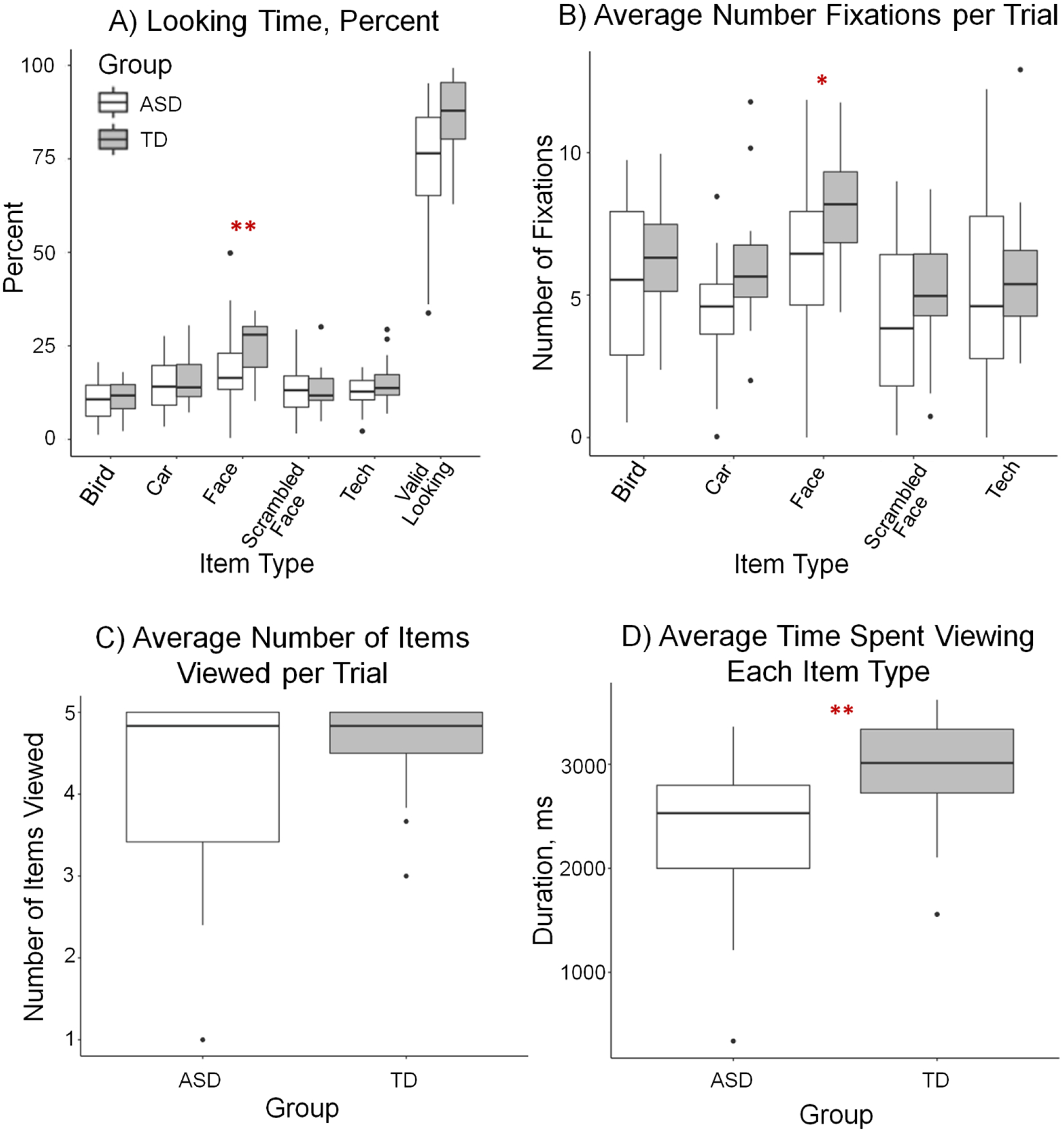
Visual exploration paradigms involving object arrays have been used to examine salience of social stimuli such as faces in ASD. Recent work suggests performance on these paradigms may associate with clinical features of ASD. We evaluate metrics from a visual exploration paradigm in 4-to-11-year-old children with ASD (n = 23; 18 males) and typical development (TD; n = 23; 13 males). Presented with arrays containing faces and nonsocial stimuli, children with ASD looked less at (p = 0.002) and showed fewer fixations to (p = 0.022) faces than TD children, and spent less time looking at each object on average (p = 0.004). Attention to the screen and faces correlated positively with social and cognitive skills in the ASD group (ps < .05). This work furthers our understanding of objective measures of visual exploration in ASD and its potential for quantifying features of ASD.
Keywords: Autism spectrum disorder; Eye-tracking; Visual exploration; Visual processing; Visual search.
© 2022. The Author(s), under exclusive licence to Springer Science+Business Media, LLC, part of Springer Nature.
Figures

References
-
- American Psychiatric Association. 2013. Diagnostic and Statistical Manual of Mental Disorders: DSM-5. Arlington, Va.: American Psychiatric Association.
-
- Brenner Laurie a, Turner Katherine C., and Müller Ralph-Axel. 2007. “Eye Movement and Visual Search: Are There Elementary Abnormalities in Autism?” Journal of Autism and Developmental Disorders 37(7):1289–1309. - PubMed
MeSH terms
Grants and funding
LinkOut - more resources
Full Text Sources
Medical
