


Noninvasive Screening Tool for Hyperkalemia Using a Single-Lead Electrocardiogram and Deep Learning: Development and Usability Study
- PMID: 35657658
- PMCID: PMC9206199
- DOI: 10.2196/34724
Noninvasive Screening Tool for Hyperkalemia Using a Single-Lead Electrocardiogram and Deep Learning: Development and Usability Study
Abstract
Background: Hyperkalemia monitoring is very important in patients with chronic kidney disease (CKD) in emergency medicine. Currently, blood testing is regarded as the standard way to diagnose hyperkalemia (ie, using serum potassium levels). Therefore, an alternative and noninvasive method is required for real-time monitoring of hyperkalemia in the emergency medicine department.
Objective: This study aimed to propose a novel method for noninvasive screening of hyperkalemia using a single-lead electrocardiogram (ECG) based on a deep learning model.
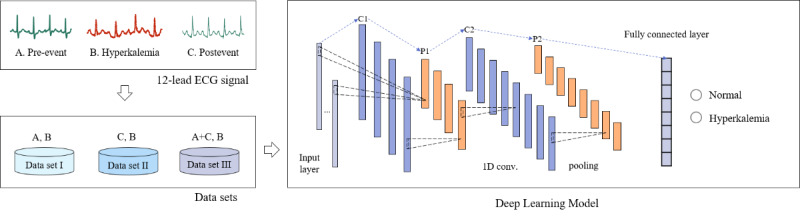
Methods: For this study, 2958 patients with hyperkalemia events from July 2009 to June 2019 were enrolled at 1 regional emergency center, of which 1790 were diagnosed with chronic renal failure before hyperkalemic events. Patients who did not have biochemical electrolyte tests corresponding to the original 12-lead ECG signal were excluded. We used data from 855 patients (555 patients with CKD, and 300 patients without CKD). The 12-lead ECG signal was collected at the time of the hyperkalemic event, prior to the event, and after the event for each patient. All 12-lead ECG signals were matched with an electrolyte test within 2 hours of each ECG to form a data set. We then analyzed the ECG signals with a duration of 2 seconds and a segment composed of 1400 samples. The data set was randomly divided into the training set, validation set, and test set according to the ratio of 6:2:2 percent. The proposed noninvasive screening tool used a deep learning model that can express the complex and cyclic rhythm of cardiac activity. The deep learning model consists of convolutional and pooling layers for noninvasive screening of the serum potassium level from an ECG signal. To extract an optimal single-lead ECG, we evaluated the performances of the proposed deep learning model for each lead including lead I, II, and V1-V6.
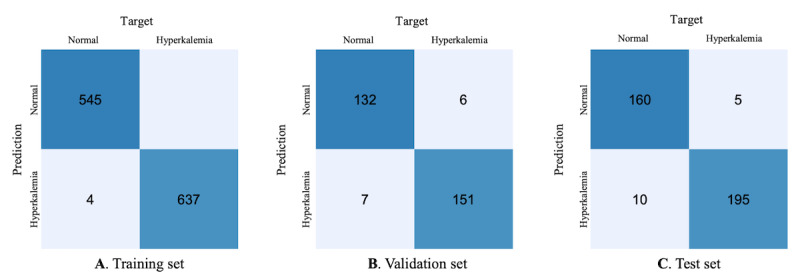
Results: The proposed noninvasive screening tool using a single-lead ECG shows high performances with F1 scores of 100%, 96%, and 95% for the training set, validation set, and test set, respectively. The lead II signal was shown to have the highest performance among the ECG leads.
Conclusions: We developed a novel method for noninvasive screening of hyperkalemia using a single-lead ECG signal, and it can be used as a helpful tool in emergency medicine.
Keywords: ECG; deep learning; electrocardiogram; emergency medicine; hyperkalemia; noninvasive screening; single-lead ECG.
©Erdenebayar Urtnasan, Jung Hun Lee, Byungjin Moon, Hee Young Lee, Kyuhee Lee, Hyun Youk. Originally published in JMIR Medical Informatics (https://medinform.jmir.org), 03.06.2022.
Conflict of interest statement
Conflicts of Interest: None declared.
Figures
References
-
- Fitch K, Woolley JM, Engel T, Blumen H. The clinical and economic burden of hyperkalemia on medicare and commercial payers. Am Health Drug Benefits. 2017 Jun;10(4):202–210. http://europepmc.org/abstract/MED/28794824 - PMC - PubMed
-
- Einhorn LM, Zhan M, Hsu VD, Walker LD, Moen MF, Seliger SL, Weir MR, Fink JC. The frequency of hyperkalemia and its significance in chronic kidney disease. Arch Intern Med. 2009 Jun 22;169(12):1156–62. doi: 10.1001/archinternmed.2009.132. http://europepmc.org/abstract/MED/19546417 169/12/1156 - DOI - PMC - PubMed
-
- Raebel MA, Ross C, Xu S, Roblin DW, Cheetham C, Blanchette CM, Saylor G, Smith DH. Diabetes and drug-associated hyperkalemia: effect of potassium monitoring. J Gen Intern Med. 2010 Apr 20;25(4):326–33. doi: 10.1007/s11606-009-1228-x. http://europepmc.org/abstract/MED/20087674 - DOI - PMC - PubMed
LinkOut - more resources
Full Text Sources
Other Literature Sources
