


Post-abortion family planning utilization and associated factors in health facilities of Wolaita Zone, Southern Ethiopia: Mixed study
- PMID: 35657945
- PMCID: PMC9165889
- DOI: 10.1371/journal.pone.0267545
Post-abortion family planning utilization and associated factors in health facilities of Wolaita Zone, Southern Ethiopia: Mixed study
Abstract
Background: Unintended pregnancy due to disuse of family planning is the main cause of abortion globally. Women with a history of abortion are at higher risk of developing another unintended pregnancy, which may lead to repeated abortions and life-threatening complications. The immediate post-abortion period before women leave health institutions is a crucial time to provide family planning services. In Ethiopia, many women leave health facilities without using family planning methods. Therefore, this study aimed to determine the utilization of post-abortion family planning and its associated factors in health institutions in Wolaita Zone, Southern Ethiopia.
Methods: Facility-based mixed cross sectional study was conducted between April 1 and June 30, 2018. A systematic sampling method was used to select the 408 participants. Seven key informants were selected for in-depth interviews and observations were made using a checklist. Data were collected through face-to-face interviews using a structured questionnaire. Data were entered into EPI INFO 3.5.1 and exported to SPSS 21 for cleaning and analysis. Bivariate analysis was employed and a P-value <0.25 was considered for the multivariable analysis. Qualitative data were coded and thematically analyzed to support the quantitative findings.
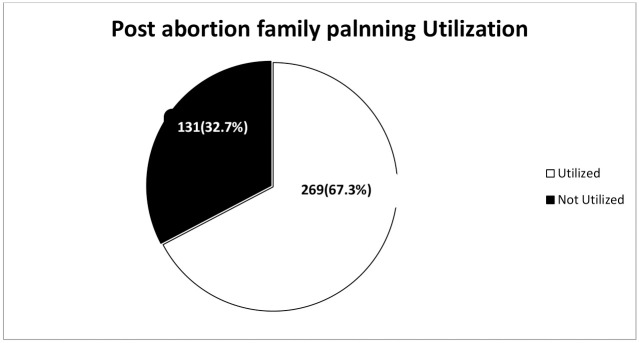
Results: Data were obtained from 400 participants (response rate, 98%). The magnitude of post-abortion family planning was 67.3% [95% CI (62.8, 71.8)]. Marital status [AOR 95% CI 3.86(1.9, 7.8)], Good knowledge about post-abortion family planning [AOR 95% CI 2.48(1.22, 5.03)], Non-governmental health facility [AOR 95% CI 6.62(3.47, 12.6)] Counseling [AOR 95% CI 3.6(2.02, 6.4)] and husbands' support [AOR 95% CI 3.21(1.81-5.7)] were significantly associated with Post-abortion family planning utilization.
Conclusion: The utilization of post-abortion family planning was low in Wolaita Sodo health institutions. Marital status, knowledge of post-abortion family planning, use of services at non-governmental health facilities, counseling, and husbands' support were determinants of post-abortion family planning.
Conflict of interest statement
NO authors have competing interests.
Figures
References
-
- World Health Organization. Medical eligibility criteria for contraceptive use. In: Health DoR, editor. Fourth edition ed. Geneva, Switzerland: WHO Press; 2010.
-
- World Health Organization. Safe abortion: Technical and policy guidance for the health system. 2nd edition ed. Geneva: WorldHealthOrganization; 2012.
-
- S DJ, Ashford LS, Vlassoff M. Adding it up: the costs and benefits of investing in family planning and maternal and newborn health. New York:: Guttmacher Institute and UNFPA; 2009.
MeSH terms
LinkOut - more resources
Full Text Sources
Medical
Miscellaneous
