


High HIV incidence among young women in South Africa: Data from a large prospective study
- PMID: 35657948
- PMCID: PMC9165791
- DOI: 10.1371/journal.pone.0269317
High HIV incidence among young women in South Africa: Data from a large prospective study
Abstract
Introduction: South Africa has the highest national burden of HIV globally. Understanding drivers of HIV acquisition in recently completed, prospective studies in which HIV was an endpoint may help inform the strategy and investments in national HIV prevention efforts and guide the design of future HIV prevention trials. We assessed HIV incidence and correlates of incidence among women enrolled in ECHO (Evidence for Contraceptive Options and HIV Outcomes), a large, open-label randomized clinical trial that compared three highly effective. reversible methods of contraception and rates of HIV acquisition.
Methods: During December 2015 to October 2018, ECHO followed sexually active, HIV-seronegative women, aged 16-35 years, seeking contraceptive services and willing to be randomized to one of three contraceptive methods (intramuscular depot medroxyprogesterone acetate, copper intrauterine device, or levonorgestrel implant) for 12-18 months at nine sites in South Africa. HIV incidence based on prospectively observed HIV seroconversion events. Cox proportional hazards regression models were used to define baseline cofactors related to incident HIV infection.
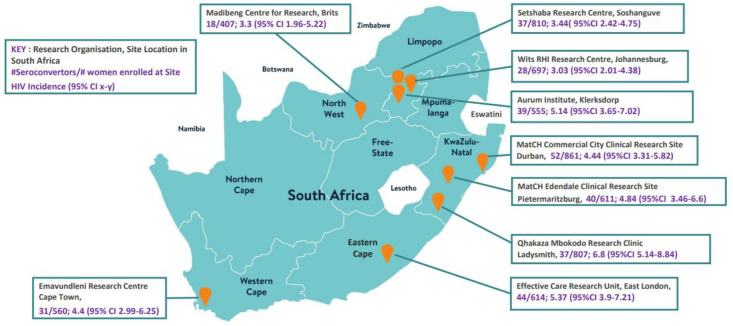
Results: 5768 women were enrolled and contributed 7647 woman-years of follow-up. The median age was 23 years and 62.5% were ≤24 years. A total of 345 incident HIV infections occurred, an incidence of 4.51 per 100 woman-years (95%CI 4.05-5.01). Incidence was >3 per 100 woman-years at all sites. Age ≤24 years, baseline infection with sexually transmitted infections, BMI≤30, and having new or multiple partners in the three months prior to enrollment were associated with incident HIV.
Conclusions: HIV incidence was high among South African women seeking contraceptive services. Integration of diagnostic management of sexually transmitted infections alongside delivery of HIV prevention options in health facilities providing contraception services are needed to mitigate ongoing risks of HIV acquisition for this vulnerable population.
Clinical trial registration: ClinicalTrials.gov, number NCT02550067 was the main Clinical Trial from which this secondary, non-randomized / observational analysis was derived with data limited to just South African sites.
Conflict of interest statement
The authors have declared that no competing interests exist.
Figures
References
-
- Human Sciences Reseach Council. The Fifth South African National HIV Prevalence, Incidence, Behaviour and Communication Survey, 2017: HIV Impact Assessment Summary Report. Cape Town, HSRC Press. 2018.
-
- UNAIDS JUNPoHA. UNAIDS DATA 2019. https://wwwunaidsorg/sites/default/files/media_asset/2019-UNAIDS-data_enpdf. 2019.
-
- Simbayi L, Zuma K, Zungu N, Moyo S, Marinda E, Jooste S, et al.. South African National HIV Prevalence, Incidence, Behaviour and Communication Survey. 2019. Epub Cape Town: HSRC Press, 2017.
-
- Hofmeyr GJ, Morrison CS, Baeten JM, Chipato T, Donnell D, Gichangi P, et al.. Rationale and design of a multi-center, open-label, randomised clinical trial comparing HIV incidence and contraceptive benefits in women using three commonly-used contraceptive methods (the ECHO study). Gates Open Res. 2018;1:17-. doi: 10.12688/gatesopenres.12775.2 . - DOI - PMC - PubMed
Publication types
MeSH terms
Substances
Associated data
Grants and funding
LinkOut - more resources
Full Text Sources
Medical
