


Racial Bias Beliefs Related to COVID-19 Among Asian Americans, Native Hawaiians, and Pacific Islanders: Findings From the COVID-19 Effects on the Mental and Physical Health of Asian Americans and Pacific Islanders Survey Study (COMPASS)
- PMID: 35658091
- PMCID: PMC9364971
- DOI: 10.2196/38443
Racial Bias Beliefs Related to COVID-19 Among Asian Americans, Native Hawaiians, and Pacific Islanders: Findings From the COVID-19 Effects on the Mental and Physical Health of Asian Americans and Pacific Islanders Survey Study (COMPASS)
Erratum in
-
Correction: Racial Bias Beliefs Related to COVID-19 Among Asian Americans, Native Hawaiians, and Pacific Islanders: Findings From the COVID-19 Effects on the Mental and Physical Health of Asian Americans and Pacific Islanders Survey Study (COMPASS).J Med Internet Res. 2022 Oct 31;24(10):e42716. doi: 10.2196/42716. J Med Internet Res. 2022. PMID: 36315935 Free PMC article.
Abstract
Background: During the COVID-19 pandemic, there have been increased reports of racial biases against Asian American and Native Hawaiian and Pacific Islander individuals. However, the extent to which different Asian American and Native Hawaiian and Pacific Islander groups perceive and experience (firsthand or as a witness to such experiences) how COVID-19 has negatively affected people of their race has not received much attention.
Objective: This study used data from the COVID-19 Effects on the Mental and Physical Health of Asian Americans and Pacific Islanders Survey Study (COMPASS), a nationwide, multilingual survey, to empirically examine COVID-19-related racial bias beliefs among Asian American and Native Hawaiian and Pacific Islander individuals and the factors associated with these beliefs.
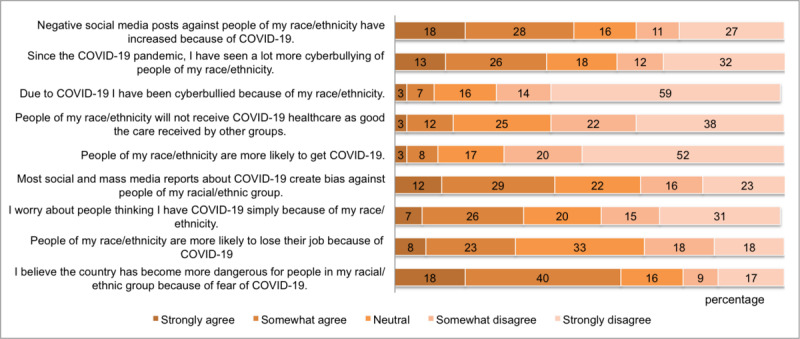
Methods: COMPASS participants were Asian American and Native Hawaiian and Pacific Islander adults who were able to speak English, Chinese (Cantonese or Mandarin), Korean, Samoan, or Vietnamese and who resided in the United States during the time of the survey (October 2020 to May 2021). Participants completed the survey on the web, via phone, or in person. The Coronavirus Racial Bias Scale (CRBS) was used to assess COVID-19-related racial bias beliefs toward Asian American and Native Hawaiian and Pacific Islander individuals. Participants were asked to rate the degree to which they agreed with 9 statements on a 5-point Likert scale (ie, 1=strongly disagree to 5=strongly agree). Multivariable linear regression was used to examine the associations between demographic, health, and COVID-19-related characteristics and perceived racial bias.
Results: A total of 5068 participants completed the survey (mean age 45.4, SD 16.4 years; range 18-97 years). Overall, 73.97% (3749/5068) agreed or strongly agreed with ≥1 COVID-19-related racial bias belief in the past 6 months (during the COVID-19 pandemic). Across the 9 racial bias beliefs, participants scored an average of 2.59 (SD 0.96, range 1-5). Adjusted analyses revealed that compared with Asian Indians, those who were ethnic Chinese, Filipino, Hmong, Japanese, Korean, Vietnamese, and other or multicultural had significantly higher mean CRBS scores, whereas no significant differences were found among Native Hawaiian and Pacific Islander individuals. Nonheterosexual participants had statistically significant and higher mean CRBS scores than heterosexual participants. Compared with participants aged ≥60 years, those who were younger (aged <30, 30-39, 40-49, and 50-59 years) had significantly higher mean CRBS scores. US-born participants had significantly higher mean CRBS scores than foreign-born participants, whereas those with limited English proficiency (relative to those reporting no limitation) had lower mean CRBS scores.
Conclusions: Many COMPASS participants reported racial bias beliefs because of the COVID-19 pandemic. Relevant sociodemographic contexts and pre-existing and COVID-19-specific factors across individual, community, and society levels were associated with the perceived racial bias of being Asian during the pandemic. The findings underscore the importance of addressing the burden of racial bias on Asian American and Native Hawaiian and Pacific Islander communities among other COVID-19-related sequelae.
Keywords: Asian American; COVID-19; Native Hawaiian and Pacific Islander; mobile phone; racial bias.
©Van Ta Park, Janice Y Tsoh, Marcelle Dougan, Bora Nam, Marian Tzuang, Quyen N Vuong, Joon Bang, Oanh L Meyer. Originally published in the Journal of Medical Internet Research (https://www.jmir.org), 09.08.2022.
Conflict of interest statement
Conflicts of Interest: None declared.
Figures
References
-
- Tessler H, Choi M, Kao G. The anxiety of being Asian American: hate crimes and negative biases during the COVID-19 pandemic. Am J Crim Justice. 2020;45(4):636–46. doi: 10.1007/s12103-020-09541-5. http://europepmc.org/abstract/MED/32837158 9541 - DOI - PMC - PubMed
-
- Ellerbeck A. Survey: more than 30 percent of Americans have witnessed COVID-19 bias against Asians. The Center for Public Integrity. [2020-05-01]. https://publicintegrity.org/health/coronavirus-and-inequality/survey-maj...
-
- Many Black and Asian Americans say they have experienced discrimination amid the COVID-19 outbreak. Pew Research Center. [2021-04-27]. https://www.pewresearch.org/social-trends/2020/07/01/many-black-and-asia...
Publication types
MeSH terms
Grants and funding
LinkOut - more resources
Full Text Sources
Medical
Miscellaneous
