


Molnupiravir combined with different repurposed drugs further inhibits SARS-CoV-2 infection in human nasal epithelium in vitro
- PMID: 35658229
- PMCID: PMC9057985
- DOI: 10.1016/j.biopha.2022.113058
Molnupiravir combined with different repurposed drugs further inhibits SARS-CoV-2 infection in human nasal epithelium in vitro
Abstract
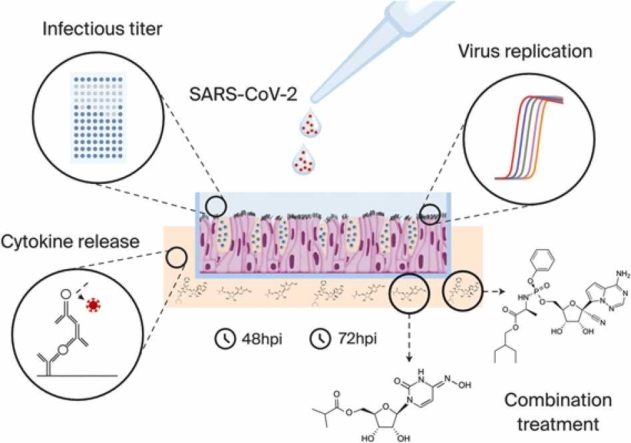
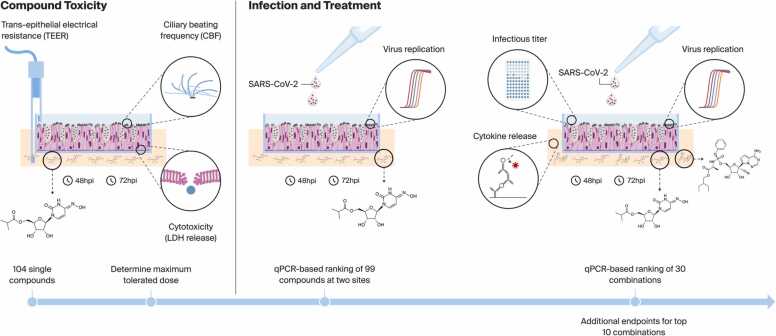
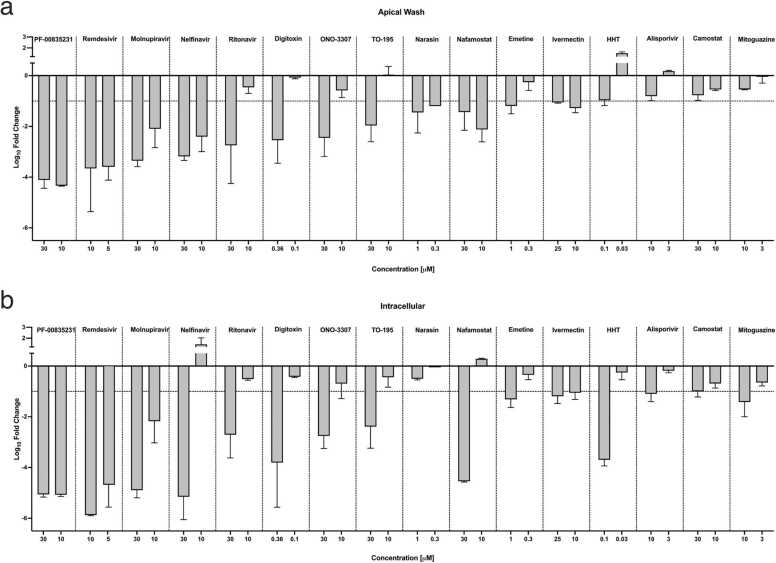
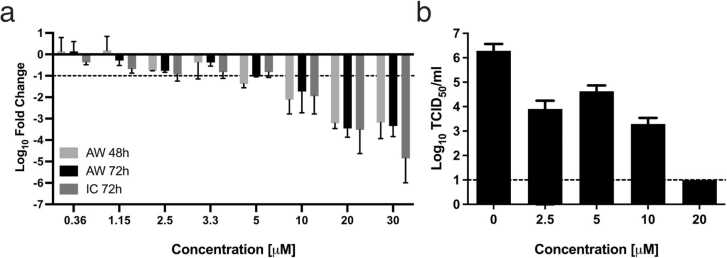
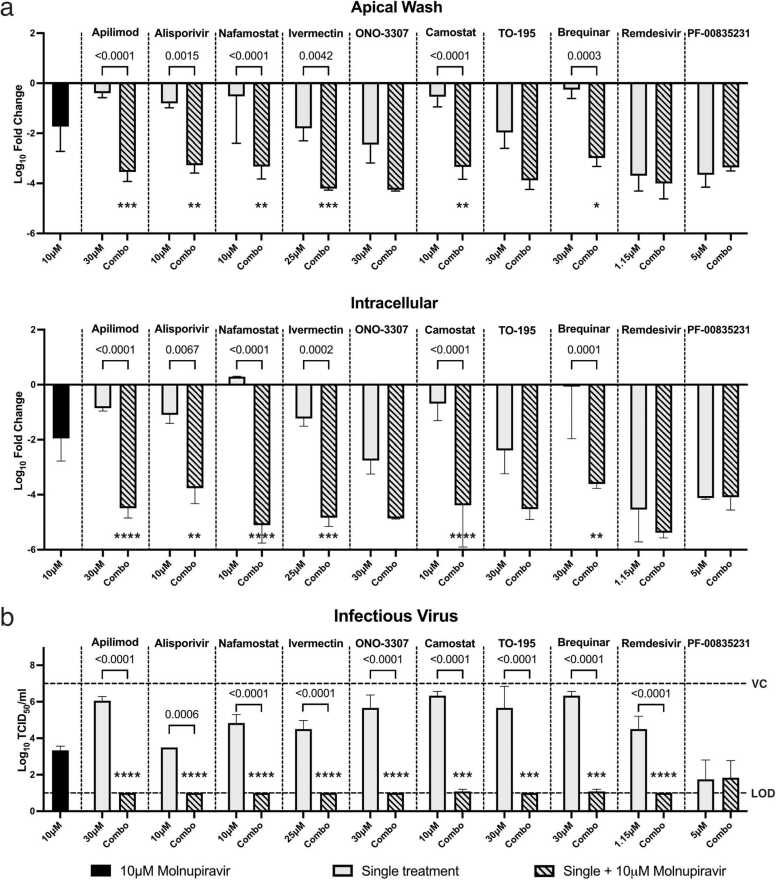
The severe acute respiratory syndrome coronavirus 2 (SARS-CoV-2) has caused a worldwide pandemic with unprecedented economic and societal impact. Currently, several vaccines are available and multitudes of antiviral treatments have been proposed and tested. Although many of the vaccines show clinical efficacy, they are not equally accessible worldwide. Additionally, due to the continuous emergence of new variants and generally short duration of immunity, the development of effective antiviral treatments remains of the utmost importance. Since the emergence of SARS-CoV-2, substantial efforts have been undertaken to repurpose existing drugs for accelerated clinical testing and emergency use authorizations. However, drug-repurposing studies using cellular assays often identify hits that later prove ineffective clinically, highlighting the need for more complex screening models. To this end, we evaluated the activity of single compounds that have either been tested clinically or already undergone extensive preclinical profiling, using a standardized in vitro model of human nasal epithelium. Furthermore, we also evaluated drug combinations based on a sub-maximal concentration of molnupiravir. We report the antiviral activity of 95 single compounds and 30 combinations. We show that only a few single agents are highly effective in inhibiting SARS-CoV-2 replication while selected drug combinations containing 10 µM molnupiravir boosted antiviral activity compared to single compound treatment. These data indicate that molnupiravir-based combinations are worthy of further consideration as potential treatment strategies against coronavirus disease 2019 (COVID-19).
Keywords: Air-liquid interface; Antivirals; COVID-19; Drug repurposing; SARS-CoV-2.
Copyright © 2022 The Authors. Published by Elsevier Masson SAS.. All rights reserved.
Conflict of interest statement
The authors have declared no conflict of interest.
Figures
References
-
- Gorbalenya A.E., Baker S.C., Baric R.S., de Groot R.J., Drosten C., Gulyaeva A.A., Haagmans B.L., Lauber C., Leontovich A.M., Neuman B.W., Penzar D., Perlman S., Poon L.L.M., Samborskiy D.V., Sidorov I.A., Sola I., Ziebuhr J., Coronaviridae V. Study group of the international committee on taxonomy of, the species Severe acute respiratory syndrome-related coronavirus: classifying 2019-nCoV and naming it SARS-CoV-2. Nat. Microbiol. 2020;5(4):536–544. - PMC - PubMed
-
- WHO, WHO Coronavirus (COVID-19) Dashboard, 2021. 〈https://covid19.who.int/〉. (Accessed 28 March 2022).
-
- Long Q.-X., Tang X.-J., Shi Q.-L., Li Q., Deng H.-J., Yuan J., Hu J.-L., Xu W., Zhang Y., Lv F.-J., Su K., Zhang F., Gong J., Wu B., Liu X.-M., Li J.-J., Qiu J.-F., Chen J., Huang A.-L. Clinical and immunological assessment of asymptomatic SARS-CoV-2 infections. Nat. Med. 2020;26:1200–1204. - PubMed
MeSH terms
Substances
LinkOut - more resources
Full Text Sources
Miscellaneous
