Review
. 2022 Jun 3;15(1):74.
doi: 10.1186/s13045-022-01293-5.

How we treat NK/T-cell lymphomas

Affiliations
Review

How we treat NK/T-cell lymphomas

Eric Tse et al. J Hematol Oncol. .

Abstract

Natural killer (NK)/T-cell lymphomas are aggressive malignancies with a predilection for Asian and South American populations. Epstein-Barr virus (EBV) infection in lymphoma cells is universal. Predominantly extranodal, NK/T-cell lymphomas are divided clinically into nasal (involving the nose and upper aerodigestive tract), non-nasal (involving the skin, gastrointestinal tract, testes, and other organs), and aggressive leukaemia/lymphoma (involving the marrow and multiple organs) subtypes. Initial assessment should include imaging with positron emission tomography computed tomography (PET/CT), quantification of plasma EBV DNA as a surrogate marker of lymphoma load, and bone marrow examination with in situ hybridization for EBV-encoded small RNA. Prognostication can be based on presentation parameters (age, stage, lymph node involvement, clinical subtypes, and EBV DNA), which represent patient factors and lymphoma load; and dynamic parameters during treatment (serial plasma EBV DNA and interim/end-of-treatment PET/CT), which reflect response to therapy. Therapeutic goals are to achieve undetectable plasma EBV DNA and normal PET/CT (Deauville score ≤ 3). NK/T-cell lymphomas express the multidrug resistance phenotype, rendering anthracycline-containing regimens ineffective. Stage I/II nasal cases are treated with non-anthracycline asparaginase-based regimens plus sequential/concurrent radiotherapy. Stage III/IV nasal, and non-nasal and aggressive leukaemia/lymphoma cases are treated with asparaginase-containing regimens and consolidated by allogeneic haematopoietic stem cell transplantation (HSCT) in suitable patients. Autologous HSCT does not improve outcome. In relapsed/refractory cases, novel approaches comprise immune checkpoint blockade of PD1/PD-L1, EBV-specific cytotoxic T-cells, monoclonal antibodies, and histone deacetylase inhibitors. Future strategies may include inhibition of signalling pathways and driver mutations, and immunotherapy targeting the lymphoma and its microenvironment.

Keywords: Aggressive leukaemia/lymphoma; Asparaginase; Immune checkpoint; NK/T-cell lymphoma; Nasal; Non-nasal; PD1; Radiotherapy.


Conflict of interest statement

The authors declare that they have no competing interests.

Figures
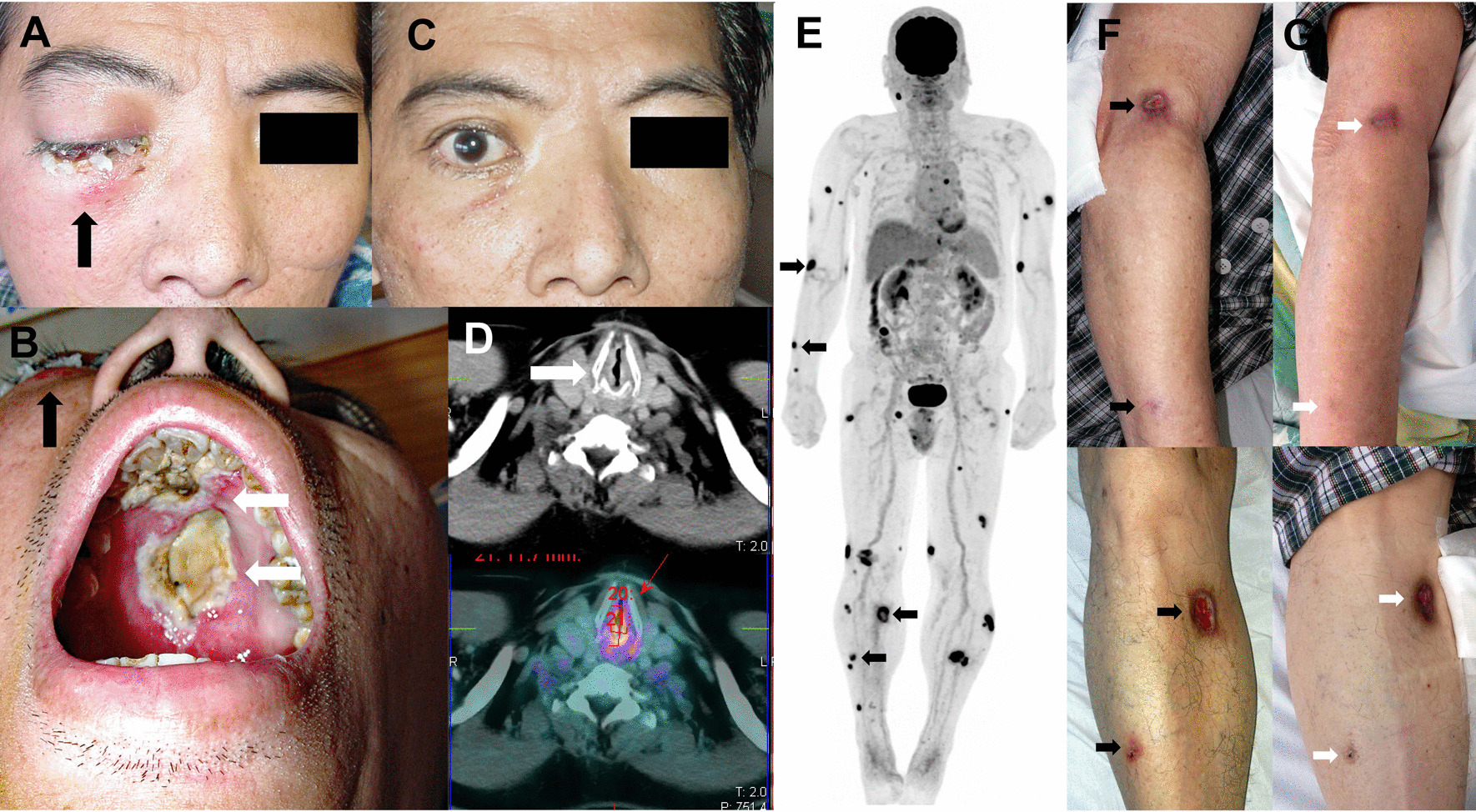
Fig. 1
Fig. 1
Clinical subtypes of NK/T-cell lymphomas. a Nasal NK/T-cell lymphoma with superior invasion into the right orbit, leading to extensive swelling and scabbing (arrow). b Same case with right orbital invasion (black arrow). Inferior invasion resulted in extensive necrosis and almost complete destruction of the hard palate (white arrows). The ensuing perforation of the hard palate would lead to a communication between the nasal and oral cavities, giving rise to the classical “lethal midline granuloma”. c Same patient about two weeks after commencement of the first cycle of the SMILE regimen. There was rapid and complete resolution of the right orbital swelling and scabbing. d Another case of upper aerodigestive tract NK/T-cell lymphoma. There was extensive involvement of the subglottis (arrow), which was markedly hypermetabolic on positron emission tomography computed tomography (PET/CT). Note that the larynx was reduced to a mere slit, causing nearly fatal airway obstruction that necessitated emergency tracheostomy. e A case of apparent non-nasal NK/T-cell lymphoma with extensive skin involvement, which on PET/CT scan was shown as numerous hypermetabolic cutaneous deposits (arrows). Examination of the nasopharynx did not show any obvious lesion. However, blind biopsies showed nasopharyngeal involvement, rendering this case indistinguishable from nasal NK/T-cell lymphoma with extensive cutaneous metastases. f Cutaneous lesions of the same case, with arrows indicating deposits corresponding to those shown by arrows on the PET/CT (e). g After the first cycle of an asparaginase-containing regimen, showing complete healing of the skin lesions (arrows)
Fig. 2
Fig. 2
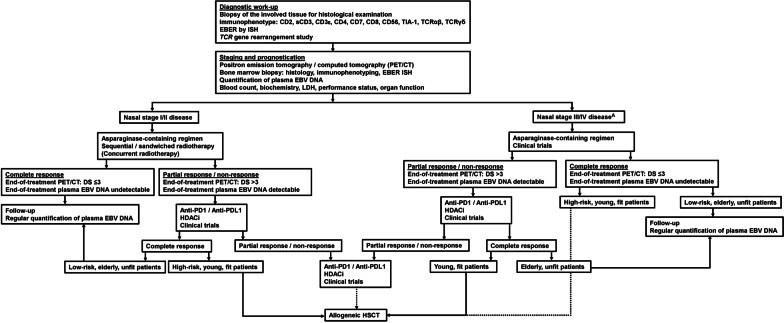
Treatment algorithm of NK/T-cell lymphoma. A denotes that for non-nasal cases of all stages, and aggressive leukaemia/lymphoma, treatment should be the same as stage III/IV nasal lymphomas. Dotted lines indicate possible options. For abbreviations please refer to the main text

References

    1. Chim CS, Ooi GC, Shek TW, Liang R, Kwong YL. Lethal midline granuloma revisited: nasal T/Natural-killer cell lymphoma. J Clin Oncol. 1999;17(4):1322–1325. doi: 10.1200/JCO.1999.17.4.1322. - DOI - PubMed
    1. Kwong YL, Anderson BO, Advani R, Kim WS, Levine AM, Lim ST. Asian Oncology Summit. Management of T-cell and natural-killer-cell neoplasms in Asia: consensus statement from the Asian Oncology Summit 2009. Lancet Oncol. 2009;10(11):1093–101. doi: 10.1016/S1470-2045(09)70265-7. - DOI - PubMed
    1. Harris NL, Jaffe ES, Stein H, Banks PM, Chan JK, Cleary ML, et al. A revised European–American classification of lymphoid neoplasms: a proposal from the International Lymphoma Study Group. Blood. 1994;84(5):1361–1392. doi: 10.1182/blood.V84.5.1361.1361. - DOI - PubMed
    1. Yamaguchi M, Suzuki R, Oguchi M. Advances in the treatment of extranodal NK/T-cell lymphoma, nasal type. Blood. 2018;131(23):2528–2540. doi: 10.1182/blood-2017-12-791418. - DOI - PubMed
    1. Tse E, Au-Yeung R, Kwong YL. Recent advances in the diagnosis and treatment of natural killer/T-cell lymphomas. Expert Rev Hematol. 2019;12(11):927–935. doi: 10.1080/17474086.2019.1660640. - DOI - PubMed

MeSH terms