


Exploratory study of the dose-related safety, tolerability, and efficacy of dimethyltryptamine (DMT) in healthy volunteers and major depressive disorder
- PMID: 35660802
- PMCID: PMC9372173
- DOI: 10.1038/s41386-022-01344-y
Exploratory study of the dose-related safety, tolerability, and efficacy of dimethyltryptamine (DMT) in healthy volunteers and major depressive disorder
Abstract
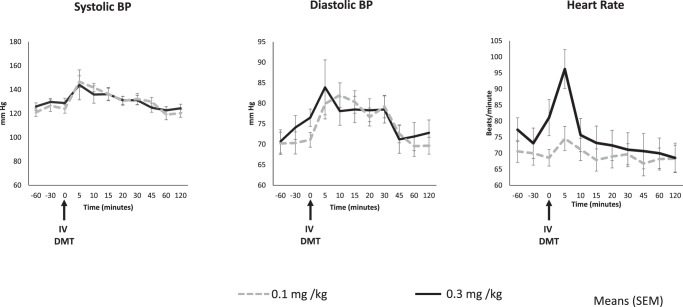
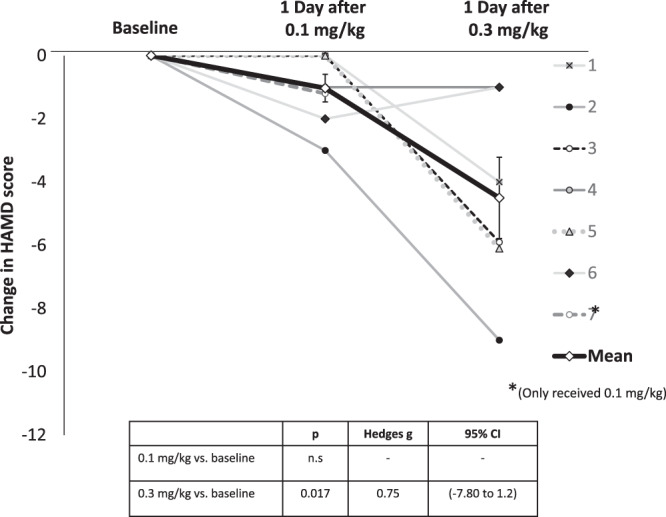
There is considerable interest in the therapeutic potential of psychedelic drugs. Dimethyltryptamine (DMT) is a potent, rapid-onset, and short-acting psychedelic drug that has not yet been independently tested for the treatment of depression. The safety, tolerability, and efficacy of intravenous DMT were investigated in treatment-resistant individuals with major depressive disorder (MDD) and healthy controls (HC) in an open-label, fixed-order, dose-escalation (0.1 mg/kg followed by 0.3 mg/kg) exploratory phase 1 study that was conducted in a typical hospital setting with strategic psychoeducation/support, but minimal psychotherapy. Tolerability, safety, cardiovascular function, abuse liability, psychedelic, and psychotomimetic effects, mood, and anxiety were assessed at each dosing session. In addition, depression was measured using the HAMD-17 in MDD participants 1 day after each dosing session. DMT was tolerated by both HC (n = 3) and MDD participants (n = 7) studied; there were no dropouts. HAMD-17 scores decreased significantly (p = 0.017) compared to baseline in MDD participants the day after receiving 0.3 mg/kg DMT (mean difference -4.5 points, 95% CI: -7.80 to -1.20, Hedge's g = 0.75). Adverse events were mostly mild with one self-limited serious event. DMT increased blood pressure, heart rate, anxiety, psychedelic effects, and psychotomimetic effects, which resolved within 20-30 min of injection. There were no dose-related differences in measures of drug reinforcement and abuse liability. In this small exploratory pilot study, intravenous DMT at doses of 0.1 and 0.3 mg/kg was mostly safe and tolerated and may have next-day (rapid) antidepressant effects in patients with treatment-resistant MDD. Further rigorous trials are warranted to replicate these findings and to determine the durability of antidepressant effects.
© 2022. This is a U.S. Government work and not under copyright protection in the US; foreign copyright protection may apply.
Conflict of interest statement
The authors declare no competing interests.
Figures
References
-
- Griffiths RR, Johnson MW, Carducci MA, Umbricht A, Richards WA, Richards BD, et al. Psilocybin produces substantial and sustained decreases in depression and anxiety in patients with life-threatening cancer: a randomized double-blind trial. J Psychopharmacol. 2016;30:1181–97. doi: 10.1177/0269881116675513. - DOI - PMC - PubMed
Publication types
MeSH terms
Substances
Supplementary concepts
Grants and funding
LinkOut - more resources
Full Text Sources
Other Literature Sources
