


The Effect of Treatment With Clear Aligners Versus Fixed Appliances on Oral Health-Related Quality of Life in Patients With Severe Crowding: A One-Year Follow-Up Randomized Controlled Clinical Trial
- PMID: 35663697
- PMCID: PMC9156343
- DOI: 10.7759/cureus.25472
The Effect of Treatment With Clear Aligners Versus Fixed Appliances on Oral Health-Related Quality of Life in Patients With Severe Crowding: A One-Year Follow-Up Randomized Controlled Clinical Trial
Abstract
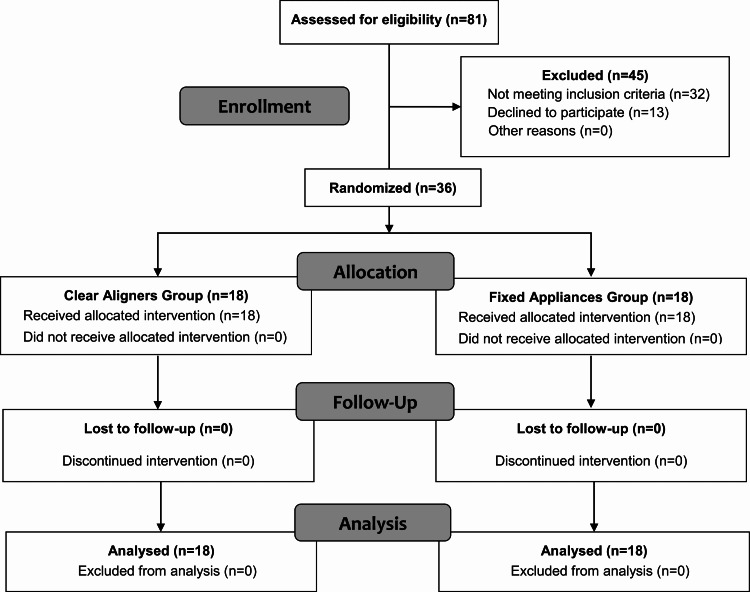
Objective To compare the level of oral health-related quality of life (OHRQoL) between patients receiving clear aligners or fixed appliances within one year of follow-up using Oral Health Impact Profile 14 (OHIP-14), a validated self-administered questionnaire. Materials and methods A single-centered, two-arm parallel-group randomized controlled clinical trial was conducted on 36 adult patients (19 females, 17 males; age range: 18 to 25 years) who had severe crowding and require orthodontic treatment with first premolars extraction. The patients were equally and randomly divided into two groups: The clear aligners (CA) group and the fixed appliances (FA) group. OHRQoL was assessed using the OHIP-14 tool at various times during comprehensive orthodontic therapy: baseline (T0), one week (T1), two weeks (T2), one month (T3), 6 months (T4), and 12 months (T5) after starting the active orthodontic treatment. Mann-Whitney U test or Friedman test were used to detect significant differences. The level of significance was set at 5%. Results All of the selected patients entered the statistical analysis stage. There were no significant differences between the CA and FA groups for the psychological discomfort, psychological disability, social disability, and handicap (P˃0.05) at almost all assessment times. For the functional limitation, physical pain, physical disability, and the overall score, there were significant differences between the studied groups (P˂0.05), with the FA group having higher mean scores than the CA group in all of the assessment times. Conclusion Patients' treatment with clear aligners has less impact on OHRQoL than those treated using conventional fixed appliances during the first year of treatment.
Keywords: class i malocclusion; clear aligners; crowding; functional limitation; oral health impact profile; oral health-related quality of life; physical disability; physical pain; psychological disability; psychological discomfort.
Copyright © 2022, Jaber et al.
Conflict of interest statement
The authors have declared that no competing interests exist.
Figures
References
-
- Determinants of orthodontic treatment need and demand: a cross-sectional path model study. Taghavi Bayat J, Huggare J, Mohlin B, Akrami N. Eur J Orthod. 2017;39:85–91. - PubMed
-
- The impact of malocclusion and its treatment on quality of life: a literature review. Zhang M, McGrath C, Hägg U. Int J Paediatr Dent. 2006;16:381–387. - PubMed
-
- Malocclusions and perceptions of attractiveness, intelligence, and personality, and behavioral intentions. Olsen JA, Inglehart MR. Am J Orthod Dentofacial Orthop. 2011;140:669–679. - PubMed
LinkOut - more resources
Full Text Sources
Medical