


Neuroinflammation in Parkinson's Disease - Putative Pathomechanisms and Targets for Disease-Modification
- PMID: 35663989
- PMCID: PMC9158130
- DOI: 10.3389/fimmu.2022.878771
Neuroinflammation in Parkinson's Disease - Putative Pathomechanisms and Targets for Disease-Modification
Abstract
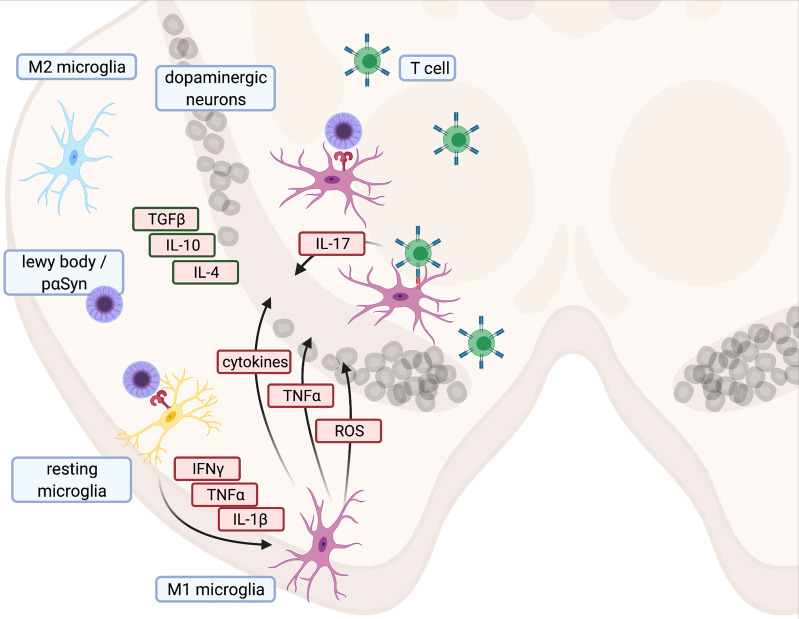
Parkinson's disease (PD) is a progressive and debilitating chronic disease that affects more than six million people worldwide, with rising prevalence. The hallmarks of PD are motor deficits, the spreading of pathological α-synuclein clusters in the central nervous system, and neuroinflammatory processes. PD is treated symptomatically, as no causally-acting drug or procedure has been successfully established for clinical use. Various pathways contributing to dopaminergic neuron loss in PD have been investigated and described to interact with the innate and adaptive immune system. We discuss the possible contribution of interconnected pathways related to the immune response, focusing on the pathophysiology and neurodegeneration of PD. In addition, we provide an overview of clinical trials targeting neuroinflammation in PD.
Keywords: Parkinson’s disease; T cells; animal models; inflammatory cascades; microglia; neurodegeneration; neuroinflammation.
Copyright © 2022 Grotemeyer, McFleder, Wu, Wischhusen and Ip.
Conflict of interest statement
The authors declare that the research was conducted in the absence of any commercial or financial relationships that could be construed as a potential conflict of interest.
Figures
References
-
- Parkinson J. An Essay on the Shaking Palsy. Needly and Jones, London: Whittingham and Rowland for Sherwood; (1817).
Publication types
MeSH terms
LinkOut - more resources
Full Text Sources
Medical
