


War Experience, Daily Stressors and Mental Health Among the Inter-taliban Generation Young Adults in Northern Afghanistan: A Cross-Sectional School-Based Study
- PMID: 35664485
- PMCID: PMC9161635
- DOI: 10.3389/fpsyt.2022.877934
War Experience, Daily Stressors and Mental Health Among the Inter-taliban Generation Young Adults in Northern Afghanistan: A Cross-Sectional School-Based Study
Abstract
Objectives: The specific objectives of the study are to examine the mental health (depression and anxiety) of the first generation of post-Taliban government and compare these measures with its preceding generation, and to assess war experience of the first generation of post-Taliban government. We also wanted to assess the daily stressors and their contribution to the mental health, and to assess mental health as a result of war experiences and daily stressors with respect to demographic measures such as sex, marital status, age, mother's age, birth order, and ethnicities.
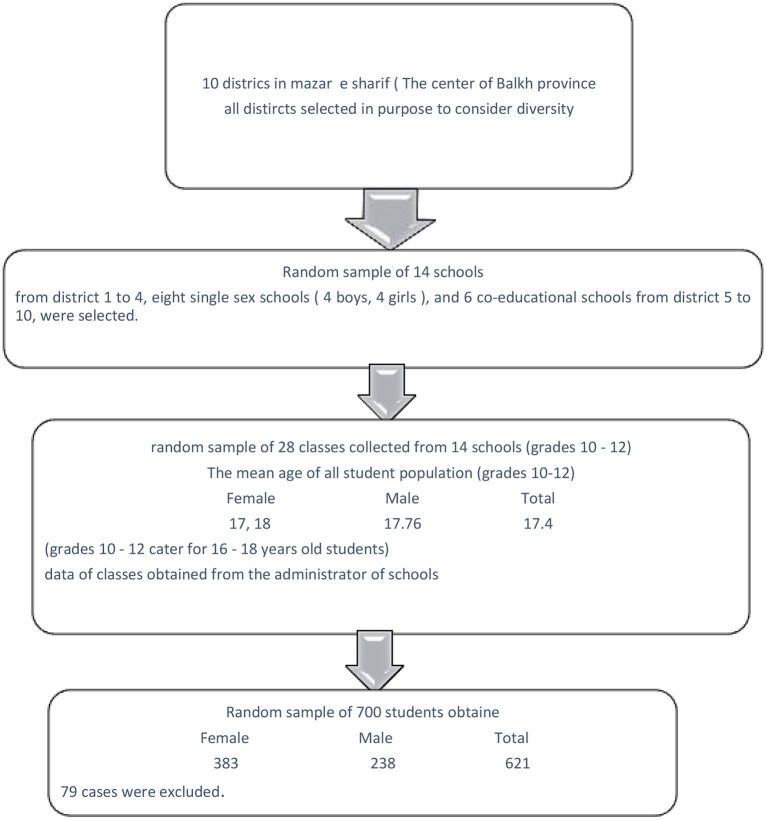
Methods: In a cross-sectional design, 621 high school students, were randomly selected to participate in the study to assess war experience, daily stressors, and mental health among the first generation of young adults under post-Taliban government.
Results: The participants had 17.37 ± 0.9 mean years of ages, 94.8% of them were unmarried. Poor mental health was significantly associated with higher exposure to war, but not with the age of participants (P = 0.08). There was no association between war experiences and the age and ethnicity of our participants (p = 0.9, p = 0.7). Age differences were negligible for daily stressors too (P = 0.07). Daily stressors scores were higher for female than male students (P = 0.02). The majority of young adults surveyed, declared themselves in agreement with statements such as the security situation in Afghanistan makes me frustrated (56%), air pollution as a concern (41%), and not having anyone to talk about what is in their heart (28.8%). Gender differences were highly significant for mental health, as appraised by both The Hopkins Symptoms Checklist (HSCL) -depression and HSCL-anxiety. Girls presented higher rates of depression, anxiety, and daily stressors than boys, and boys presented higher rates of war experiences than girls.
Conclusion: War experience, daily stressors, and mental health were irrelevant with age, ethnicity and marital status. Factor such as being the first-born child of the family, higher reported war experiences, and daily stressors all negatively impact mental health. Alongside war and its direct effects, the existing socio-cultural context must be considered as a potential factor mediating the mental health of girls in Afghanistan.
Keywords: Afghanistan; Taliban fall; conflict zone; daily stressors; mental health; post-Taliban generation; war experience; young adults.
Copyright © 2022 Razjouyan, Farokhi, Qaderi, Qaderi, Masoumi, Shah, Pourhoseingholi, Ahmadi, Lucero-Prisno, Ozaki, Kotera, Shah, Negin and Qaderi.
Conflict of interest statement
The authors declare that the research was conducted in the absence of any commercial or financial relationships that could be construed as a potential conflict of interest.
Figures
References
-
- WHO . Social Determinants of Health in Countries in Conflict: A Perspective From the Eastern Mediterranean Region. World Health Organization (2018). Available online at: https://apps.who.int/iris/handle/10665/119883 (accessed September 07, 2021).
-
- BBC . Afghanistan War: Tracking the Killings in August 2019. British Broadcasting Corporation (2019). Available online at: https://www.bbc.co.uk/news/world-asia-49662640 (accessed July 09, 2020).
-
- WHO . mhGAP: Mental Health Action Programme: Scaling Up Care for Mental, Neurological, and Substance Use Disorders. World Health Organization (2008). Available online at: https://apps.who.int/iris/handle/10665/43809 (accessed April 06, 2019). - PubMed
LinkOut - more resources
Full Text Sources
