. 2023 Apr;23(3):722-736.
doi: 10.1037/emo0001088. Epub 2022 Jun 6.

Computationally-defined markers of uncertainty aversion predict emotional responses during a global pandemic

Affiliations

Computationally-defined markers of uncertainty aversion predict emotional responses during a global pandemic

Toby Wise et al. Emotion. 2023 Apr.

Abstract

Exposure to stressful life events involving threat and uncertainty often results in the development of anxiety. However, the factors that confer risk and resilience for anxiety following real world stress at a computational level remain unclear. We identified core components of uncertainty aversion moderating response to stress posed by the COVID-19 pandemic derived from computational modeling of decision making. Using both cross-sectional and longitudinal analyses, we investigated both immediate effects at the onset of the stressor, as well as medium-term changes in response to persistent stress. 479 subjects based in the United States completed a decision-making task measuring risk aversion, loss aversion, and ambiguity aversion in the early stages of the pandemic (March 2020). Self-report measures targeting threat perception, anxiety, and avoidant behavior in response to the pandemic were collected at the same time point and 8 weeks later (May 2020). Cross-sectional analyses indicated that higher risk aversion predicted higher perceived threat from the pandemic, and ambiguity aversion for guaranteed gains predicted perceived threat and pandemic-related anxiety. In longitudinal analyses, ambiguity aversion for guaranteed gains predicted greater increases in perceived infection likelihood. Together, these results suggest that individuals who have a low-level aversion toward uncertainty show stronger negative emotional reactions to both the onset and persistence of real-life stress. (PsycInfo Database Record (c) 2023 APA, all rights reserved).


Figures

Figure 1.
Figure 1.
Task conditions, representing combinations of risk, loss, and ambiguity. On each trial, subjects chose between two options, each shown on the left and right of the screen within a circle. Each option could contain either a single “sure” outcome, or two “risky” outcomes. Outcomes could either be positive (+), negative (−) or zero, and could be unambiguous, where the potential outcome was shown to the subject (e.g. 40), or ambiguous, where the potential outcome was not shown (?).
Figure 2.
Figure 2.
A) Study session in relation to the United States COVID-19 pandemic. At time 1 (T1), completed between 3/13/20 and 3/14/20, subjects completed questionnaire measures and the gambling task. At time 2 (T2), completed between 5/4/20 and 5/11/20, subjects completed only questionnaires. For reference, daily confirmed SARS-nCov-2 cases and deaths are shown over this time period, demonstrating the dramatic increase in the scale of the pandemic between the two time points, along with mobility data indicating the decrease in population-level movement over the time period relative to median mobility in January and February (data from https://www.google.com/covid19/mobility/). B) Distributions of risk aversion, loss aversion, and ambiguity aversion in the sample, as assessed by approximate behavioral indicators. Risk aversion is represented by the total number of gambles chosen, loss aversion as the contrast between condition 4 and condition 1, and ambiguity aversion as the contrast between condition 4 and 6. The solid vertical line indicates the mean across subjects. C) Factor loadings for the five factors identified using the questionnaire data. Numbers represent item numbers, and item descriptions are provided in Table S1. D) Top: Change in scores on the five factors identified through factor analysis of the questionnaire data between time 1 and time 2. Bottom: Distributions of latent change scores from longitudinal models.
Figure 3.
Figure 3.
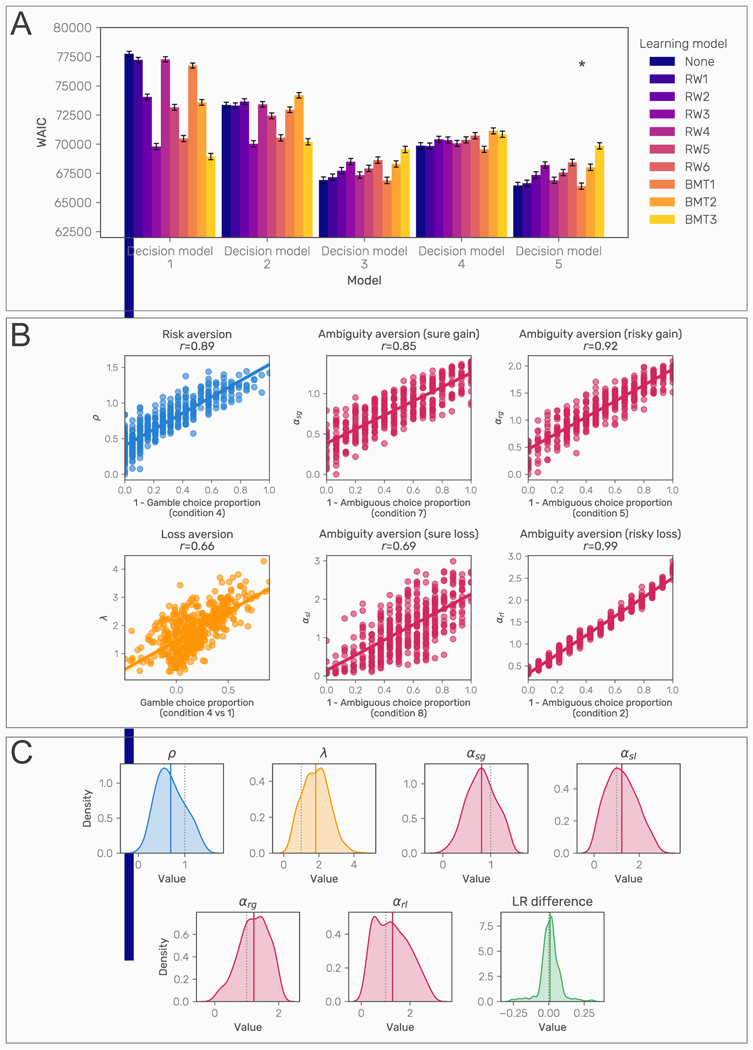
A) Model comparison results, showing WAIC scores for each candidate combination of decision and learning models (lower scores represent better fit). Models are grouped on the X axis according to the decision model used, while bars within these groups represent the learning model used. RW: Rescorla Wagner, BMT: Bayesian Mean Tracker. B) Relationships between model-agnostic measures of decision making processes and parameters from the winning model. C) Distributions of estimated parameter values. The dotted gray line indicates the value at which no bias in either decision making or learning is present, while the solid line indicates the mean value across subjects. For parameters in the decision model (ρ, λ, α) higher values indicate aversion, while for the learning rate difference higher values indicate faster learning from gains relative to losses.
Figure 4.
Figure 4.
Predictors of psychological and behavioral factor scores. A) Effects of (model ( parameters on each of the five factors identified through factor analysis. Estimates represent standardized parameter estimates from a latent path model using variables measured at Time 1. Significant effects, corrected for multiple comparisons, are highlighted. B) Scatter plots showing significant relationships between decision-making variables and self-report measures. Regression lines are plotted for illustration and were not used for statistical inference, as they do not account for other variables included in the full model. The effect on virus anxiety is shown for illustration but does not survive correction for multiple comparisons.
Figure 5.
Figure 5.
Predictors of longitudinal changes in psychological and behavioral factor scores. A) Effects of model parameters on change in the variables identified through factor analysis. Estimates represent standardized parameter estimates from a latent change score model, predicting change scores from behavioral variables measured at Time 1. Significant effects, corrected for multiple comparisons, are highlighted. B) Scatter plots showing significant relationships between decision-making variables and changes in self-report measures, with latent change scores derived from the model plotted on the Y axis. Regression lines are plotted for illustration and were not used for statistical inference, as they do not account for other variables included in the full model. The effect on general anxiety is shown for illustration but does not survive correction for multiple comparisons.

References

    1. Abdellaoui M, Bleichrodt H, & L’Haridon O. (2008). A tractable method to measure utility and loss aversion under prospect theory. Journal of Risk and Uncertainty, 36(3), 245–266. 10.1007/s11166-008-9039-8 - DOI
    1. Abdellaoui M, Bleichrodt H, L’Haridon O, & van Dolder D. (2016). Measuring Loss Aversion under Ambiguity: A Method to Make Prospect Theory Completely Observable. Journal of Risk and Uncertainty, 52(1), 1–20. 10.1007/s11166-016-9234-y - DOI
    1. Amir N, Beard C, & Bower E. (2005). Interpretation Bias and Social Anxiety. Cognitive Therapy and Research, 29(4), 433–443. 10.1007/s10608-005-2834-5 - DOI
    1. Aylward J, Valton V, Ahn W-Y, Bond RL, Dayan P, Roiser JP, & Robinson OJ (2019). Altered learning under uncertainty in unmedicated mood and anxiety disorders. Nature Human Behaviour, 1. 10.1038/s41562-019-0628-0 - DOI - PMC - PubMed
    1. Bavel JJV, Baicker K, Boggio PS, Capraro V, Cichocka A, Cikara M, Crockett MJ, Crum AJ, Douglas KM, Druckman JN, Drury J, Dube O, Ellemers N, Finkel EJ, Fowler JH, Gelfand M, Han S, Haslam SA, Jetten J, … Willer R. (2020). Using social and behavioural science to support COVID-19 pandemic response. Nature Human Behaviour, 4(5), 460–471. 10.1038/s41562-020-0884-z - DOI - PubMed