. 2022 Jun 21;327(23):2306-2316.
doi: 10.1001/jama.2022.8801.

Association of Estimated GFR Calculated Using Race-Free Equations With Kidney Failure and Mortality by Black vs Non-Black Race

Collaborators, Affiliations

Association of Estimated GFR Calculated Using Race-Free Equations With Kidney Failure and Mortality by Black vs Non-Black Race

Orlando M Gutiérrez et al. JAMA. .

Abstract

Importance: At a given estimated glomerular filtration rate (eGFR), individuals who are Black have higher rates of mortality and kidney failure with replacement therapy (KFRT) compared with those who are non-Black. Whether the recently adopted eGFR equations without race preserve racial differences in risk of mortality and KFRT at a given eGFR is unknown.

Objective: To assess whether eGFR equations with and without race and cystatin C document racial differences in risk of KFRT and mortality in populations including Black and non-Black participants.

Design, setting, and participants: Retrospective individual-level data analysis of 62 011 participants from 5 general population and 3 chronic kidney disease (CKD) US-based cohorts with serum creatinine, cystatin C, and follow-up for KFRT and mortality from 1988 to 2018.

Exposures: Chronic Kidney Disease Epidemiology Collaboration equation with serum creatinine (eGFRcr with and without race), cystatin C (eGFRcys without race), or both markers (eGFRcr-cys without race).

Main outcomes and measures: The prevalence of decreased eGFR at baseline and hazard ratios of KFRT and mortality in Black vs non-Black participants were calculated, adjusted for age and sex. Analyses were performed within each cohort and with random-effect meta-analyses of the models.

Results: Among 62 011 participants (20 773 Black and 41 238 non-Black; mean age, 63 years; 53% women), the prevalence ratio (95% CI; percent prevalences) of eGFR less than 60 mL/min/1.73 m2 comparing Black with non-Black participants was 0.98 (95% CI, 0.93-1.03; 11% vs 12%) for eGFRcr with race, 0.95 (95% CI, 0.91-0.98; 17% vs 18%) for eGFRcys, and 1.2 (95% CI, 1.2-1.3; 13% vs 11%) for eGFRcr-cys but was 1.8 (95% CI, 1.7-1.8; 15% vs 9%) for eGFRcr without race. During a mean follow-up of 13 years, 8% and 4% of Black and non-Black participants experienced KFRT and 34% and 39% died, respectively. Decreased eGFR was associated with significantly greater risk of both outcomes for all equations. At an eGFR of 60 mL/min/1.73 m2, the hazard ratios for KFRT comparing Black with non-Black participants were 2.8 (95% CI, 1.6-4.9) for eGFRcr with race, 3.0 (95% CI, 1.5-5.8) for eGFRcys, and 2.8 (95% CI, 1.4-5.4) for eGFRcr-cys vs 1.3 (95% CI, 0.8-2.1) for eGFRcr without race. The 5-year absolute risk differences for KFRT comparing Black with non-Black participants were 1.4% (95% CI, 0.2%-2.6%) for eGFRcr with race, 1.1% (95% CI, 0.2%-1.9%) for eGFRcys, and 1.3% (95% CI, 0%-2.6%) for eGFRcr-cys vs 0.37% (95% CI, -0.32% to 1.05%) for eGFRcr without race. Similar patterns were observed for mortality.

Conclusions and relevance: In this retrospective analysis of 8 US cohorts including Black and non-Black individuals, the eGFR equation without race that included creatinine and cystatin C, but not the eGFR equation without race that included creatinine without cystatin C, demonstrated racial differences in the risk of KFRT and mortality throughout the range of eGFR. The eGFRcr-cys equation may be preferable to the eGFRcr equation without race for assessing racial differences in the risk of KFRT and mortality associated with low eGFR.


Conflict of interest statement

Conflict of Interest Disclosures: Dr Gutiérrez reported receiving grants from Akebia, Amgen, and GlaxoSmithKline and personal fees from AstraZeneca, Reata, and Ardelyx, and serving on a data monitoring committee for QED outside the submitted work. Dr Grams reported receiving grants from the National Institutes of Health (NIH) and National Kidney Foundation (NKF) during the conduct of the study; receiving grants from the NIH and NKF and nonfinancial support from Kidney Disease: Improving Global Outcomes (KDIGO) outside the submitted work; and being a member of the USRDS Scientific Advisory Committee and NKF Scientific Advisory Committee and KDIGO Executive Committee. Dr Matsushita reported receiving grants from the NIH during the conduct of the study and personal fees from Akebia and Kyowa Kirin and grants from Kyowa Kirin outside the submitted work. Dr Go reported receiving grants from the National Institute of Diabetes, Digestive, and Kidney Diseases during the conduct of the study. Dr Shlipak reported receiving personal fees from Cricket Health, Intercept Pharmaceuticals, Bayer Pharmaceuticals, AstraZeneca, and Boehringer Ingelheim and grants from Bayer Pharmaceuticals outside the submitted work. Dr Inker reported funding to Tufts Medical Center for research, consulting, or contracts with the NIH, NKF, Reata, Omeros, Chinnocks Tricida, and Goldfinch Bio. Dr Inker also reported receiving consulting fees from Diametrix and being a member of the NKF-American Society of Nephrology (ASN) Task Force on Reassessing the Inclusion of Race in Diagnosing Kidney Disease; the views presented here are hers and the authors’ and do not reflect the views of the NKF-ASN Task Force. Dr Crews reported receiving grants from Somatus and Baxter International outside the submitted work and being a member of the NKF-ASN Task Force on Reassessing the Inclusion of Race in Reassessing the Inclusion of Race in Diagnosing Kidney Disease. Dr Levey reported receiving grants from the NIH, NKF (grant support for Chronic Kidney Disease Epidemiology Collaboration and Chronic Kidney Disease Prognosis Consortium [CKD-PC]) during the conduct of the study and personal fees from AstraZeneca for participation in data and safety monitoring boards for dapagliflozin clinical trials. Dr Coresh reported receiving grants from the NIH and NKF during the conduct of the study and being a consultant and owning stock options of Healthy.io outside the submitted work. No other disclosures were reported.

Figures

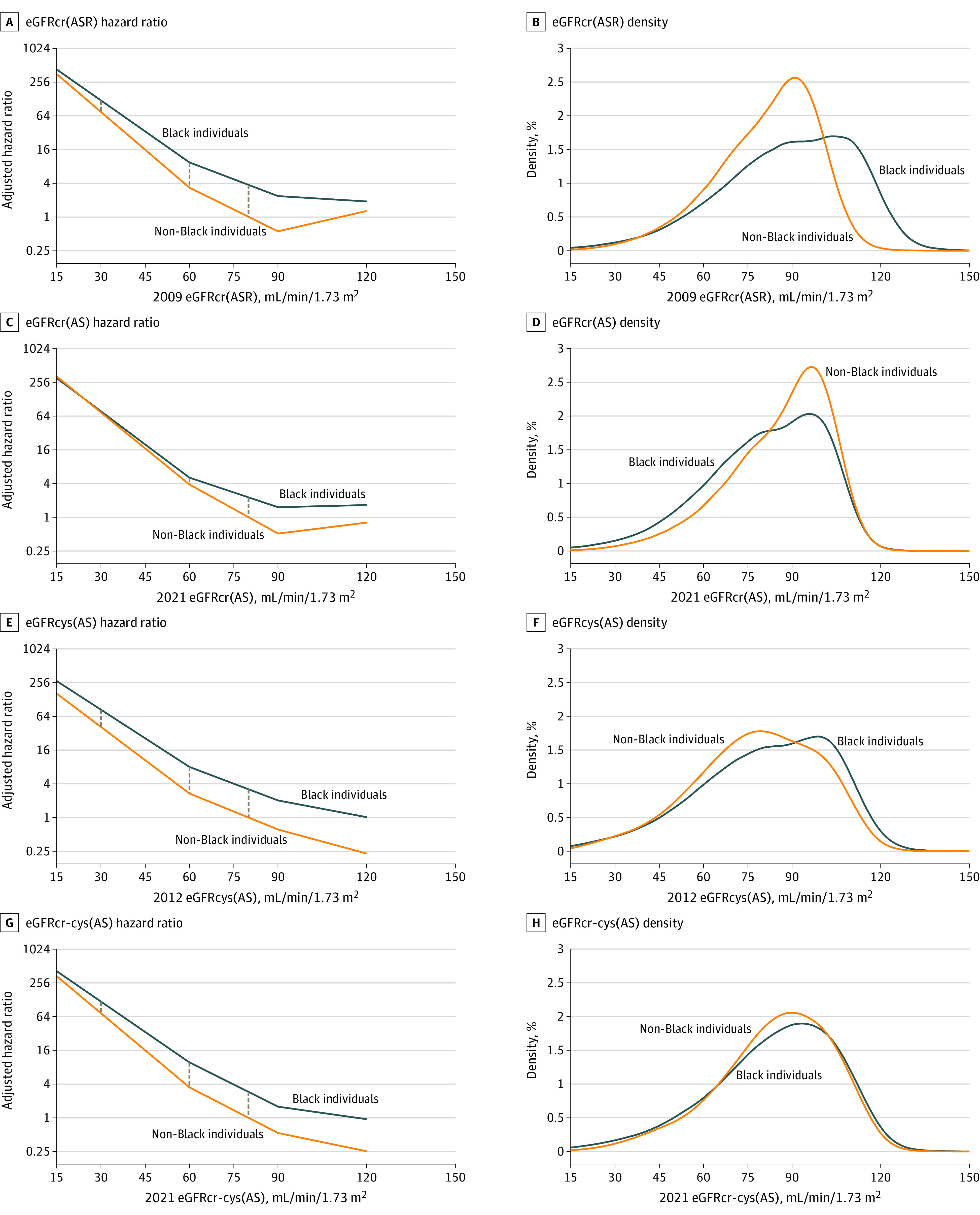
Figure 1.
Figure 1.. Risk of Kidney Failure With Replacement Therapy (KFRT) Associated With Level of Estimated Glomerular Filtration Rate (eGFR) in Black and Non-Black Participants for Different GFR Estimating Equations
Vertical lines show the difference in log hazard ratios between Black and non-Black participants for a given eGFR, which are smaller for 2021 eGFRcr(AS) than for the other equations. The hazard ratio is adjusted for age and sex and calculated vs the reference point (80 mL/min/1.73 m2 in the non-Black population). Point estimates at eGFRs of 30, 60, and 80 mL/min/1.73 m2 are reported in Table 2. The KFRT meta-analysis included participants from AASK, ARIC, CRIC, MDRD, and REGARDS. Density plots show the distribution of eGFR in the population-based cohorts (ARIC and REGARDS). AS indicates age and sex and ASR, age, sex, and race.
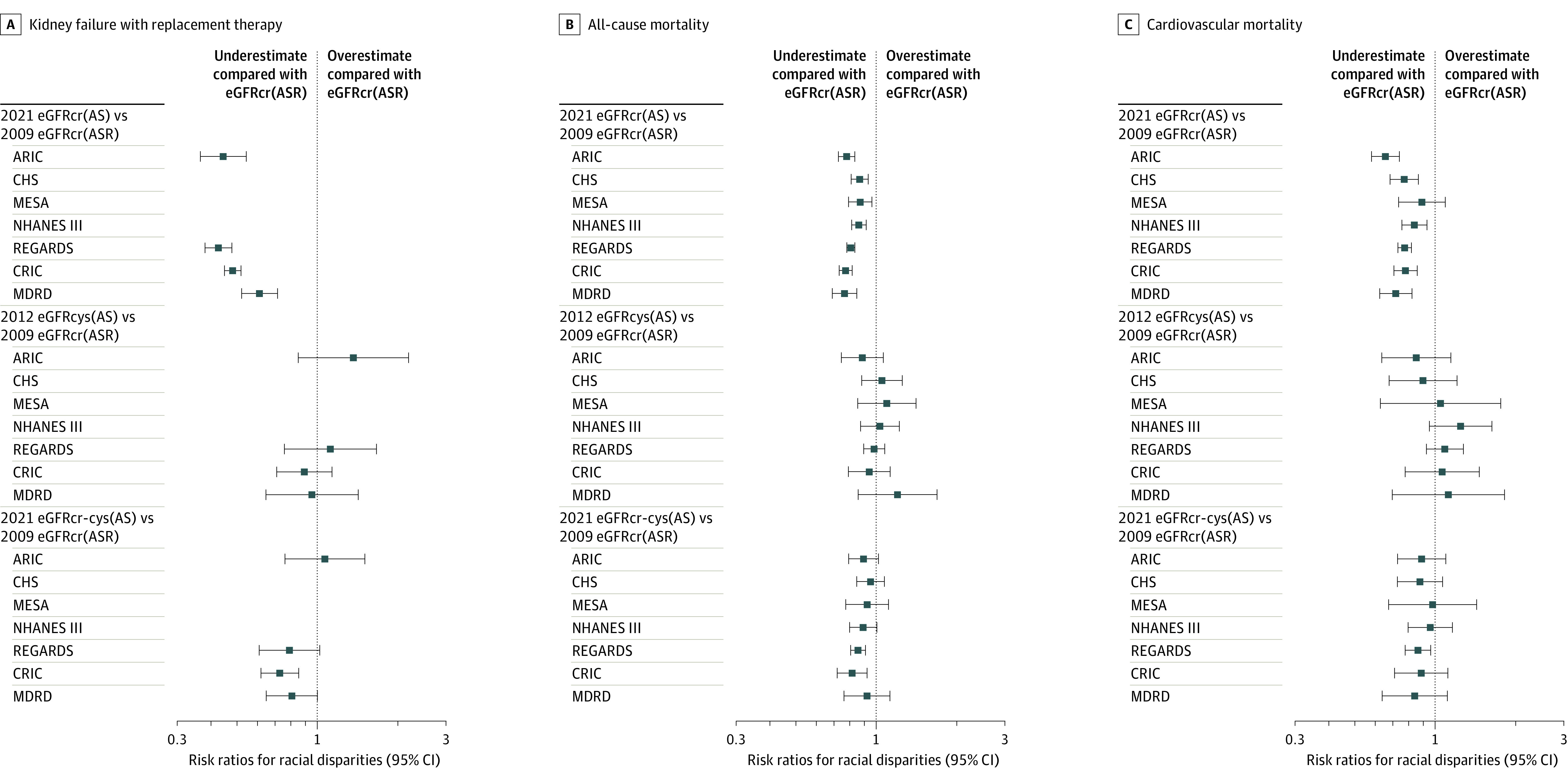
Figure 2.
Figure 2.. Relative Hazard Ratios for Black vs Non-Black Participants Using Different Glomerular Filtration Rate (GFR) Estimating Equations Compared With 2009 eGFRcr(ASR) in Each Participating Cohort
Estimates are the ratio of Black vs non-Black participant hazard ratio at eGFR of 60 mL/min/1.73 m2 using each equation compared with the corresponding hazard ratio for the 2009 eGFRcr(ASR) adjusted for age and sex. The 2021 eGFRcr(AS) results in a significant attenuation of racial differences compared with the 2009 eGFRcr(ASR) in 17 of 18 relative hazard ratios (95% CIs did not include 1.0). In contrast, for the 2012 eGFRcys(AS) and 2021 eGFRcr-cys(AS), 32 of 36 95% CIs for the relative hazard ratios contain 1.0. Risk ratios less than 1 represent underestimation compared with eGFRcr (age, sex, and race). The data are available in eTable 5 in Supplement 1. ARIC indicates Atherosclerosis Risk in Communities; AS, age and sex; ASR, age, sex, and race; CHS, Cardiovascular Health Study; CRIC, Chronic Renal Insufficiency Cohort; MDRD, Modification of Diet in Renal Disease; MESA, Multi-Ethnic Study of Atherosclerosis; NHANES, National Health and Nutrition Examination Survey; and REGARDS, Reasons for Geographic and Racial Differences in Stroke.

Comment in

References

    1. Kidney Disease: Improving Global Outcomes (KDIGO) CKD Work Group . KDIGO 2012 clinical practice guideline for the evaluation and management of chronic kidney disease. Kidney Int Suppl. 2013;3(1):1-150.
    1. Eneanya ND, Yang W, Reese PP. Reconsidering the consequences of using race to estimate kidney function. JAMA. 2019;322(2):113-114. doi: 10.1001/jama.2019.5774 - DOI - PubMed
    1. Inker LA, Eneanya ND, Coresh J, et al. ; Chronic Kidney Disease Epidemiology Collaboration . New creatinine- and cystatin C-based equations to estimate GFR without race. N Engl J Med. 2021;385(19):1737-1749. doi: 10.1056/NEJMoa2102953 - DOI - PMC - PubMed
    1. Delgado C, Baweja M, Crews DC, et al. A unifying approach for GFR estimation: recommendations of the NKF-ASN Task Force on Reassessing the Inclusion of Race in Diagnosing Kidney Disease. J Am Soc Nephrol. 2021;32(12):2994-3015. doi: 10.1681/ASN.2021070988 - DOI - PMC - PubMed
    1. Matsushita K, Ballew SH, Astor BC, et al. ; Chronic Kidney Disease Prognosis Consortium . Cohort profile: the Chronic Kidney Disease Prognosis Consortium. Int J Epidemiol. 2013;42(6):1660-1668. doi: 10.1093/ije/dys173 - DOI - PubMed