. 2022 Aug;102(2):92-105.
doi: 10.1124/molpharm.122.000529. Epub 2022 Jun 6.

Effects of Inhibitors of SLC9A-Type Sodium-Proton Exchangers on Survival Motor Neuron 2 (SMN2) mRNA Splicing and Expression

Affiliations

Effects of Inhibitors of SLC9A-Type Sodium-Proton Exchangers on Survival Motor Neuron 2 (SMN2) mRNA Splicing and Expression

Sambee Kanda et al. Mol Pharmacol. 2022 Aug.

Abstract

Spinal muscular atrophy (SMA) is an autosomal recessive, pediatric-onset disorder caused by the loss of spinal motor neurons, thereby leading to muscle atrophy. SMA is caused by the loss of or mutations in the survival motor neuron 1 (SMN1) gene. SMN1 is duplicated in humans to give rise to the paralogous survival motor neuron 2 (SMN2) gene. This paralog is nearly identical except for a cytosine to thymine transition within an exonic splicing enhancer element within exon 7. As a result, the majority of SMN2 transcripts lack exon 7 (SMNΔ7), which produces a truncated and unstable SMN protein. Since SMN2 copy number is inversely related to disease severity, it is a well established target for SMA therapeutics development. 5-(N-ethyl-N-isopropyl)amiloride (EIPA), an inhibitor of sodium/proton exchangers (NHEs), has previously been shown to increase exon 7 inclusion and SMN protein levels in SMA cells. In this study, NHE inhibitors were evaluated for their ability to modulate SMN2 expression. EIPA as well as 5-(N,N-hexamethylene)amiloride (HMA) increase exon 7 inclusion in SMN2 splicing reporter lines as well as in SMA fibroblasts. The EIPA-induced exon 7 inclusion occurs via a unique mechanism that does not involve previously identified splicing factors. Transcriptome analysis identified novel targets, including TIA1 and FABP3, for further characterization. EIPA and HMA are more selective at inhibiting the NHE5 isoform, which is expressed in fibroblasts as well as in neuronal cells. These results show that NHE5 inhibition increases SMN2 expression and may be a novel target for therapeutics development. SIGNIFICANCE STATEMENT: This study demonstrates a molecular mechanism by which inhibitors of the sodium-protein exchanger increase the alternative splicing of SMN2 in spinal muscular atrophy cells. NHE5 selective inhibitors increase the inclusion of full-length SMN2 mRNAs by targeting TIA1 and FABP3 expression, which is distinct from other small molecule regulators of SMN2 alternative splicing. This study provides a novel means to increase full-length SMN2 expression and a novel target for therapeutics development.


Figures

Fig. 1.
Fig. 1.
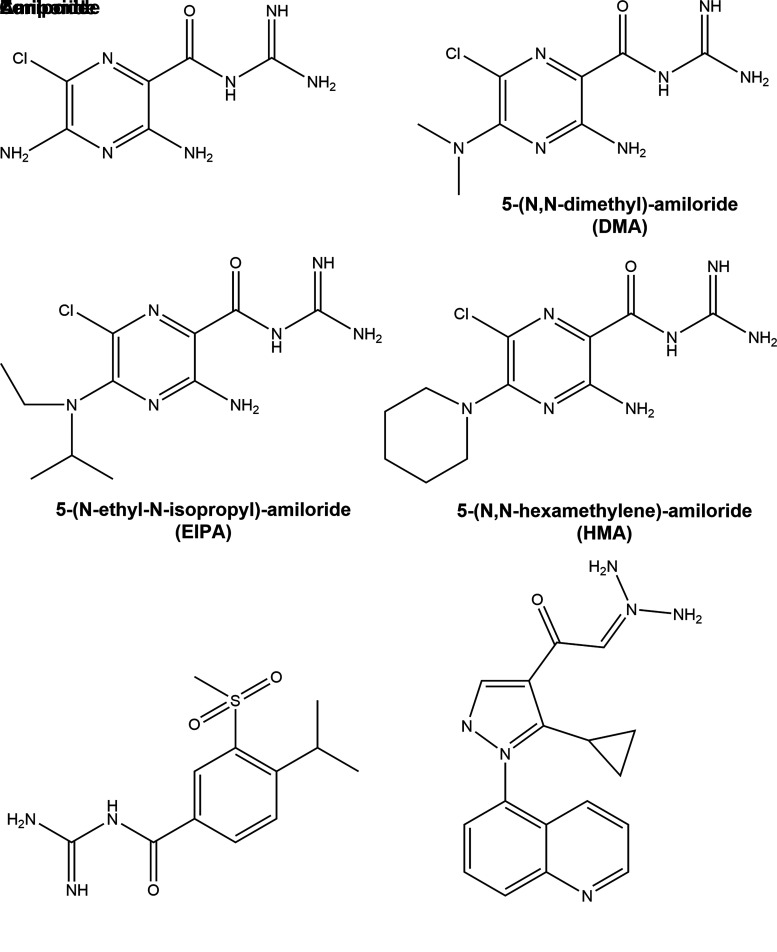
Chemical structures of the SLC9A-type NHE inhibitors tested.
Fig. 2.
Fig. 2.
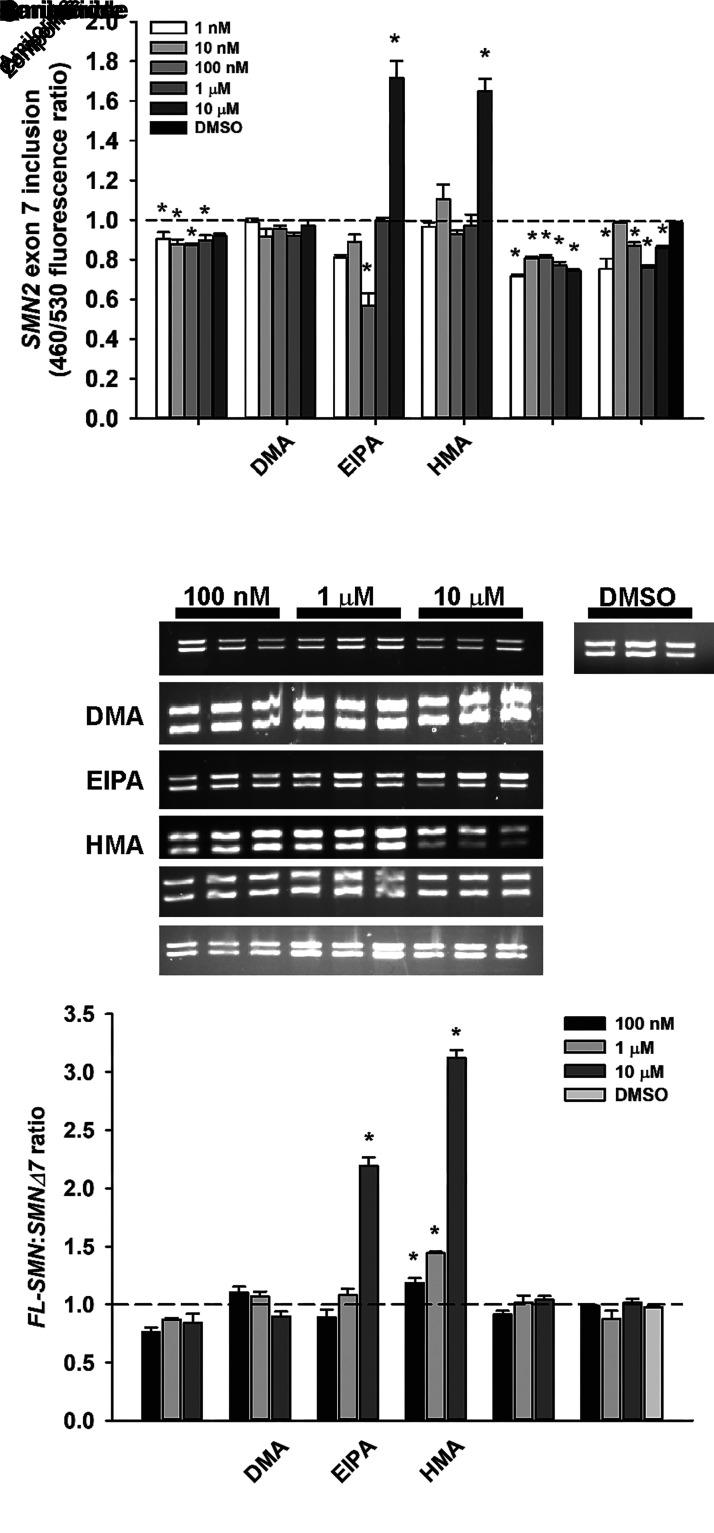
Effects of NHE inhibitors on SMN2 alternative splicing. (A) SMN2 exon 7 inclusion reporter cells (NSC-34:SMN2:Mg2:bla5.3) were treated with varying concentrations of the NHE inhibitors amiloride, DMA, EIPA, HMA, cariporide, or zoniporide (1 nM to 10 µM; n = 4 per dose) or DMSO for 19 hours. BLA activity was measured fluorimetrically. (B and C) Effect of NHE inhibitors on SMN2 exon 7 inclusion in type II SMA fibroblasts. Type II SMA fibroblasts (GM03813) were treated with varying concentrations (100 nM to 10 μM; n = 3 per group) of NHE inhibitors or DMSO for 5 days (n = 3 per treatment group). After total RNA isolation, samples were analyzed for relative amounts of FL-SMN and SMNΔ7 transcripts by RT-PCR and agarose gel electrophoresis. COL3A served as a loading control in this assay. The relative amounts of FL-SMN and SMNΔ7 transcripts were also measured on carrier fibroblasts (GM03814). The asterisk (*) denotes a statistically significant (P < 0.05) difference between NHE inhibitor- and vehicle-treated cells.
Fig. 3.
Fig. 3.
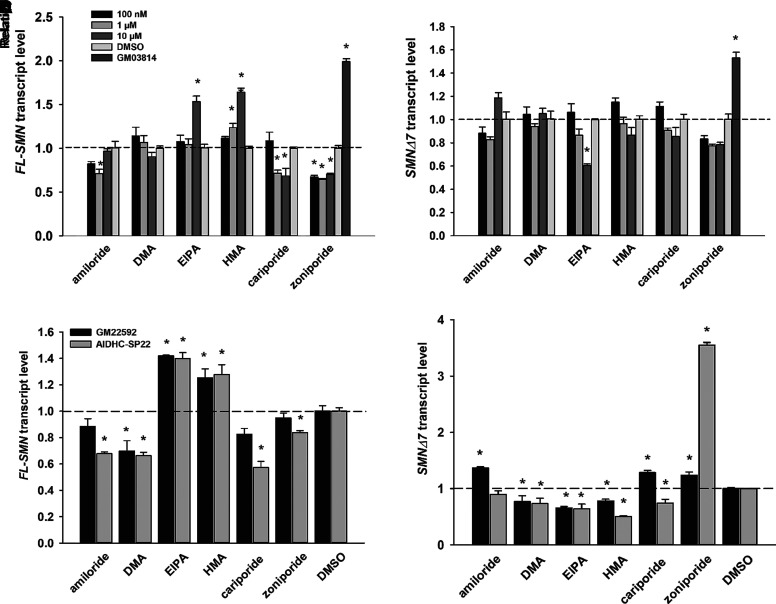
Effects of NHE inhibitors on expression of FL-SMN and SMNΔ7 mRNA transcripts in SMA patient-derived fibroblasts. GM03813 type II SMA fibroblasts were treated with different concentrations of NHE inhibitors (100 nM to 10 μM; n = 3 per dose) or DMSO for 5 days. Changes in FL-SMN (A) or SMNΔ7 (B) transcript levels were measured via quantitative RT-PCR with β-actin, glyceraldehyde-3-phosphate dehydrogenase, and large ribosomal protein P0 serving as reference transcripts. FL-SMN and SMNΔ7 transcript levels were also measured in GM03814 carrier fibroblasts. Changes in FL-SMN (C) or SMNΔ7 (D) transcript levels were measured in two other type II SMA fibroblast lines (GM22592 and AIDHC-SP22) treated with NHE inhibitors (10 μM; n = 3 per inhibitor) for 5 days. All transcript levels were expressed relative to DMSO-treated GM03813 cells (dashed line). The asterisk (*) denotes a statistically significant (P < 0.05) difference between NHE inhibitor- and vehicle-treated cells.
Fig. 4.
Fig. 4.
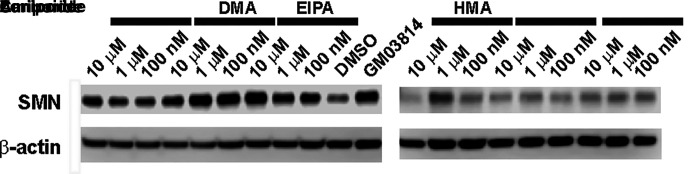
Effects of NHE inhibitors on SMN protein levels in SMA fibroblasts. GM03813 type II SMA fibroblasts were treated with different concentrations of NHE inhibitors (100 nM to 10 μM; n = 3 per dose) or DMSO for 5 days. Changes in SMN protein levels were measured via immunoblot using β-actin as a reference protein. SMN protein levels were also measured in GM03814 carrier fibroblasts.
Fig. 5.
Fig. 5.
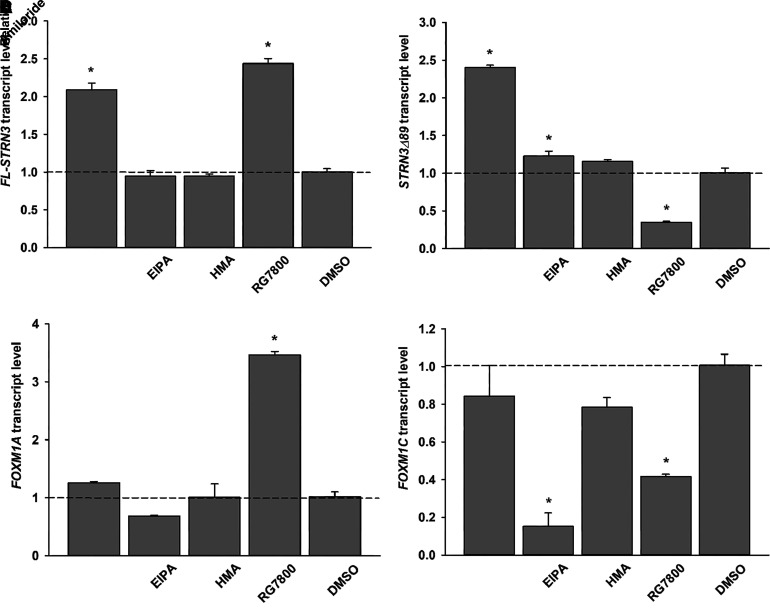
Effects of the NHE inhibitors on alternative splicing of STRN3 and FOXM1 in type II SMA fibroblasts. GM03813 type II SMA fibroblasts were treated with 10 μM amiloride, 10 μM EIPA, 10 μM HMA, 1 μM RG7800, or DMSO (n = 3 per group) for 5 days. The levels of FL-STRN3 (A), STRN3Δ89 (B), FOXM1 containing exons Va and VIIa [FOXM1A (C)], and FOXM1 containing exon Va [FOXM1C; (D)] transcripts were measured in total RNA extracted from treated cells by quantitative RT-PCR. All transcript levels were expressed relative to DMSO-treated GM03813 cells (dashed line). The asterisk (*) denotes a statistically significant (P < 0.05) difference between drug- and vehicle-treated cells.
Fig. 6.
Fig. 6.
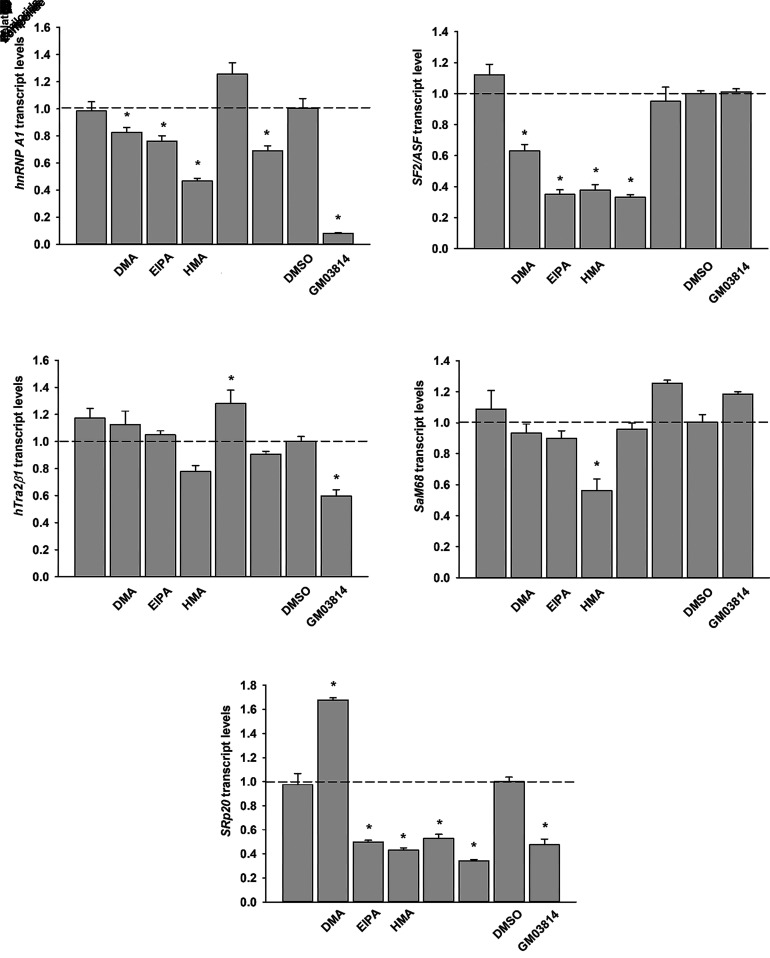
Effects of NHE inhibitors on the expression of splicing regulators involved in SMN2 exon 7 alternative splicing. GM03813 type II SMA fibroblasts were treated with 10 μM NHE inhibitors (amiloride, DMA, EIPA, HMA, cariporide, or zoniporide) or DMSO (n = 3 per group) for 5 days. hnRNP-A1 (A), SF2/ASF (B), hTRA2β1 (C), SaM68 (D), and SRp20 (E) transcript levels were measured in total RNA extracted from treated cells by quantitative RT-PCR. Transcript levels were also measured in GM03814 carrier fibroblasts. All transcript levels were expressed relative to DMSO-treated GM03813 cells (dashed line). The asterisk (*) denotes a statistically significant (P < 0.05) difference between drug- and vehicle-treated cells.
Fig. 7.
Fig. 7.
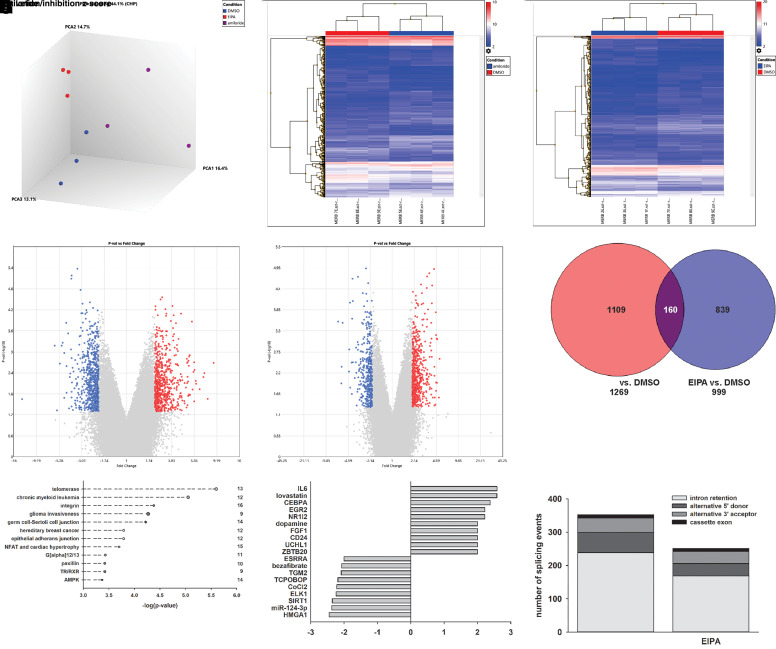
Identification of differentially expressed transcripts in type II SMA fibroblasts treated with amiloride or EIPA. GM03813 type II SMA fibroblasts were treated with 10 μM amiloride, 10 μM EIPA, or DMSO (n = 3 per group) for 5 days, and their RNA pools were analyzed for differential transcript expression using Clariom D human transcriptome arrays. (A) Principal component analysis of samples treated with amiloride (purple), EIPA (red), or DMSO (blue). Hierarchical clustering analysis of amiloride versus DMSO (B) and EIPA versus DMSO (C). Volcano plots of amiloride versus DMSO (D) and EIPA versus DMSO (E) type II SMA fibroblast transcriptomes. Significantly upregulated transcripts are shown in red, and significantly downregulated transcripts are shown in blue. (F) Venn diagram showing the similarities and differences between the amiloride versus DMSO (red) and EIPA versus DMSO (blue) transcriptomes. The overlap between these two transcriptomes is shown in purple. (G) The top dozen canonical pathways—out of 165—that were significantly over-represented in the EIPA-unique transcriptome. The numbers next to the pathway lines represent the number of differentially expressed molecules for each pathway. (H) The upstream regulators that are significantly and uniquely differentially regulated in EIPA-treated type II SMA fibroblasts. (I) Distributions of the categorized differential splicing events between amiloride versus DMSO and EIPA versus DMSO transcriptomes.
Fig. 8.
Fig. 8.
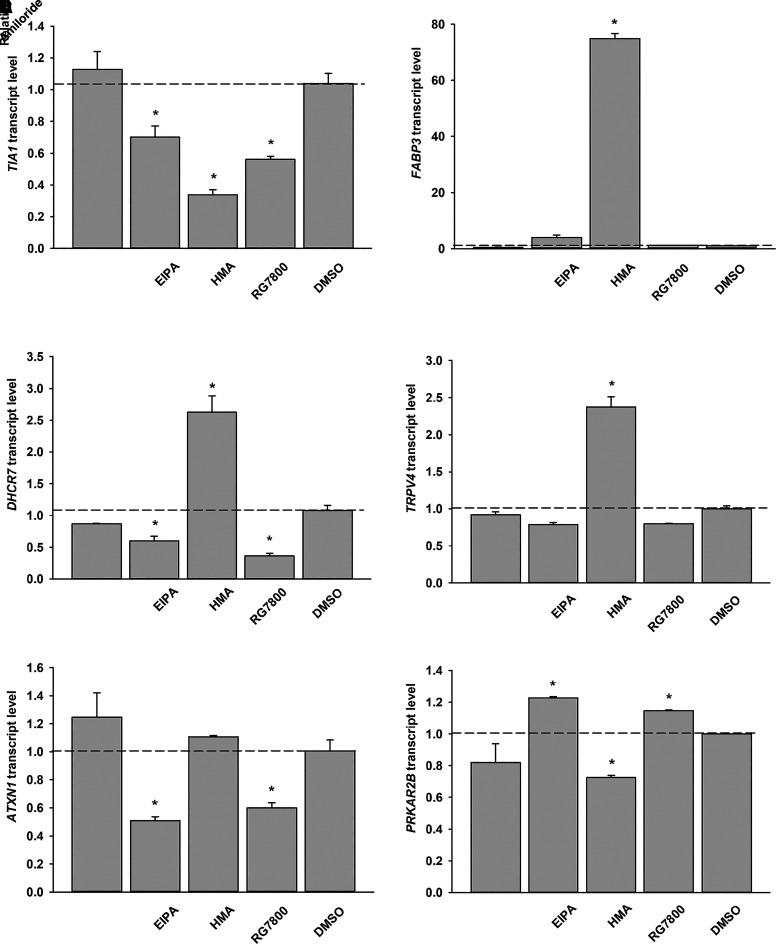
Validation of EIPA- and HMA-responsive transcripts in type II SMA fibroblasts. GM03813 type II SMA fibroblasts were treated with 10 μM amiloride, 10 μM EIPA, 10 μM HMA, 1 μM RG7800, or DMSO (n = 3 per group) for 5 days. TIA1 (A), FABP3 (B), DHCR7 (C), TRPV4 (D), ATXN1 (E), and PRKARB2 (F) transcript levels were measured in total RNA extracted from treated cells by quantitative RT-PCR. All transcript levels were expressed relative to DMSO-treated GM03813 cells (dashed line). The asterisk (*) denotes a statistically significant (P < 0.05) difference between drug- and vehicle-treated cells.

Similar articles

References

    1. Andreassi C, Jarecki J, Zhou J, Coovert DD, Monani UR, Chen X, Whitney M, Pollok B, Zhang M, Androphy E,, et al. (2001) Aclarubicin treatment restores SMN levels to cells derived from type I spinal muscular atrophy patients. Hum Mol Genet 10:2841–2849. - PubMed
    1. Baranello G, Darras BT, Day JW, Deconinck N, Klein A, Masson R, Mercuri E, Rose K, El-Khairi M, Gerber M,, et al. ; FIREFISH Working Group (2021) Risdiplam in type 1 spinal muscular atrophy. N Engl J Med 384:915–923. - PubMed
    1. Barrett T, Wilhite SE, Ledoux P, Evangelista C, Kim IF, Tomashevsky M, Marshall KA, Phillippy KH, Sherman PM, Holko M,, et al. (2013) NCBI GEO: archive for functional genomics data sets--update. Nucleic Acids Res 41:D991–D995. - PMC - PubMed
    1. Borsi L, Balza E, Gaggero B, Allemanni G, Zardi L (1995) The alternative splicing pattern of the tenascin-C pre-mRNA is controlled by the extracellular pH. J Biol Chem 270:6243–6245. - PubMed
    1. Burnett BG, Muñoz E, Tandon A, Kwon DY, Sumner CJ, Fischbeck KH (2009) Regulation of SMN protein stability. Mol Cell Biol 29:1107–1115. - PMC - PubMed

MeSH terms