. 2022 Dec;29(6):2108-2121.
doi: 10.3758/s13423-022-02127-8. Epub 2022 Jun 6.

Preferred music listening is associated with perceptual learning enhancement at the expense of self-focused attention

Affiliations

Preferred music listening is associated with perceptual learning enhancement at the expense of self-focused attention

Pietro Sarasso et al. Psychon Bull Rev. 2022 Dec.

Abstract

Can preferred music listening improve following attentional and learning performances? Here we suggest that this may be the case. In Experiment 1, following preferred and non-preferred musical-piece listening, we recorded electrophysiological responses to an auditory roving-paradigm. We computed the mismatch negativity (MMN - the difference between responses to novel and repeated stimulation), as an index of perceptual learning, and we measured the correlation between trial-by-trial EEG responses and the fluctuations in Bayesian Surprise, as a quantification of the neural attunement with stimulus informational value. Furthermore, during music listening, we recorded oscillatory cortical activity. MMN and trial-by-trial correlation with Bayesian surprise were significantly larger after subjectively preferred versus non-preferred music, indicating the enhancement of perceptual learning. The analysis on oscillatory activity during music listening showed a selective alpha power increased in response to preferred music, an effect often related to cognitive enhancements. In Experiment 2, we explored whether this learning improvement was realized at the expense of self-focused attention. Therefore, after preferred versus non-preferred music listening, we collected Heart-Beat Detection (HBD) accuracy, as a measure of the attentional focus toward the self. HBD was significantly lowered following preferred music listening. Overall, our results suggest the presence of a specific neural mechanism that, in response to aesthetically pleasing stimuli, and through the modulation of alpha oscillatory activity, redirects neural resources away from the self and toward the environment. This attentional up-weighting of external stimuli might be fruitfully exploited in a wide area of human learning activities, including education, neurorehabilitation and therapy.

Keywords: Attention; ECG; EEG; Heartbeat; Learning; MMN; Music; Neuroaesthetics.


Figures

Fig. 1
Fig. 1
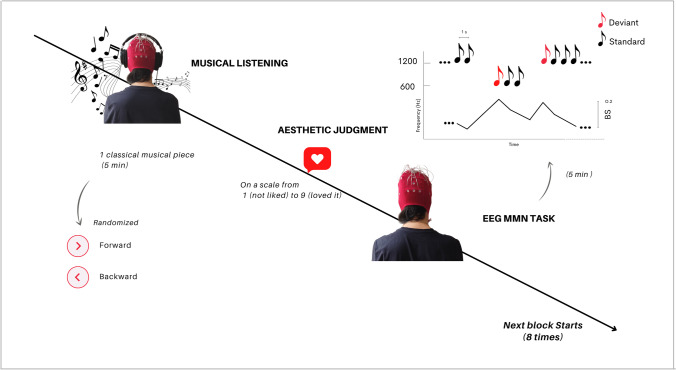
Experiment 1 – experimental paradigm. The sequence of deviant and standard sounds presented according to a roving paradigm followed 5 min of music (or reversed music) listening. Right after the end of each musical piece we collected aesthetic ratings. The whole procedure was identically repeated eight times, once for each musical stimulus. The EEG was registered during the whole experiment
Fig. 2
Fig. 2
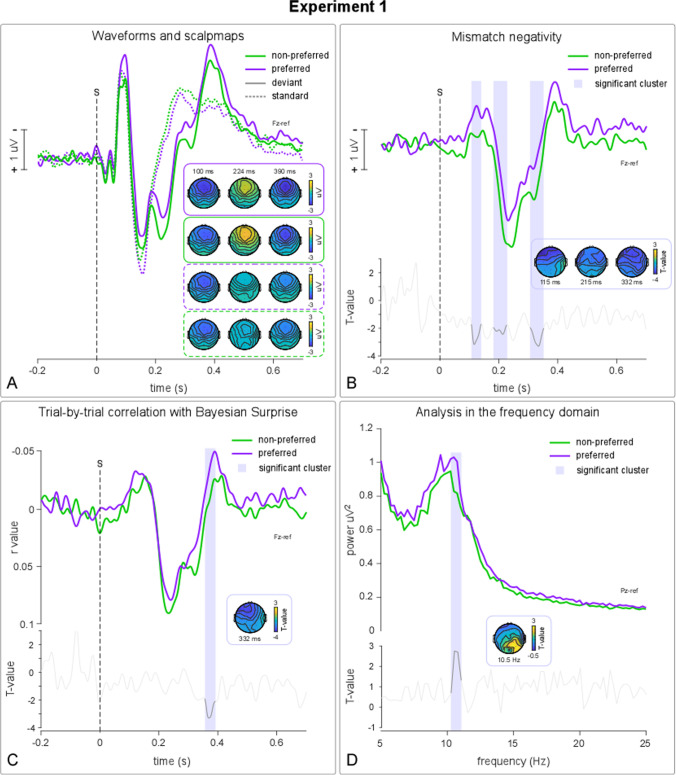
Experiment 1 – results. In panel A, grand average (N = 18) responses triggered by standard and deviant sounds after listening to preferred and non-preferred music are depicted. Scalpmaps represent average amplitudes across deviancy and preference conditions at 100, 224 and 390 ms post-onset, corresponding to the N1, P2 and N4 peak latencies. MMN differential waveforms (deviant-standard) are represented in panel B and peaked at around 150 ms post-onset. T-values from the point-by-point t-test comparing MMN after preferred and non-preferred music listening are shown at the bottom of the panel. Significant t-values are highlighted in black and grey shaded areas and correspond to significant clusters surviving cluster-based permutation correction. Scalpmaps represent t-values within significant clusters. Panel C shows average r-values between amplitudes at Fz and Bayesian Surprise and t-values from the point-by-point trial-by-trial correlation analysis. Shaded areas correspond to significant clusters surviving cluster-based permutation correction as revealed by the pint-by-point t-test comparing average r-values corresponding to preferred vs. non-preferred music listening. The scalpmap represents t-values within the significant cluster. Panel D shows the resting state EEG spectral profile registered during the last 80s of music listening. Shaded areas correspond to significant clusters surviving cluster-based permutation correction as revealed by the pint-by-point t-test comparing the spectrum corresponding to preferred vs. non-preferred music listening. The scalpmap represents t-values within the cluster centred over the upper alpha frequency (10.5 Hz)
Fig. 3
Fig. 3
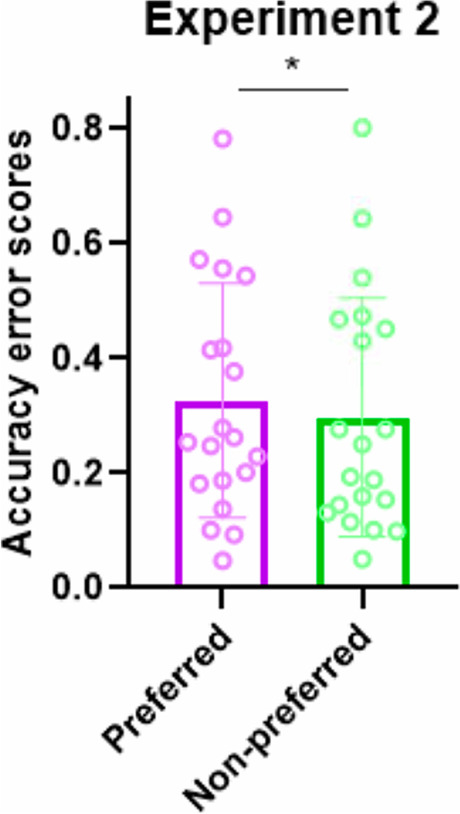
Experiment 2 – results. The histogram represents average error scores (the index is inversely related to heart-beat detection (HBD) accuracies; see Methods) from the HBD task following preferred and non-preferred music listening. Dots represent single subjects’ error scores. Bars represent standard deviations

References

    1. Ainley V, Tsakiris M. Body conscious? Interoceptive awareness, measured by heartbeat perception, is negatively correlated with self-objectification. PLoS ONE. 2013;8(2):e55568. doi: 10.1371/journal.pone.0055568. - DOI - PMC - PubMed
    1. Ainley V, Tajadura-Jiménez A, Fotopoulou A, Tsakiris M. Looking into myself: Changes in interoceptive sensitivity during mirror self-observation. Psychophysiology. 2012;49(11):1672–1676. doi: 10.1111/j.1469-8986.2012.01468.x. - DOI - PMC - PubMed
    1. Alper, K. R., John, E. R., Brodie, J., Günther, W., Daruwala, R., & Prichep, L. S. (2006). Correlation of PET and qEEG in normal subjects. Psychiatry Research - Neuroimaging. 10.1016/j.pscychresns.2005.06.008 - PubMed

    1. Angelakis E, Stathopoulou S, Frymiare JL, Green DL, Lubar JF, Kounios J. EEG neurofeedback: A brief overview and an example of peak alpha frequency training for cognitive enhancement in the elderly. The Clinical Neuropsychologist. 2007;21(1):110–129. doi: 10.1080/13854040600744839. - DOI - PubMed
    1. Baldeweg T, Klugman A, Gruzelier J, Hirsch SR. Mismatch negativity potentials and cognitive impairment in schizophrenia. Schizophrenia Research. 2004;69(2):203–217. doi: 10.1016/j.schres.2003.09.009. - DOI - PubMed