


Implementation Evaluation of HUGS/Abrazos During the COVID-19 Pandemic: A Program to Foster Resiliency in Pregnancy and Early Childhood
- PMID: 35669744
- PMCID: PMC9163339
- DOI: 10.3389/fpubh.2022.862388
Implementation Evaluation of HUGS/Abrazos During the COVID-19 Pandemic: A Program to Foster Resiliency in Pregnancy and Early Childhood
Abstract
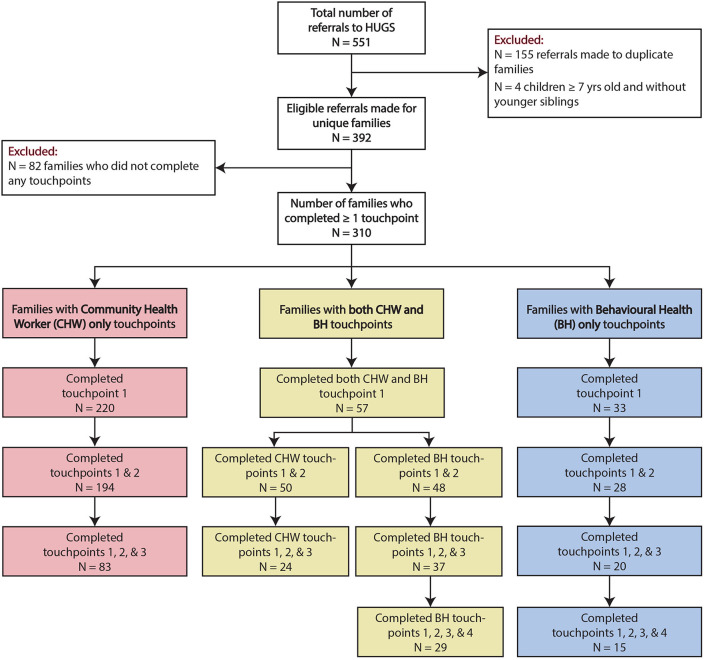
Early life adversity can significantly impact child development and health outcomes throughout the life course. With the COVID-19 pandemic exacerbating preexisting and introducing new sources of toxic stress, social programs that foster resilience are more necessary now than ever. The Helping Us Grow Stronger (HUGS/Abrazos) program fills a crucial need for protective buffers during the COVID-19 pandemic, which has escalated toxic stressors affecting pregnant women and families with young children. HUGS/Abrazos combines patient navigation, behavioral health support, and innovative tools to ameliorate these heightened toxic stressors. We used a mixed-methods approach, guided by the Reach, Effectiveness, Adoption, Implementation, and Maintenance (RE-AIM) framework, to evaluate the implementation of the HUGS/Abrazos program at Massachusetts General Hospital from 6/30/2020-8/31/2021. Results of the quality improvement evaluation revealed that the program was widely adopted across the hospital and 392 unique families were referred to the program. The referred patients were representative of the communities in Massachusetts disproportionately affected by the COVID-19 pandemic. Furthermore, 79% of referred patients followed up with the initial referral, with sustained high participation rates throughout the program course; and they were provided with an average of four community resource referrals. Adoption and implementation of the key components in HUGS/Abrazos were found to be appropriate and acceptable. Furthermore, the implemented program remained consistent to the original design. Overall, HUGS/Abrazos was well adopted as an emergency relief program with strong post-COVID-19 applicability to ameliorate continuing toxic stressors while decreasing burden on the health system.
Keywords: COVID-19 pandemic; RE-AIM; early childhood; patient navigation; resilience; toxic stress.
Copyright © 2022 Liu, Simione, Perkins, Price, Luo, Lopez, Catalan, Chen, Torres, Kwete, Seigel, Edlow, Parra, Hunter, Boudreau and Taveras.
Conflict of interest statement
The authors declare that the research was conducted in the absence of any commercial or financial relationships that could be construed as a potential conflict of interest.
Figures
References
-
- Felitti VJ, Anda RF, Nordenberg D, Williamson DF, Spitz AM, Edwards V, et al. . Relationship of childhood abuse and household dysfunction to many of the leading causes of death in adults. The adverse childhood experiences (ACE) Study. Am J Prev Med. (1998) 14:245–58. 10.1016/S0749-3797(98)00017-8 - DOI - PubMed
-
- Committee Committee on Psychosocial Aspects of Child and Family Health C on EC. Garner AS, Shonkoff JP, Siegel BS, Dobbins MI, Earls MF, et al. . Early childhood adversity, toxic stress, and the role of the pediatrician: translating developmental science into lifelong health. Pediatrics. (2012) 129:e224–31. 10.1542/peds.2011-2662 - DOI - PubMed
Publication types
MeSH terms
Grants and funding
LinkOut - more resources
Full Text Sources
Medical
