. 2022 Aug 29;190(1):387-402.
doi: 10.1093/plphys/kiac259.

WUSCHEL-related homeobox genes cooperate with cytokinin to promote bulbil formation in Lilium lancifolium

Affiliations

WUSCHEL-related homeobox genes cooperate with cytokinin to promote bulbil formation in Lilium lancifolium

Guoren He et al. Plant Physiol. .

Abstract

The bulbil is an important vegetative reproductive organ in triploid tiger lily (Lilium lancifolium). Based on our previously obtained transcriptome data, we screened two WUSCHEL-related homeobox (WOX) genes closely related to bulbil formation, LlWOX9 and LlWOX11. However, the biological functions and regulatory mechanisms of LlWOX9 and LlWOX11 are unclear. In this study, we cloned the full-length coding sequences of LlWOX9 and LlWOX11. Transgenic Arabidopsis (Arabidopsis thaliana) showed increased branch numbers, and the overexpression of LlWOX9 and LlWOX11 in stem segments promoted bulbil formation, while the silencing of LlWOX9 and LlWOX11 inhibited bulbil formation, indicating that LlWOX9 and LlWOX11 are positive regulators of bulbil formation. Cytokinin type-B response regulators could bind to the promoters of LlWOX9 and LlWOX11 and promote their transcription. LlWOX11 could enhance cytokinin pathway signaling by inhibiting the transcription of type-A LlRR9. Our study enriches the understanding of the regulation of plant development by the WOX gene family and lays a foundation for further research on the molecular mechanism of bulbil formation in lily.


Figures

Figure 1
Figure 1
Full-length cloning and phylogenetic tree of LlWOX9 and LlWOX11. A, Full-length cloning and domain prediction of LlWOX9 and LlWOX11. B, Neighbor-joining tree of the LlWOX9 amino acid sequence of L. lancifolium and WOX9 amino acid sequences from other species. C, Neighbor-joining tree of the LlWOX11 amino acid sequence of L. lancifolium and WOX11 amino acid sequences from other species. Bootstrap values from 1,000 replicates were used to assess the robustness of the tree.
Figure 2
Figure 2
Subcellular localization, expression patterns, and FISH of LlWOX9 and LlWOX11. A, Subcellular localization of LlWOX9-GFP and LlWOX11-GFP proteins in L. lancifolium leaf epidermal cells with DAPI staining. Scale bars = 50 μm. B, LlWOX9 and LlWOX11 expression during bulbil formation. C, LlWOX9 and LlWOX11 expression in different tissues. Values are means ± sd (n = 3). Lowercase letters (a–d in B; a–e in C) indicate significantly different values (Student’s t test, P < 0.05). D, Gene-specific probe of LlWOX9 used in FISH. E, FISH of LlWOX9 during bulbil formation. F, Gene-specific probe of LlWOX11 used in FISH. G, FISH of LlWOX11 during bulbil formation. L, leaf; S, stem. Scale bar in (A) S2 and (B) S1 and S2, 100 μm. Scale bar in (A) S1 and S3–S5 and (B) S3–S5, 500 μm.
Figure 3
Figure 3
The phenotypes of 35S:LlWOX9 and 35S:LlWOX11 transgenic lines and wild-type A. thaliana plants. A, The transgenic plants of the T3 generation of A. thaliana were detected by PCR. “−” indicates the negative control. 1–5 represent different transgenic lines overexpressing LlWOX9, 6–11 represent different transgenic lines overexpressing LlWOX11. B, The branching phenotypes of wild-type Col and transgenic plants overexpressing LlWOX9. Scale bar is 3 cm. C, The phenotypes of transgenic plants overexpressing LlWOX9. The arrows represent multiple branches in one leaf axil; the triangle represents abnormal branches, and the white box represents abnormal elongation of stem internodes. Scale bar is 1 cm. D, The numbers of branches on wild-type Col and transgenic plants overexpressing LlWOX9. n = 10 plants for each repeat. Values are means ± sd (n = 3). Lowercase letters in (c) and (e) indicate significantly different values (Student’s t test, P < 0.05). E, The branching phenotypes of wild-type Col and transgenic plants overexpressing LlWOX11. Scale bar is 3 cm. F, The inflorescence branching phenotypes of wild-type Col and transgenic plants overexpressing LlWOX11. The arrows represent branches in leaf axil. Scale bar is 2 cm. Images in (B), (C), (E), and (F) were digitally extracted for comparison. G, The numbers of branches on wild-type Col and transgenic plants overexpressing LlWOX11. n = 10 plants for each repeat. Values are means ± sd (n = 3). Lowercase letters in (C) and (E) indicate significantly different values (Student’s t test, P < 0.05).
Figure 4
Figure 4
Phenotype and relative expression of LlWOX9 and LlWOX11 in leaf axils after overexpressing or silencing LlWOX9 and LlWOX11. A, The phenotype of the leaf axil after the transient overexpression of LlWOX9 and LlWOX11. The white boxes show an enlargement of the indicated portion of the leaf axil. The arrows show the bulbil has formed in leaf axil. Scale bar is 1 mm. B, The bulbil induction rate after the transient overexpression of LlWOX9 and LlWOX11. Values are means ± sd (n = 3). Lowercase letters indicate significantly different values (Student’s t test, P < 0.05). C, Specific fragments of genes used in VIGS experiments. D, PCR was used to detect the presence of the TRV1 and TRV2 viruses in the leaf axils. CK is the negative control, TRV2 is the positive control. Lanes 1, 3, 6, and 9 show TRV1 detection; 2, 4, 7, and 10 show the detection of coat proteins in TRV2; and lanes 5, 8, and 11 show the detection of inserts in TRV2. E, The phenotype of the leaf axil after silencing LlWOX9 and LlWOX11. The arrows show the bulbil has formed in leaf axil. Scale bar is 5 mm. F, The relative expression of LlWOX9 and LlWOX11 in leaf axils after silencing LlWOX9 and LlWOX11. n = 20 plants for each repeat. Values are means ± sd (n = 3). Lowercase letters in (B), (F), and (G) indicate significantly different values (Student’s t test, P < 0.05). G, The bulbil induction rate after silencing LlWOX9 and LlWOX11. n = 20 plants for each repeat. Values are means ± sd (n = 3). Lowercase letters indicate significantly different values (Student’s t test, P < 0.05).
Figure 5
Figure 5
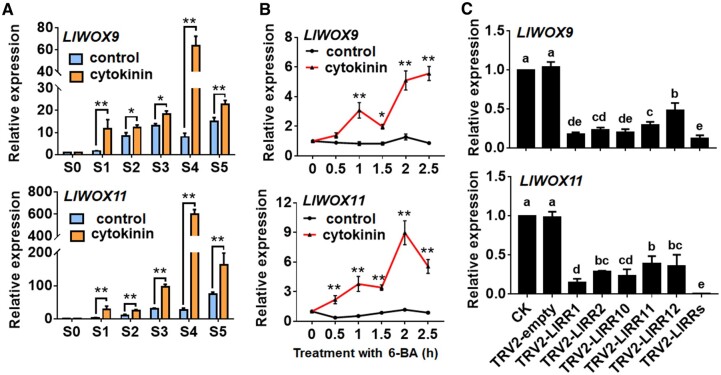
Expression of LlWOX9 and LlWOX11 after treatment with 6-BA and type-B LlRR silencing. A, Expression of LlWOX9 and LlWOX11 after treatment with 4-μM 6-BA during bulbil formation. Values are means ± sd (n = 3). Asterisks indicate significantly different values (Student’s t test, *P < 0.05 and **P < 0.01). B, Expression of LlWOX9 and LlWOX11 in leaf axils at stage S4 after 10-mM 6-BA treatment. Values are means ± sd (n = 3). Asterisks indicate significantly different values (Student’s t test, *P < 0.05 and **P < 0.01). C, Expression of LlWOX9 and LlWOX11 after type-B LlRR silencing. Values are means   sd (n = 3). Lowercase letters indicate significantly different values (Student’s t test, P < 0.05).
Figure 6
Figure 6
Detection of LlWOX9 and LlWOX11 promoter activity. A, The LlWOX9 and LlWOX11 promoters contain a large number of type-B RR binding elements. B, The expression of GUS was driven by the 35S, LlWOX9, and LlWOX11 promoters, and GUS staining was performed in L. lancifolium stems after cultured 4 and 12 days. The stems were digitally extracted for comparison. The circles indicate leaf axils and triangles indicate bulbils. Scale bar in (B) is 1 mm.
Figure 7
Figure 7
Yeast one-hybrid and dual-luciferase reporter assays and EMSAs of type-B LlRRs with the LlWOX9 and LlWOX11 promoters. A, Division of the LlWOX9 and LlWOX11 promoters into fragments according to the location of type-B RR binding elements (GATT/C). B, Y1H assays between five type-B LlRRs and LlWOX9 promoter fragments. C, Y1H assays between type-B LlRRs and LlWOX11 promoter fragments. D, The transient activation test in N. benthamiana leaves verified the transcriptional activation ability of the five type-B LlRRs toward the LlWOX9 and LlWOX11 promoters. Values are means ± sd (n = 3). Asterisks indicate significantly different values (Student’s t test, **P < 0.01). e, The binding ability of His-LlRR1 protein toward the proLlWOX9-1 and proLlWOX11-2 fragments was verified by EMSAs. The binding element GATT was mutated to TTTT in the mutant probe.
Figure 8
Figure 8
The interaction between LlWOX11 and the LlRR9 promoter was verified by dual-luciferase reporter and Y1H assays and EMSA. A, A WOX-binding element (TTAATGAG) in the promoter of LlRR9. B, The transient activation test in N. benthamiana leaves verified the transcriptional activation ability of LlWOX9 and LlWOX11 toward the LlRR9 promoter. Values are means ± sd (n = 3). Asterisks indicate significantly different values (Student’s t test, **P < 0.01). C, The expression of LlRR9 after overexpression LlWOX9 and LlWOX11. Values are means ± sd (n = 3). Lowercase letters indicate significantly different values (Student’s t test, P < 0.05). D, The binding ability of LlWOX11 toward the LlRR9 promoter was verified by Y1H assay. E, The binding ability of the MBP-LlWOX11 protein toward the proLlRR9 fragment was verified by EMSA. The binding element TTAATGA was mutated to AAAAAAA in the mutant probe.
Figure 9
Figure 9
Model of WOX gene cooperation with cytokinin signaling to regulate the bulbil formation.

References

    1. Abraham-Juárez MJ, Hernández Cárdenas R, Santoyo Villa JN, O’connor D, Sluis A, Hake S, Ordaz-Ortiz J, Terry L, Simpson J (2015) Functionally different PIN proteins control auxin flux during bulbil development in Agave tequilana. J Exp Bot 66: 3893–3905 - PMC - PubMed
    1. Abraham-Juárez MJ, Martínez-Hernández A, Leyva-González MA, Herrera-Estrella L, Simpson J (2010) Class I KNOX genes are associated with organogenesis during bulbil formation in Agave tequilana. J Exp Bot 61: 4055–4067 - PubMed
    1. Bach A, Sochacki D (2012) Propagation of ornamental geophytes: physiology and management. InKamenetsky R, Okubo H, eds, Ornamental Geophytes: From Basic Science to Sustainable Production. CRC Press, Boca Raton, FL, pp 261–286
    1. Bell AD, Bryan A (2008) Plant Form: An Illustrated Guide to Flowering Plant Morphology. Timber Press, Portland, Oregon
    1. Breuninger H, Rikirsch E, Hermann M, Ueda M, Laux T (2008) Differential expression of WOX genes mediates apical-basal axis formation in the Arabidopsis embryo. Dev Cell 14: 867–876 - PubMed

Publication types

MeSH terms