. 2022 Jun 7;13(1):3150.
doi: 10.1038/s41467-022-30856-w.

A functionally conserved STORR gene fusion in Papaver species that diverged 16.8 million years ago

Affiliations

A functionally conserved STORR gene fusion in Papaver species that diverged 16.8 million years ago

Theresa Catania et al. Nat Commun. .

Erratum in

Abstract

The STORR gene fusion event is considered essential for the evolution of the promorphinan/morphinan subclass of benzylisoquinoline alkaloids (BIAs) in opium poppy as the resulting bi-modular protein performs the isomerization of (S)- to (R)-reticuline essential for their biosynthesis. Here, we show that of the 12 Papaver species analysed those containing the STORR gene fusion also contain promorphinans/morphinans with one important exception. P. californicum encodes a functionally conserved STORR but does not produce promorphinans/morphinans. We also show that the gene fusion event occurred only once, between 16.8-24.1 million years ago before the separation of P. californicum from other Clade 2 Papaver species. The most abundant BIA in P. californicum is (R)-glaucine, a member of the aporphine subclass of BIAs, raising the possibility that STORR, once evolved, contributes to the biosynthesis of more than just the promorphinan/morphinan subclass of BIAs in the Papaveraceae.


Conflict of interest statement

The authors declare no competing interests.

Figures
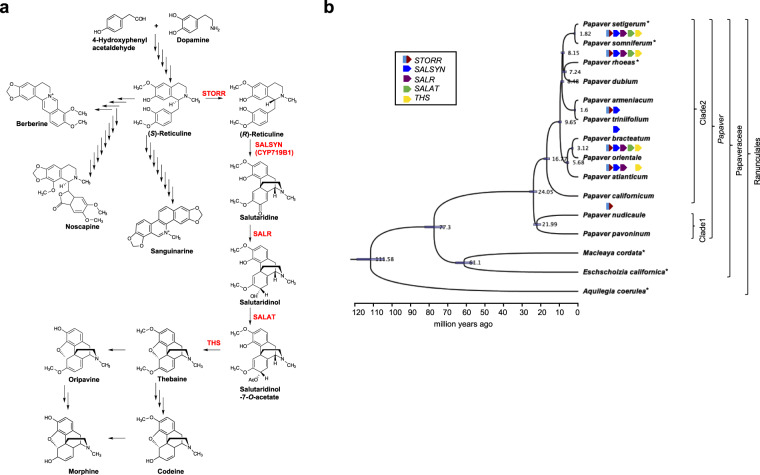
Fig. 1
Fig. 1. Metabolite and transcriptomic analysis to investigate STORR and its distribution in Papaver species.
a Schematic of the benzylisoquinoline pathway and enzymes in Opium Poppy with a focus on morphinan production. (S)-reticuline is the central branch point of BIA metabolism in opium poppy for the production of structurally distinct compounds including the morphinans plus noscapine, berberine and sanguinarine. Conversion of (S)- to (R)-reticuline by STORR represents the first committed step in biosynthesis of the promorphinans (salutaridine, Salutaridinol and salutaridinol-7-O-acetate) and morphinans (thebaine, oripavine, codeine and morphine). Compound names are in black and enzymes specific to the promorphinan and morphinan pathway are in red. b Species phylogeny inferred by Bayesian inference species tree using eight single copy conserved ortholog sequences. Phylogeny and divergence dates are estimated using BEAST2, which are shown on the nodes. Light-blue bars at the nodes indicate the range with 95% highest posterior density. Taxonomy groupings of the species are indicated and the twelve Papaver species are placed into two different clades (Clade 1 and Clade 2) as described by Carolan et al.. Species highlighted with an asterisk indicate all gene sequences were identified and retrieved from the corresponding annotated genomes whereas for the remaining nine Papaver species, transcriptomic datasets were used. Presence of the STORR and the four promorphinan genes are shown under species names (Supplementary Data 2). Source data are provided as a Source Data file.
Fig. 2
Fig. 2. Functional analysis of STORR proteins in Papaver species.
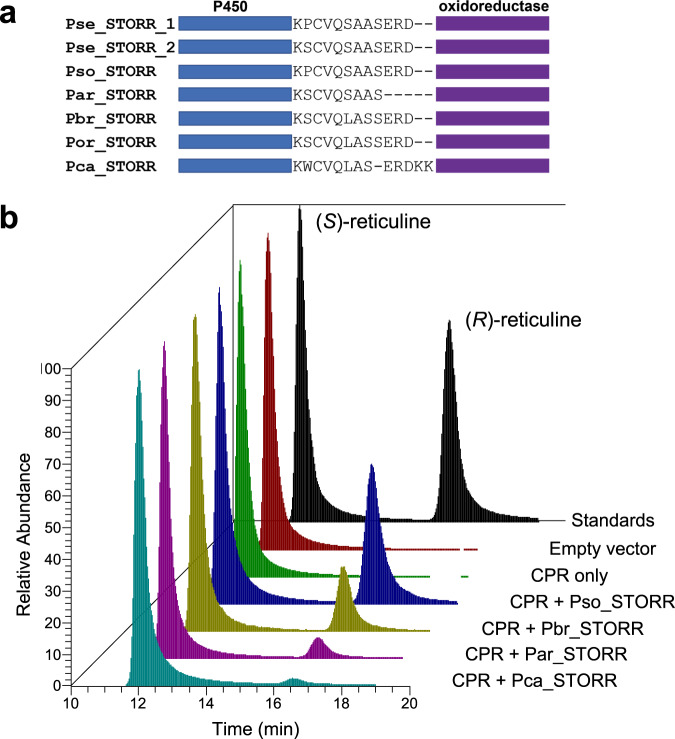
a Alignment of the amino acid linker connecting the STORR P450 and oxidoreductase modules. Pse P. setigerum, Pso P. somniferum, Par P. armeniacum, Pbr P. bracteatum, Por P. orientale and Pca P. californicum. b Functional characterisation of the STORR proteins by heterologous expression in S. cerevisiae. STORR protein from P. californicum, P. armeniacum, P. bracteatum and P. somniferum were separately produced with a P. somniferum cytochrome P450 reductase (CPR) redox partner in S. cerevisiae. Microsomal proteins were assayed with (S)-reticuline as substrate. Relative abundance is used to show the reticuline epimers present in the sample. Reticuline standards (black), pESC-trp empty vector (red), pESC-trp vector + cytochrome P450 reductase (CPR)(green), pESC-TRP + CPR + Pso STORR (blue), pESC-TRP + CPR + Pbr STORR (gold), pESC-TRP + CPR + Pam STORR (pink) and pESC-TRP + CPR + Pca STORR (cyan). Source data are provided as a Source Data file.
Fig. 3
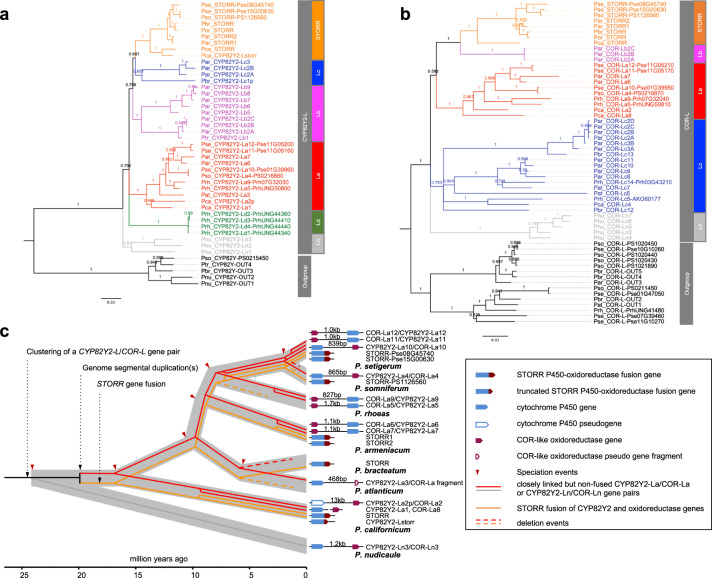
Fig. 3. Evolutionary history of the formation of STORR fusion gene inferred from gene tree analyses of its P450 CYP82Y2 and oxidoreductase modules.
a Phylogenetic gene tree of CYP82Y2-L P450 subfamily constructed using Bayesian Inference. b Phylogenetic gene tree of COR-L oxidoreductase subfamily constructed using Bayesian Inference. The posterior probabilities are shown on the branches and scale bar represents substitutions per nucleotide site. Both trees were rooted based on branch position of orthologous outgroup containing P. somniferum sequences CYP82Y-PS0215450 for CYP82Y2-L tree and COR_L-PS0211450/PS1020430/PS1020440/PS1020450/PS1021890 for the COR-L tree as described in Li et al.. STORR, La, Lb, Lc, Ld and Ln are defined as orthologous subgroups and their members are highlighted by coloured branches. A three letter prefix followed by an underscore is used as a species identifier for each gene; including Par P. armeniacum, Pat P. atlanticum, Pbr P. bracteatum, Pca P. californicum, Pnu P. nudicaule, Por P. orientale, Prh P. rhoeas, Ptr P. triniifolium, Pse P. setigerum and Pso P. somniferum. c Schematic representation of the evolutionary history of STORR reconciling the species tree with gene trees. The fusion event was preceded by the clustering of a gene pair of CYP82Y2-L and COR-L genes and subsequent segmental duplications. The grey background branches denote species divergence with speciation time points indicated by red arrows. The orange lines denote STORR and the red lines a gene pair of CYP82Y2-La and COR-La. The grey line indicates an ancestral CYP82Y2-L and COR-L gene pair prior to the divergence of P. nudicaule from the Clade 2 Papaver species. The exclusive presence of Clade 2 species in La and STORR subgroups and a single P. nudicaule Ln subgroup in both CYP82Y2-L and COR-L trees is consistent with the segmental duplication occurring after the divergence of P. nudicaule from Clade 2 species but before STORR formation between 24.1 and 16.8 MYA. Source data are provided as a Source Data file.
Fig. 4
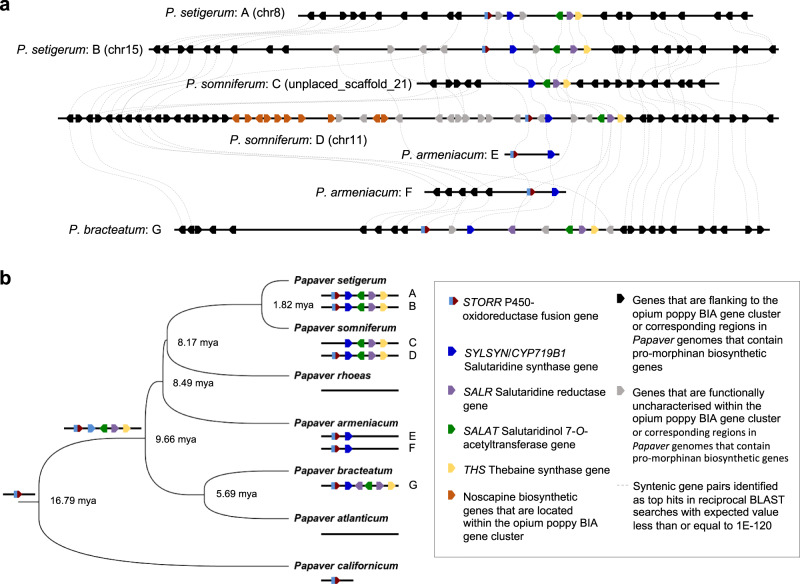
Fig. 4. Evolutionary history of the STORR plus promorphinan component of the BIA gene cluster in Papaver.
a Graphic representation of synteny between contigs that contain STORR and promorphinan genes in Papaver genomes. Arrangement of the genes and their orientations of the syntenic regions of Papaver species are shown as indicated in the inset (Supplementary Data 5); including the corresponding regions in the opium poppy genome, one of which contains the BIA gene cluster and its flanking regions (P. somniferum: C&D), the two syntenic regions in the P. setigerum genome on Chromosomes 8 and 15 (P. setigerum: A&B); the two contigs of 94 kb and 294 kb from the P. armeniacum genome (P. armeniacum: E&F) and the single 1.2 Mb contig of the P. bracteatum assembly (P. bracteatum: G). Dashed lines denote syntenic gene pairs. b Summary of the evolutionary history of the STORR plus promorphinan genes of the BIA gene cluster in Papaver as inferred from the species phylogeny and synteny in the genomes. The phylogeny for the selected subset of Papaver species and divergent times at the branching points were extracted from the species tree in Fig. 1b. The emergence of STORR and its clustering with all four promorphinan genes are indicated on the ancestral nodes. These are derived from the presence and organisation of these genes in the genomes of these extant species, which are also shown. Source data are provided as a Source Data file.

References

    1. Ziegler J, et al. Evolution of morphine biosynthesis in opium poppy. Phytochemistry. 2009;70:1696–1707. - PubMed
    1. Hagel JM, Facchini PJ. Benzylisoquinoline alkaloid metabolism: a century of discovery and a brave new world. Plant Cell Physiol. 2013;54:647–672. - PubMed
    1. Winzer T, et al. Morphinan biosynthesis in opium poppy requires a P450-oxidoreductase fusion protein. Science. 2015;349:309–312. - PubMed
    1. Farrow SC, Hagel JM, Beaudoin GA, Burns DC, Facchini PJ. Stereochemical inversion of (S)-reticuline by a cytochrome P450 fusion in opium poppy. Nat. Chem. Biol. 2015;11:728–732. - PubMed
    1. Guo L, et al. The opium poppy genome and morphinan production. Science. 2018;362:343–347. - PubMed

Publication types