


Is treatment in certified cancer centers related to better survival in patients with pancreatic cancer? Evidence from a large German cohort study
- PMID: 35672675
- PMCID: PMC9172168
- DOI: 10.1186/s12885-022-09731-w
Is treatment in certified cancer centers related to better survival in patients with pancreatic cancer? Evidence from a large German cohort study
Abstract
Background: Treatment of cancer patients in certified cancer centers, that meet specific quality standards in term of structures and procedures of medical care, is a national treatment goal in Germany. However, convincing evidence that treatment in certified cancer centers is associated with better outcomes in patients with pancreatic cancer is still missing.
Methods: We used patient-specific information (demographic characteristics, diagnoses, treatments) from German statutory health insurance data covering the period 2009-2017 and hospital characteristics from the German Standardized Quality Reports. We investigated differences in survival between patients treated in hospitals with and without pancreatic cancer center certification by the German Cancer Society (GCS) using the Kaplan-Meier estimator and Cox regression with shared frailty.
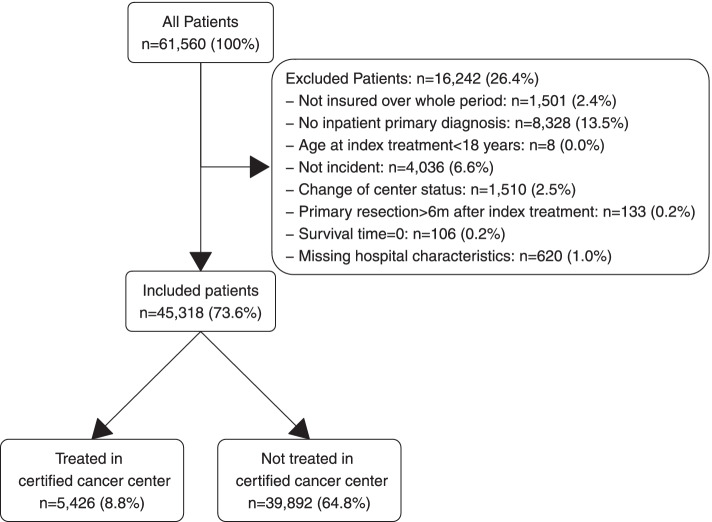
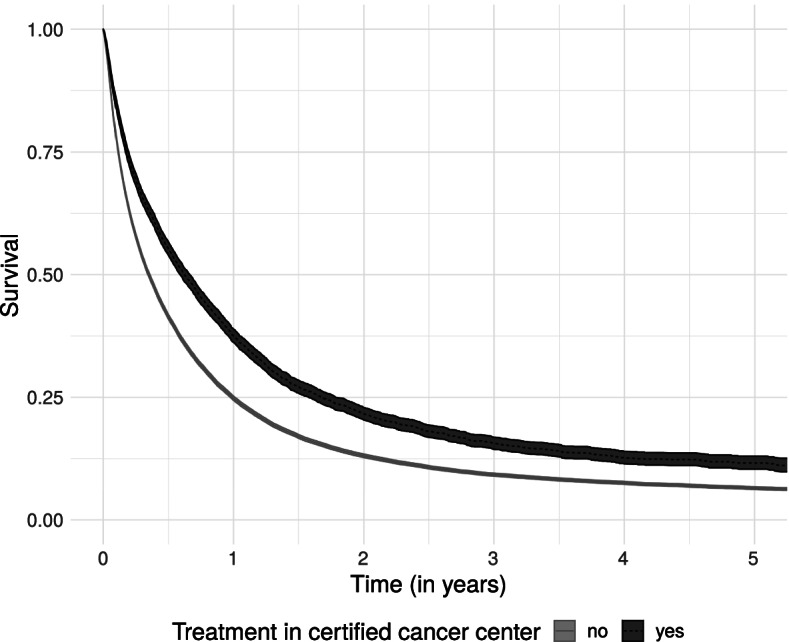
Results: The final sample included 45,318 patients with pancreatic cancer treated in 1,051 hospitals (96 GCS-certified, 955 not GCS-certified). 5,426 (12.0%) of the patients were treated in GCS-certified pancreatic cancer centers. Patients treated in certified and non-certified hospitals had similar distributions of age, sex, and comorbidities. Median survival was 8.0 months in GCS-certified pancreatic cancer centers and 4.4 months in non-certified hospitals. Cox regression adjusting for multiple patient and hospital characteristics yielded a significantly lower hazard of long-term, all-cause mortality in patients treated in GCS-certified pancreatic centers (Hazard ratio = 0.89; 95%-CI = 0.85-0.93). This result remained robust in multiple sensitivity analyses, including stratified estimations for subgroups of patients and hospitals.
Conclusion: This robust observational evidence suggests that patients with pancreatic cancer benefit from treatment in a certified cancer center in terms of survival. Therefore, the certification of hospitals appears to be a powerful strategy to improve patient outcomes in pancreatic cancer care.
Trial registration: ClinicalTrials.gov ( NCT04334239 ).
Keywords: Certified cancer center; Cohort study; Cox regression; Pancreatic cancer; Survival.
© 2022. The Author(s).
Conflict of interest statement
MR, JS, CB, OS, and VB work at a university hospital with certified cancer centers. In addition, they received funding from the Innovation Committee of the Federal Joint Committee during the conduct of the study. Unrelated to this study, JS received institutional funding for investigator-initiated research from Sanofi, Pfizer, Novartis, ALK, and acted as a payed consultant for Sanofi, Novartis, ALK and Lilly. OS is a member of the certification commission “Skin Cancer Centers” of the German Cancer Society. The other authors declare that they have no conflict of interest.
Figures
References
-
- Wild C, Weiderpass E, Stewart B. World cancer report: Cancer research for cancer prevention. Lyon, France: International Agency for Research on Cancer; 2020.
-
- GEKID. ZfKD at RKI . Krebs in Deutschland für 2015/2016. Berlin: Robert Koch-Institut; 2020.
Publication types
MeSH terms
Associated data
LinkOut - more resources
Full Text Sources
Medical
