


Racial Disparities in the Utilization of Shoulder Arthroplasty in the United States: Trends from 2011 to 2017
- PMID: 35673617
- PMCID: PMC9165742
- DOI: 10.2106/JBJS.OA.21.00144
Racial Disparities in the Utilization of Shoulder Arthroplasty in the United States: Trends from 2011 to 2017
Abstract
As the incidence of shoulder arthroplasty rises at exponential rates, race is an important consideration, as racial disparities have been reported in lower-extremity arthroplasty in the United States. Our study sought to examine these disparities.
Methods: Using the National Inpatient Sample (NIS) database, all anatomic total shoulder arthroplasty (aTSA) and reverse total shoulder arthroplasty (RSA) procedures from 2011 to 2017 were analyzed. The patients were divided into the Black, Hispanic, and White groups.
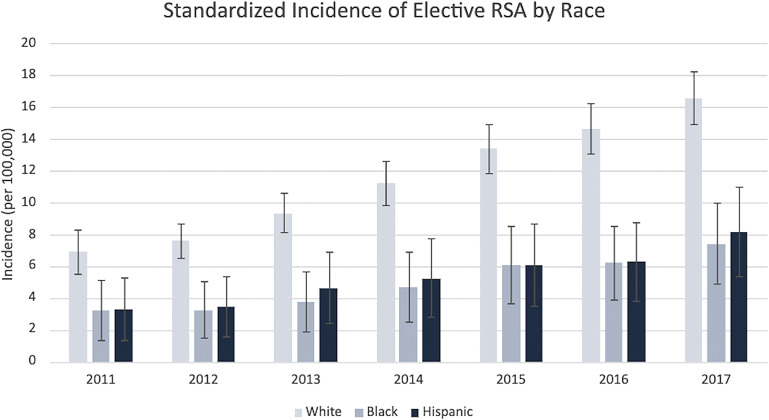
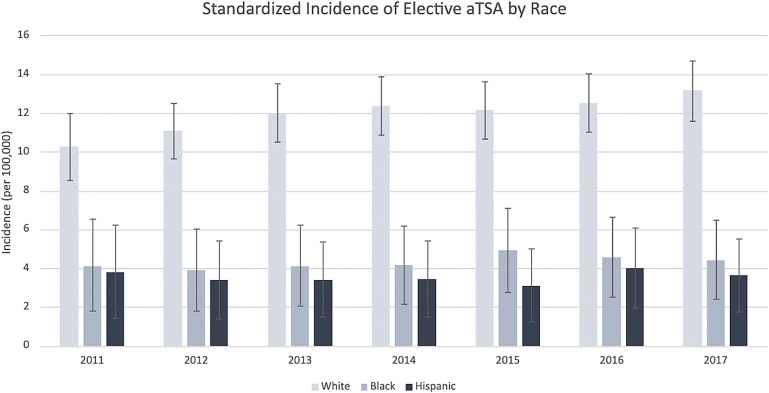
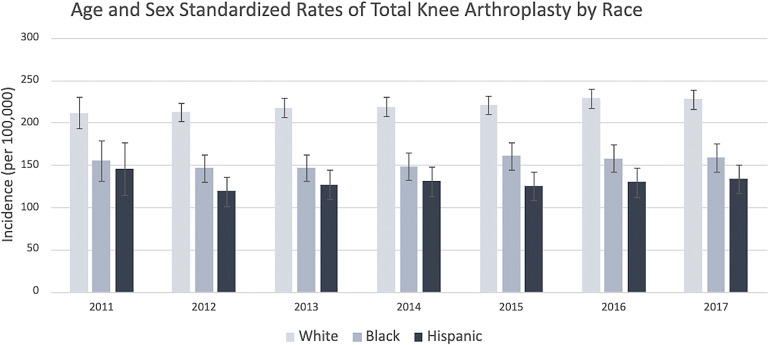
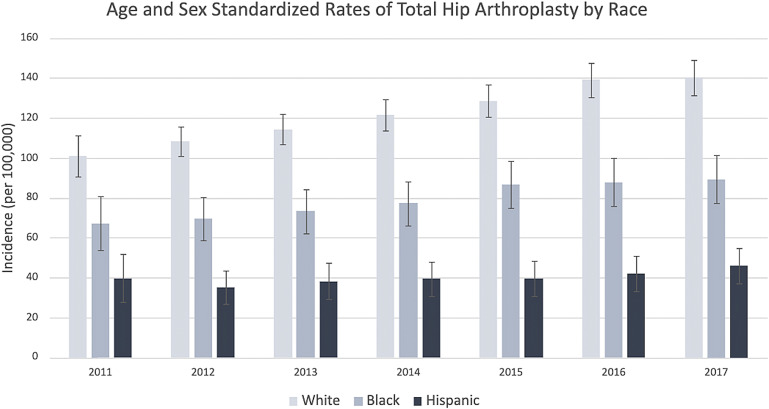
Results: Overall, 91.4% of the patients undergoing any shoulder arthroplasty procedure were White, 4.75% were Black, and 3.85% were Hispanic. Age and sex-standardized RSA utilization rates (per 100,000) in White patients increased by 139% from 6.94 in 2011 to 16.60 in 2017. The disparity for Black patients, compared with White patients, was 118% in 2011 and 124% in 2017; the disparity for Hispanic patients was 112% in 2011 and 103% in 2017. Similar disparities in aTSA utilization rates were seen; when compared with White patients, there was a 150% disparity in 2011 and a 197% disparity in 2017 for Black patients, and a 169% disparity in 2011 and a 262% disparity in 2017 for Hispanic patients. Finally, Blacks had a higher rate of non-home discharge, longer length of stay, and higher overall costs, while Hispanics had a longer length of stay and higher cost than Whites.
Conclusions: Despite many efforts to reduce racial disparities in health-care utilization, the chasm in shoulder arthroplasty in the United States appears to be large and widening further. The exponential increase in utilization of shoulder arthroplasty has not been shared equally among races, and the disparities are larger than those reported in lower-extremity arthroplasty.
Copyright © 2022 The Authors. Published by The Journal of Bone and Joint Surgery, Incorporated. All rights reserved.
Conflict of interest statement
Figures

References
-
- Kiet TK, Feeley BT, Naimark M, Gajiu T, Hall SL, Chung TT, Ma CB. Outcomes after shoulder replacement: comparison between reverse and anatomic total shoulder arthroplasty. J Shoulder Elbow Surg. 2015. Feb;24(2):179-85. - PubMed
-
- Steen BM, Cabezas AF, Santoni BG, Hussey MM, Cusick MC, Kumar AG, Frankle MA. Outcome and value of reverse shoulder arthroplasty for treatment of glenohumeral osteoarthritis: a matched cohort. J Shoulder Elbow Surg. 2015. Sep;24(9):1433-41. - PubMed
-
- Day JS, Lau E, Ong KL, Williams GR, Ramsey ML, Kurtz SM. Prevalence and projections of total shoulder and elbow arthroplasty in the United States to 2015. J Shoulder Elbow Surg. 2010. Dec;19(8):1115-20. - PubMed
-
- Dillon MT, Chan PH, Inacio MCS, Singh A, Yian EH, Navarro RA. Yearly Trends in Elective Shoulder Arthroplasty, 2005-2013. Arthritis Care Res (Hoboken). 2017. Oct;69(10):1574-81. - PubMed
LinkOut - more resources
Full Text Sources
Research Materials