


Intraarterial Nimodipine Versus Induced Hypertension for Delayed Cerebral Ischemia: A Modified Treatment Protocol
- PMID: 35674046
- PMCID: PMC9329199
- DOI: 10.1161/STROKEAHA.121.038216
Intraarterial Nimodipine Versus Induced Hypertension for Delayed Cerebral Ischemia: A Modified Treatment Protocol
Abstract
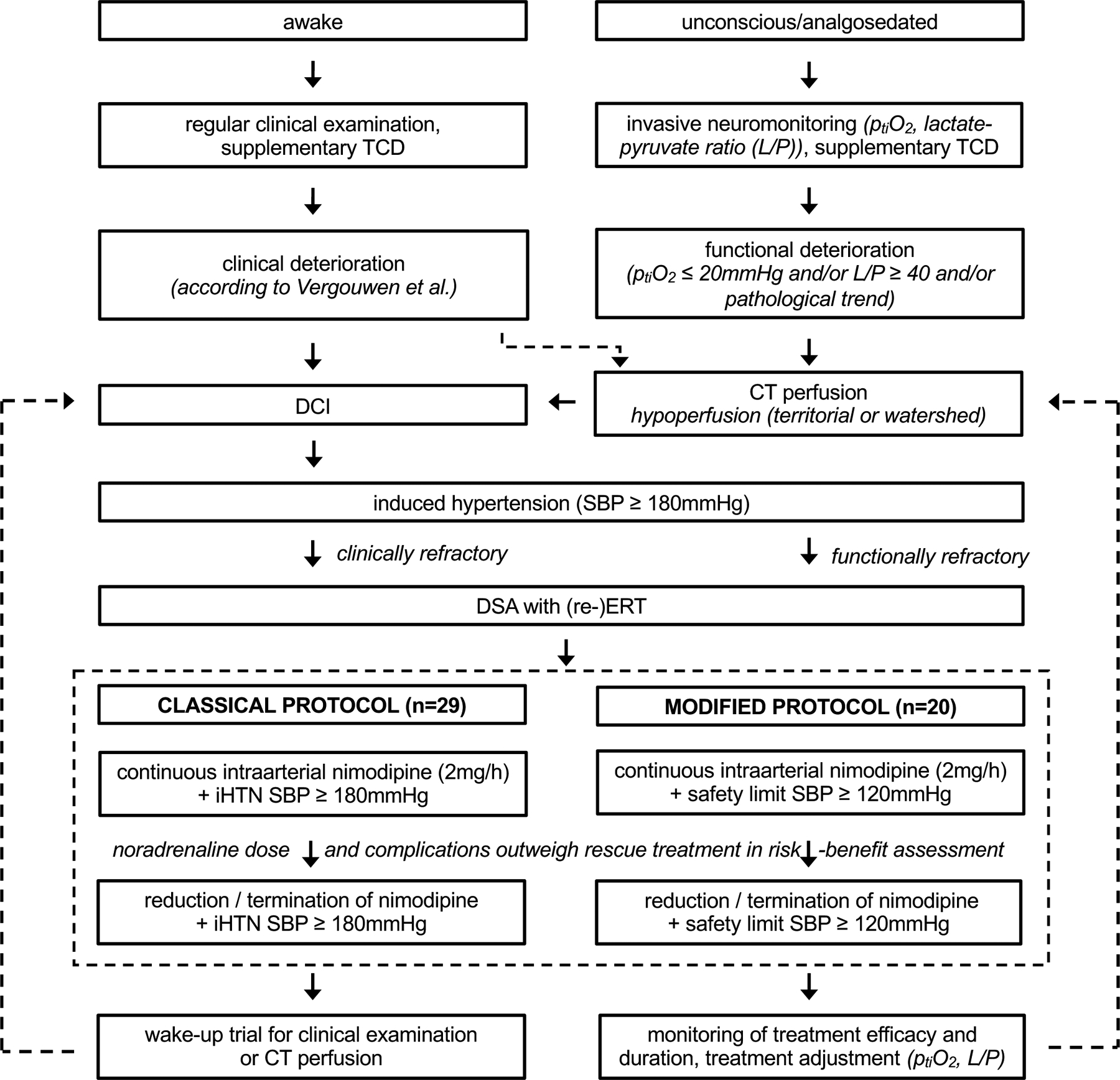
Background: Rescue treatment for delayed cerebral ischemia (DCI) after subarachnoid hemorrhage can include induced hypertension (iHTN) and, in refractory cases, endovascular approaches, of which selective, continuous intraarterial nimodipine (IAN) is one variant. The combination of iHTN and IAN can dramatically increase vasopressor demand. In case of unsustainable doses, iHTN is often prioritized over IAN. However, evidence in this regard is largely lacking. We investigated the effects of a classical (iHTN+IAN) and modified (IANonly) treatment protocol for refractory DCI in an observational study.
Methods: Rescue treatment for DCI was initiated with iHTN (target >180 mm Hg systolic) and escalated to IAN in refractory cases. Until July 2018, both iHTN and IAN were offered in cases refractory to iHTN alone. After protocol modification, iHTN target was preemptively lowered to >120 mm Hg when IAN was initiated (IANonly). Primary outcome was noradrenaline demand. Secondary outcomes included noradrenaline-associated complications, brain tissue oxygenation, DCI-related infarction and favorable 6-month outcome (Glasgow Outcome Scale 4-5).
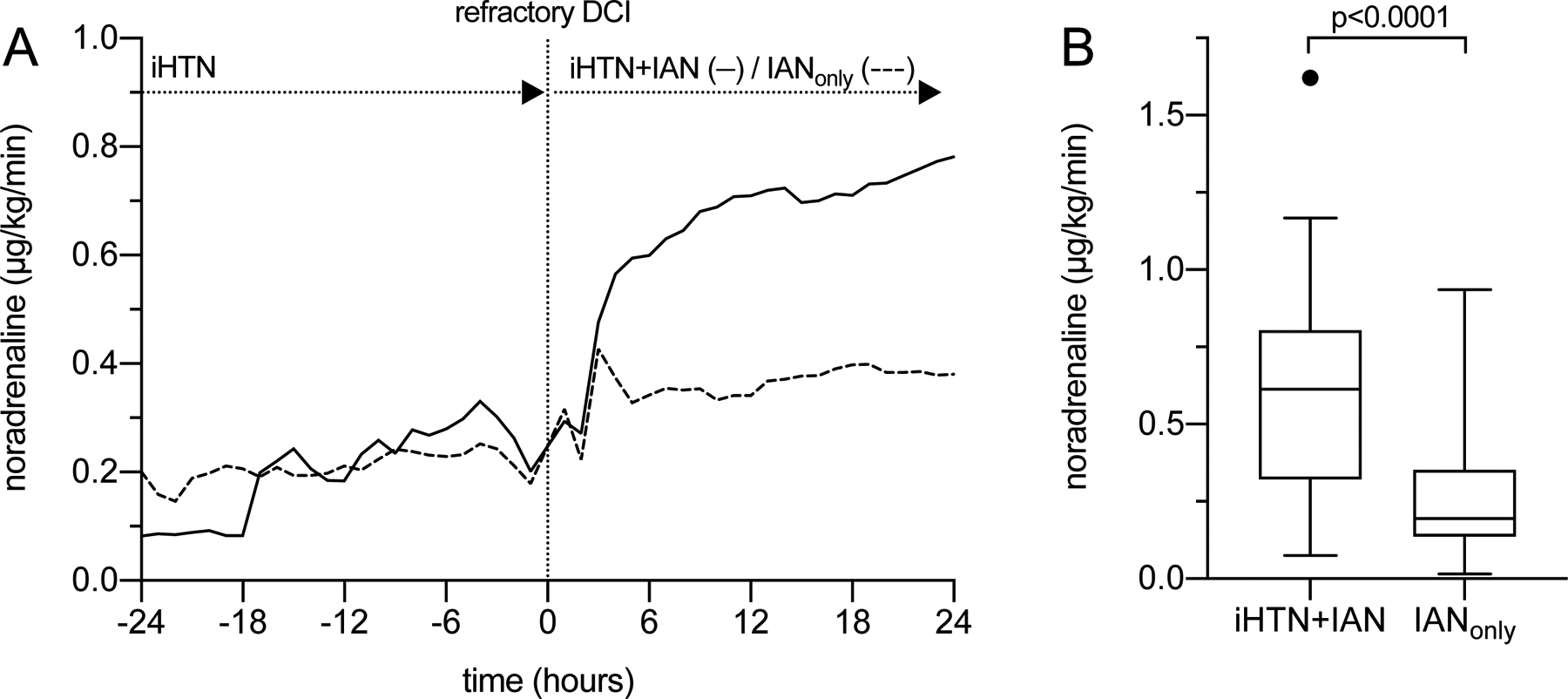
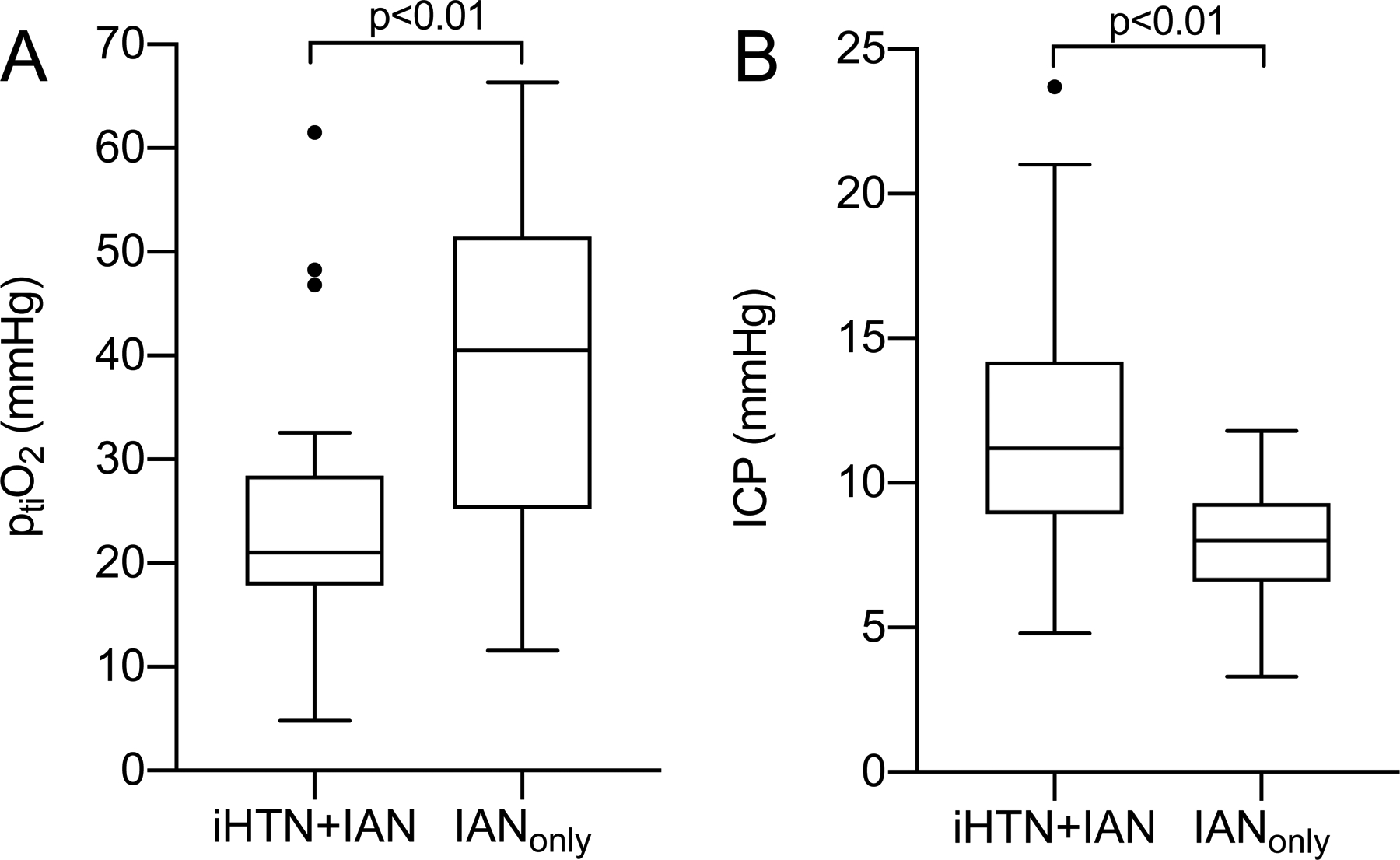
Results: N=29 and n=20 patients were treated according to the classical and modified protocol, respectively. Protocol modification resulted in a significant reduction of noradrenaline demand (iHTN+IAN 0.70±0.54 µg/kg per minute and IANonly 0.26±0.20 µg/kg per minute, P<0.0001) and minor complications (15.0% versus 48.3%, unadjusted odds ratio, 0.19 [95% CI, 0.05-0.79]; P<0.05) with comparable rates of major complications (20.0% versus 20.7%, odds ratio, 0.96 [0.23-3.95]; P=0.95). Incidence of DCI-related infarction (45.0% versus 41.1%, odds ratio, 1.16 [0.37-3.66]; P=0.80) and favorable clinical outcome (55.6% versus 40.0%, odds ratio, 1.88 [0.55-6.39]; P=0.32) were similar. Brain tissue oxygenation was significantly higher with IANonly (26.6±12.8, 39.6±15.4 mm Hg; P<0.01).
Conclusions: Assuming the potential of iHTN to be exhausted in case of refractory hypoperfusion, additional IAN may serve as a last-resort measure to bridge hypoperfusion in the DCI phase. With close monitoring, preemptive lowering of pressure target after induction of IAN may be a safe alternative to alleviate total noradrenaline load and potentially reduce complication rate.
Keywords: Glasgow Outcome Scale; brain ischemia; nimodipine; norepinephrine; subarachnoid hemorrhage.
Figures
Comment in
-
Treating Delayed Cerebral Ischemia: Should We Focus on Blood Pressure or Vasodilatation?Stroke. 2022 Aug;53(8):2617-2619. doi: 10.1161/STROKEAHA.122.039800. Epub 2022 Jun 8. Stroke. 2022. PMID: 35674047 No abstract available.
References
-
- Gathier CS, Dankbaar JW, van der Jagt M, Verweij BH, Oldenbeuving AW, Rinkel GJ, van den Bergh WM, Slooter AJ, Group HS. Effects of Induced Hypertension on Cerebral Perfusion in Delayed Cerebral Ischemia After Aneurysmal Subarachnoid Hemorrhage: A Randomized Clinical Trial. Stroke. 2015;46:3277–3281. doi: 10.1161/STROKEAHA.115.010537 - DOI - PubMed
-
- Diringer MN, Bleck TP, Claude Hemphill J, 3rd, Menon D, Shutter L, Vespa P, Bruder N, Connolly ES, Jr., Citerio G, Gress D, et al. Critical care management of patients following aneurysmal subarachnoid hemorrhage: recommendations from the Neurocritical Care Society’s Multidisciplinary Consensus Conference. Neurocrit Care. 2011;15:211–240. doi: 10.1007/s12028-011-9605-9 - DOI - PubMed
Publication types
MeSH terms
Substances
Grants and funding
LinkOut - more resources
Full Text Sources
Medical
