Review
. 2022 Aug 23;22(17):3110-3121.
doi: 10.1039/d2lc00024e.

Advancing microfluidic diagnostic chips into clinical use: a review of current challenges and opportunities

Affiliations
Review

Advancing microfluidic diagnostic chips into clinical use: a review of current challenges and opportunities

Vasant Iyer et al. Lab Chip. .

Abstract

Microfluidic diagnostic (μDX) technologies miniaturize sensors and actuators to the length-scales that are relevant to biology: the micrometer scale to interact with cells and the nanometer scale to interrogate biology's molecular machinery. This miniaturization allows measurements of biomarkers of disease (cells, nanoscale vesicles, molecules) in clinical samples that are not detectable using conventional technologies. There has been steady progress in the field over the last three decades, and a recent burst of activity catalyzed by the COVID-19 pandemic. In this time, an impressive and ever-growing set of technologies have been successfully validated in their ability to measure biomarkers in clinical samples, such as blood and urine, with sensitivity and specificity not possible using conventional tests. Despite our field's many accomplishments to date, very few of these technologies have been successfully commercialized and brought to clinical use where they can fulfill their promise to improve medical care. In this paper, we identify three major technological trends in our field that we believe will allow the next generation of μDx to have a major impact on the practice of medicine, and which present major opportunities for those entering the field from outside disciplines: 1. the combination of next generation, highly multiplexed μDx technologies with machine learning to allow complex patterns of multiple biomarkers to be decoded to inform clinical decision points, for which conventional biomarkers do not necessarily exist. 2. The use of micro/nano devices to overcome the limits of binding affinity in complex backgrounds in both the detection of sparse soluble proteins and nucleic acids in blood and rare circulating extracellular vesicles. 3. A suite of recent technologies that obviate the manual pre-processing and post-processing of samples before they are measured on a μDX chip. Additionally, we discuss economic and regulatory challenges that have stymied μDx translation to the clinic, and highlight strategies for successfully navigating this challenging space.


Figures
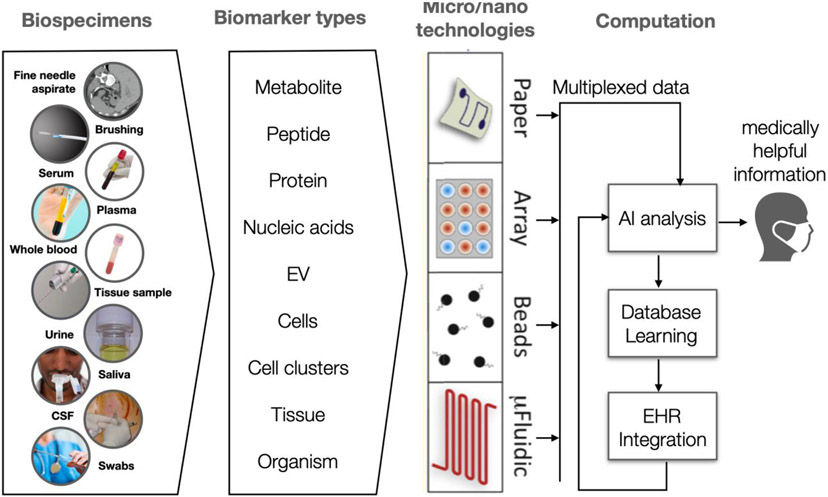
Figure 1.
Figure 1.
A wide range of biological samples can be collected and each carry potentially valuable diagnostic information. A variety of μDx technologies can be leveraged for sensitive and specific measurements on these clinical samples to provide clinically actionable information. Multiplexed measurements made by μDX generate high dimension datasets that can be analyzed using artificial intelligence based analysis to identify patterns and extract medically useful information.
Figure 2.
Figure 2.
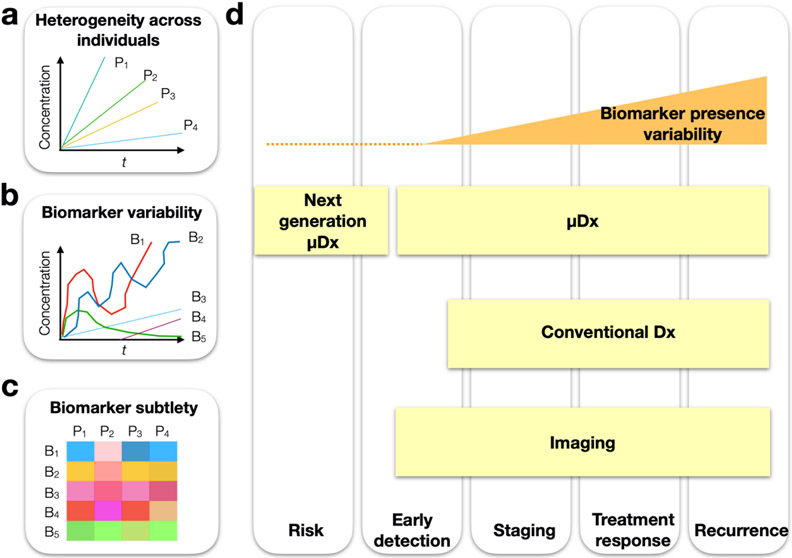
Challenges of biological measurements can arise from biomarker heterogeneity and variability. a. An illustration of multiple individuals P1:5 with the same disease that have heterogeneous expression of a given individual biomarker. b. An illustration showing that within a given patient, individual biomarkers B1:5 can vary independently, with some having values that can fall below the noise floor. c. While individual biomarkers might show suboptimal correlation with a disease state, trends across multiple biomarkers may be more indicative and can be recognized using machine learning. d. We illustrate the stages at which next generation μDx and conventional diagnostics (Dx) and imaging have the potential to resolve disease states.
Figure 3.
Figure 3.
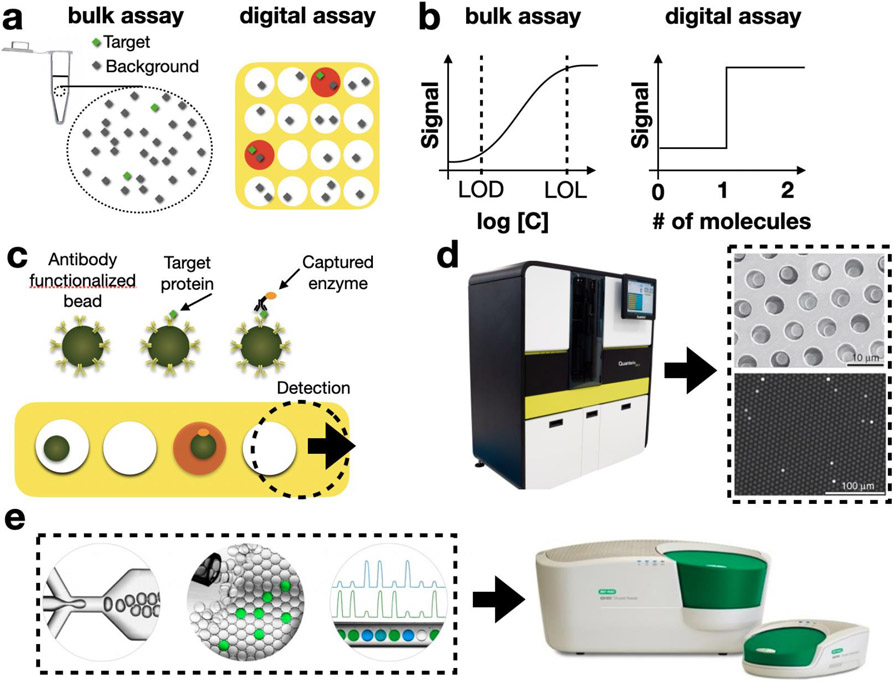
Digital Assays. a. A schematic showing a bulk assay and a digital assay. In the digital assay every compartment has one or zero copies of the target molecule (green), and the signal to background (green / black) is greater in each individual droplet than it is in the bulk. b. on curves show the signal versus concentration C for a conventional bulk assay and for a digital assay. c. A schematic of digital ELISA, in which a sandwich assay is performed on antibody functionalized beads. Any bead that has captured a target protein, captures an enzyme that makes the droplet fluoresce. d. The SIMOA system (Quanterix) uses disposable cartridges, in which the dELISA assay is performed, and a benchtop instrument for dELISA readout. e. A commercial digital droplet PCR (ddPCR) system packages droplet generation, droplet processing, and fluorescence detection together within a benchtop instrument (BioRad).
Figure 4.
Figure 4.
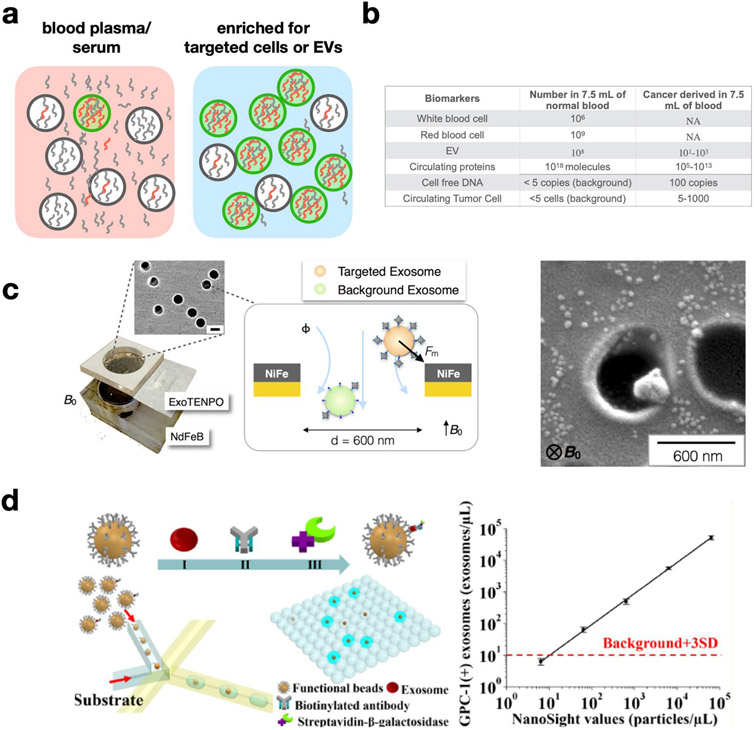
μDx isolation of extracellular vesicles (EVs). a. A schematic showing how the signal-to-background of a molecular biomarker (red/grey) can be improved by first enriching for targeted vesicles (green) from the vast background of vesicles (grey) and molecules (grey) present in clinical samples. b. Order of magnitude numbers for the quantity of biomarker concentrations for the application of cancer diagnostics in 7.5 mL of blood. c. A schematic of the Track Etched Magnetic NanoPOre (TENPO) device, as well as an electron microscopy image of an immunomagnetically isolated vesicle. d. Droplet based technologies have recently emerged, which isolate single EVs into droplets where an enzymatic reaction, such as ELISA or PCR, can be carried out to amplify the signal from a single EV. These technologies offer the potential for single EVs to be rapidly counted and profiled.

References

    1. Tay FEH Microfluidics and BioMEMS applications (Springer, 2002).
    1. Harrison DJ et al. Science, 1993, 261, 895–897. - PubMed
    1. Lee H, Ham D & Westervelt RM CMOS biotechnology (Springer, 2007).
    1. Issadore D & Westervelt RM Point-of-care Diagnostics on a Chip (Springer Science \& Business Media, 2013).
    1. Im H et al. Nature biotechnology, 2014, 32, 490. - PMC - PubMed

Publication types