Review
. 2022 Jul;109(4-5):483-504.
doi: 10.1007/s11103-022-01284-7. Epub 2022 Jun 8.

Cell wall integrity regulation across plant species

Affiliations
Review

Cell wall integrity regulation across plant species

Luis Alonso Baez et al. Plant Mol Biol. 2022 Jul.

Abstract

Plant cell walls are highly dynamic and chemically complex structures surrounding all plant cells. They provide structural support, protection from both abiotic and biotic stress as well as ensure containment of turgor. Recently evidence has accumulated that a dedicated mechanism exists in plants, which is monitoring the functional integrity of cell walls and initiates adaptive responses to maintain integrity in case it is impaired during growth, development or exposure to biotic and abiotic stress. The available evidence indicates that detection of impairment involves mechano-perception, while reactive oxygen species and phytohormone-based signaling processes play key roles in translating signals generated and regulating adaptive responses. More recently it has also become obvious that the mechanisms mediating cell wall integrity maintenance and pattern triggered immunity are interacting with each other to modulate the adaptive responses to biotic stress and cell wall integrity impairment. Here we will review initially our current knowledge regarding the mode of action of the maintenance mechanism, discuss mechanisms mediating responses to biotic stresses and highlight how both mechanisms may modulate adaptive responses. This first part will be focused on Arabidopsis thaliana since most of the relevant knowledge derives from this model organism. We will then proceed to provide perspective to what extent the relevant molecular mechanisms are conserved in other plant species and close by discussing current knowledge of the transcriptional machinery responsible for controlling the adaptive responses using selected examples.

Keywords: Cell wall integrity; Environmental responses; Receptor-like kinases; Signaling; Transcriptional regulation.


Conflict of interest statement

The authors have no conflict of interest to declare.

Figures
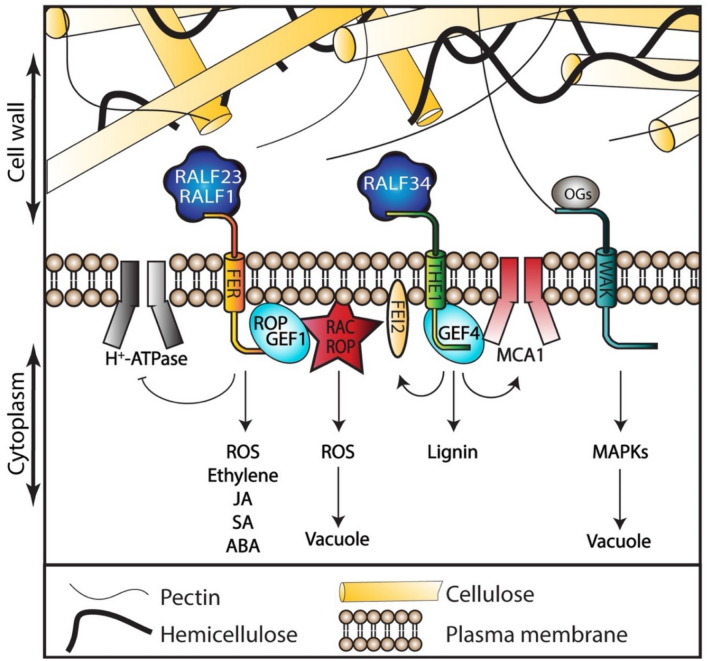
Fig. 1
Fig. 1
Receptors and their interactors participating in CWI maintenance in Arabidopsis. Membrane-bound receptor-like kinases can activate signaling pathways in response to environmental or chemical cues. Different interaction partners (co-receptors) and ligands (RALF peptides) seem to determine the specific activities of signaling process receptors, such as FER and THE1. Interaction with cell wall components (i.e. WAK or FER interactions with pectin) could trigger downstream signaling events
Fig. 2
Fig. 2
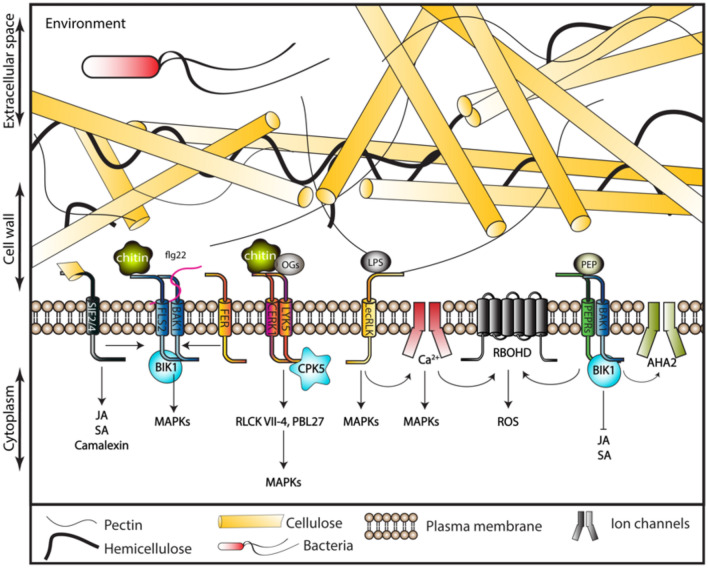
PAMPs and DAMPs activate diverse pathways in response to environmental stimuli. PAMPs and DAMPs are sensed at the plasma membrane by receptors from diverse families. Dependent on the specific perturbation and foreign or endogenous molecule detected specific defense responses are activated. Similar responses to biotic stress are observed in Arabidopsis and other plants, whereas chitin detection differs between Arabidopsis and rice (see text and Fig. 4)
Fig. 3
Fig. 3
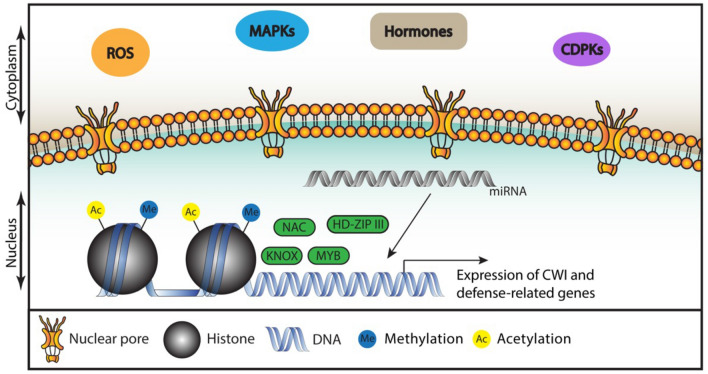
Transcriptional regulation of genes involved in responses to cell wall metabolism. An overview of relevant molecular components and structures in the cytoplasm and nucleus. Stress leads to generation of signals, which are relayed to the nucleus to modulate expression of transcriptional regulators, controlling expression of genes mediating responses to CWI impairment and biotic stress
Fig. 4
Fig. 4
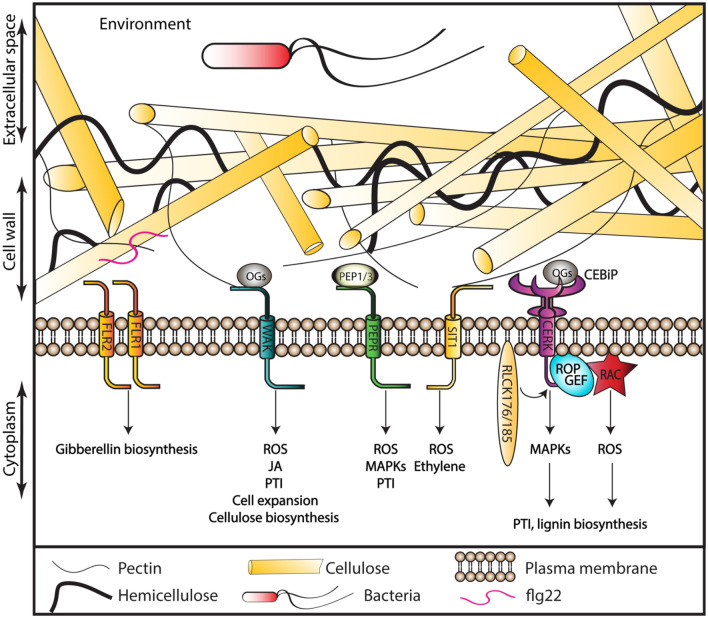
Receptors and biotic stress responses in other plants. Similar strategies to sense CWI impairment seem to be active in Arabidopsis and other plants. Since the number of family members encoding membrane-bound receptors and peptides has diversified in other plants, the specific interactions between receptors, co-receptors and ligands as well as the downstream effects of CWI impairment, can differ from the ones observed in Arabidopsis. FLR1 and FLR2 (Oryza sativa) are homologues of AtFER with specialized functions in growth and immunity. WAKs family members have increased and specialized in crops including Brachypodium, Zea maize, wheat and Oryza sativa; where they function in diverse developmental and immune responses. Similar to their function in Arabidopsis, PEPs and PEPRs have been implicated in defense responses in Zea maize and Oryza sativa. SIT1 (L-type LecRLK) and CEBiP/CERK complex and interactors represented in the figure are based on Oryza sativa studies

References

    1. Abdul Malik NA, Kumar IS, Nadarajah K. Elicitor and receptor molecules: orchestrators of plant defense and immunity. Int J Mol Sci. 2020;21:963. doi: 10.3390/ijms21030963. - DOI - PMC - PubMed
    1. Akamatsu A, Wong HL, Fujiwara M, Okuda J, Nishide K, Uno K, Imai K, Umemura K, Kawasaki T, Kawano Y, Shimamoto K. An OsCEBiP/OsCERK1-OsRacGEF1-OsRac1 module is an essential early component of chitin-induced rice immunity. Cell Host Microbe. 2013;13:465–476. doi: 10.1016/j.chom.2013.03.007. - DOI - PubMed
    1. Alonso-Simón A, García-Angulo P, Mélida H, Encina A, Álvarez JM, Acebes JL. The use of FTIR spectroscopy to monitor modifications in plant cell wall architecture caused by cellulose biosynthesis inhibitors. Plant Signal Behav. 2011;6:1104–1110. doi: 10.4161/psb.6.8.15793. - DOI - PMC - PubMed
    1. Ao Y, Li Z, Feng D, Xiong F, Liu J, Li J-F, Wang M, Wang J, Liu B, Wang H-B. OsCERK1 and OsRLCK176 play important roles in peptidoglycan and chitin signaling in rice innate immunity. Plant J. 2014;80:1072–1084. doi: 10.1111/tpj.12710. - DOI - PubMed
    1. Bacete L, Hamann T. The role of mechanoperception in plant cell wall integrity maintenance. Plants. 2020 doi: 10.3390/plants9050574. - DOI - PMC - PubMed

LinkOut - more resources