


Proteoglycans in Toll-like receptor responses and innate immunity
- PMID: 35675639
- PMCID: PMC9273283
- DOI: 10.1152/ajpcell.00088.2022
Proteoglycans in Toll-like receptor responses and innate immunity
Abstract
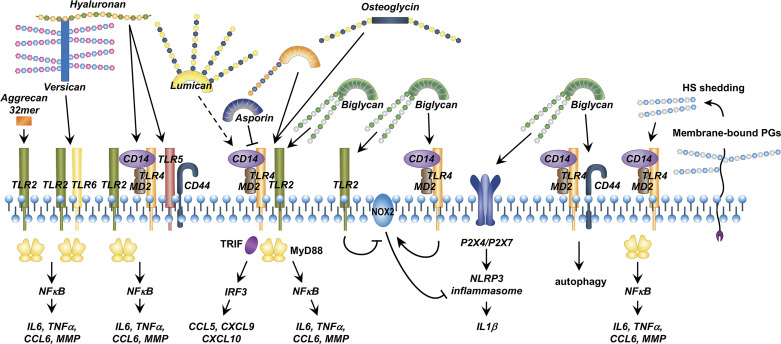
The extracellular matrix (ECM) is an active and dynamic feature of tissues that not only provides gross structure but also plays key roles in cellular responses. The ever-changing microenvironment responds dynamically to cellular and external signals, and in turn influences cell fate, tissue development, and response to environmental injury or microbial invasion. It is therefore paramount to understand how the ECM components interact with each other, the environment and cells, and how they mediate their effects. Among the ECM components that have recently garnered increased attention, proteoglycans (PGs) deserve special note. Recent evidence strongly suggests that they play a crucial role both in health maintenance and disease development. In particular, proteoglycans dictate whether homeostasis or cell death will result from a given injury, by triggering and modulating activation of the innate immune system, via a conserved array of receptors that recognize exogenous (infectious) or endogenous (tissue damage) molecular patterns. Innate immune activation by proteoglycans has important implications for the understanding of cell-matrix interactions in health and disease. In this review, we will summarize the current state of knowledge of innate immune signaling by proteoglycans, discuss the implications, and explore future directions to define progress in this area of extracellular matrix biology.
Keywords: Toll-like receptors; innate immunity; proteoglycans.
Conflict of interest statement
No conflicts of interest, financial or otherwise, are declared by the authors.
Figures
References
Publication types
MeSH terms
Substances
Grants and funding
LinkOut - more resources
Full Text Sources
