The health workforce status in the WHO African Region: findings of a cross-sectional study
- PMID: 35675966
- PMCID: PMC9109011
- DOI: 10.1136/bmjgh-2021-008317
The health workforce status in the WHO African Region: findings of a cross-sectional study
Abstract
Introduction: Several efforts have been made globally to strengthen the health workforce (HWF); however, significant challenges still persist especially in the African Region. This study was conducted by the WHO Regional Office for Africa to present the status of the HWF in 47 countries as a baseline in measuring countries' progress in implementing the Global Strategy for HWF by 2030.
Methods: This was a cross-sectional survey of 47 countries in the African Region using a semistructured questionnaire. Data were collected from January 2018 to April 2019. Before data collection, a tool was developed and piloted in four countries. The completed tools were validated in the countries by relevant stakeholders in the 47 countries. Data were collated and analysed in Epi Info and Microsoft Excel.
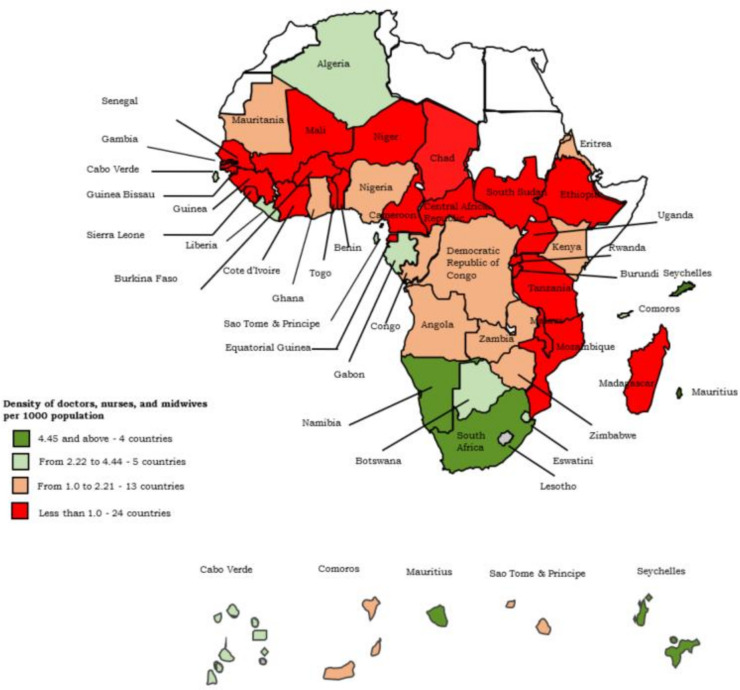
Results: The total stock of health workers was approximately 3.6 million across 47 countries. Among these, 37% of the health workers were nurses and midwives, 9% were medical doctors, 10% were laboratory personnel, 14% were community health workers, 14% were other health workers, and 12% were administrative and support staff. Results show uneven distribution of health workers within the African Region. Most health workers (85%) are in the public sector. Regional density of physicians, nurses and midwives per 1000 population was 1.55, only 4 countries had densities of more than 4.45 physicians, nurses and midwives per 1000 population.
Conclusion: This survey has demonstrated that the shortage and maldistribution of health workers in the WHO African Region remain a big challenge towards the attainment of universal access to health services. This calls for the need to substantially increase investment in the HWF based on contextual evidence in line with the current and future health needs.
Keywords: Health policy; Health systems; Public Health.
© Author(s) (or their employer(s)) 2022. Re-use permitted under CC BY-NC. No commercial re-use. See rights and permissions. Published by BMJ.
Conflict of interest statement
Competing interests: None declared.
Figures
References
-
- WHO . Working for health and growth: investing in the health workforce. Geneva: World Health Organization, 2016.
-
- WHO . Global strategy on human resources for health: workforce 2030. Geneva: World Health Organization, 2016.
-
- WHO . National health workforce accounts: a Handbook. Geneva: World Health Organization, 2017.
-
- WHO . The world health report 2006—working together for health. Geneva: World Health Organization, 2006.
-
- WHO . Health workforce requirements for universal health coverage and the sustainable development goals.(human resources for health observer, 17) 2016.
Publication types
MeSH terms
Grants and funding
LinkOut - more resources
Full Text Sources
Miscellaneous