


COVID-19 - an opportunity to improve access to primary care through organizational innovations? A qualitative multiple case study in Quebec and Nova Scotia (Canada)
- PMID: 35676668
- PMCID: PMC9177136
- DOI: 10.1186/s12913-022-08140-w
COVID-19 - an opportunity to improve access to primary care through organizational innovations? A qualitative multiple case study in Quebec and Nova Scotia (Canada)
Abstract
Background: COVID-19 catalyzed a rapid and substantial reorganization of primary care, accelerating the spread of existing strategies and fostering a proliferation of innovations. Access to primary care is an essential component of a healthcare system, particularly during a pandemic. We describe organizational innovations aiming to improve access to primary care and related contextual changes during the first 18 months of the COVID-19 pandemic in two Canadian provinces, Quebec and Nova Scotia.
Methods: We conducted a multiple case study based on 63 semi-structured interviews (n = 33 in Quebec, n = 30 in Nova Scotia) conducted between October 2020 and May 2021 and 71 documents from both jurisdictions. We recruited a diverse range of provincial and regional stakeholders (e.g., policy-makers, decision-makers, family physicians, nurses) involved in reorganizing primary care during the COVID-19 pandemic using purposeful sampling (e.g., based on role, region). Interviews were transcribed verbatim and thematic analysis was conducted in NVivo12. Emerging results were discussed by team members to identify salient themes and organized into logic models.
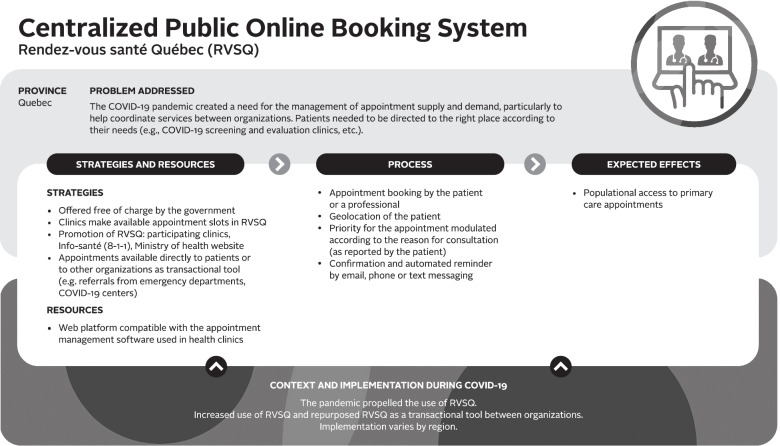
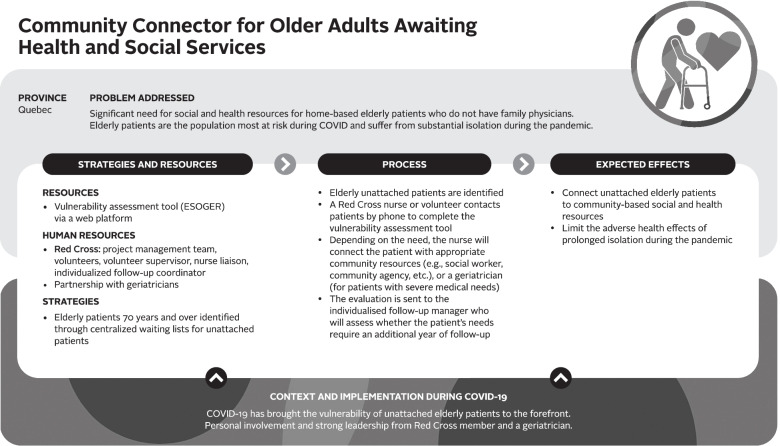
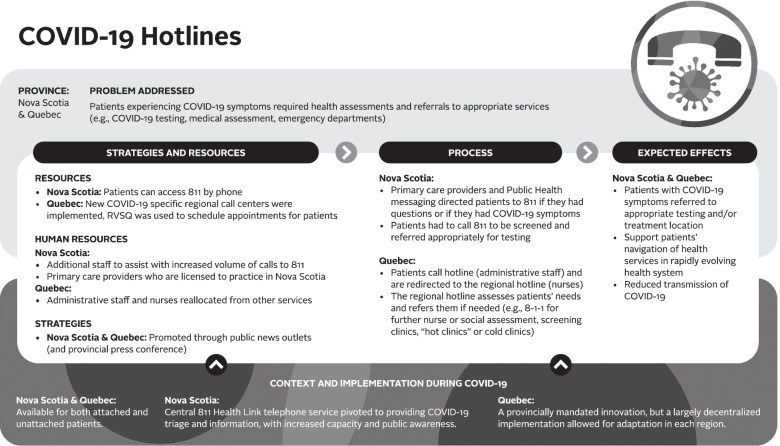
Results: We identified and analyzed six organizational innovations. Four of these - centralized public online booking systems, centralized access centers for unattached patients, interim primary care clinics for unattached patients, and a community connector to health and social services for older adults - pre-dated COVID-19 but were accelerated by the pandemic context. The remaining two innovations were created to specifically address pandemic-related needs: COVID-19 hotlines and COVID-dedicated primary healthcare clinics. Innovation spread and proliferation was influenced by several factors, such as a strengthened sense of community amongst providers, decreased patient demand at the beginning of the first wave, renewed policy and provider interest in population-wide access (versus attachment of patients only), suspended performance targets (e.g., continuity ≥80%) in Quebec, modality of care delivery, modified fee codes, and greater regional flexibility to implement tailored innovations.
Conclusion: COVID-19 accelerated the uptake and creation of organizational innovations to potentially improve access to primary healthcare, removing, at least temporarily, certain longstanding barriers. Many stakeholders believed this reorganization would have positive impacts on access to primary care after the pandemic. Further studies should analyze the effectiveness and sustainability of innovations adapted, developed, and implemented during the COVID-19 pandemic.
Keywords: Access; COVID-19; Healthcare policy; Logic models; Organizational innovation; Primary care; Qualitative case study.
© 2022. The Author(s).
Conflict of interest statement
The authors declare that they have no competing interests.
Figures



References
-
- Canadian Institute for Health Information . How Canada compares: results from the Commonwealth Fund’s 2020 International Health Policy Survey of the General Population in 11 Countries. 2021.
MeSH terms
Grants and funding
LinkOut - more resources
Full Text Sources
Medical
