


Professional identity formation of medical students: A mixed-methods study in a hierarchical and collectivist culture
- PMID: 35676696
- PMCID: PMC9175156
- DOI: 10.1186/s12909-022-03393-9
Professional identity formation of medical students: A mixed-methods study in a hierarchical and collectivist culture
Abstract
Background: Professional identity formation (PIF) has been recognized as an integral part of professional development in medical education. PIF is dynamic: it occurs longitudinally and requires immersion in the socialization process. Consequently, in the medical education context, it is vital to foster a nurturing learning environment that facilitates PIF.
Aim: This study assesses PIF among medical students in various stages of study and explores their perceptions of PIF, with its contributing and inhibiting factors.
Method: This mixed-methods study uses a sequential explanatory approach with undergraduate (years 2, 4, and 6) and postgraduate medical students in Indonesia. We examine the subjects by administering an adapted questionnaire on PIF. We completed a series of FGDs following questionnaire administration. Quantitative and thematic analyses were conducted sequentially.
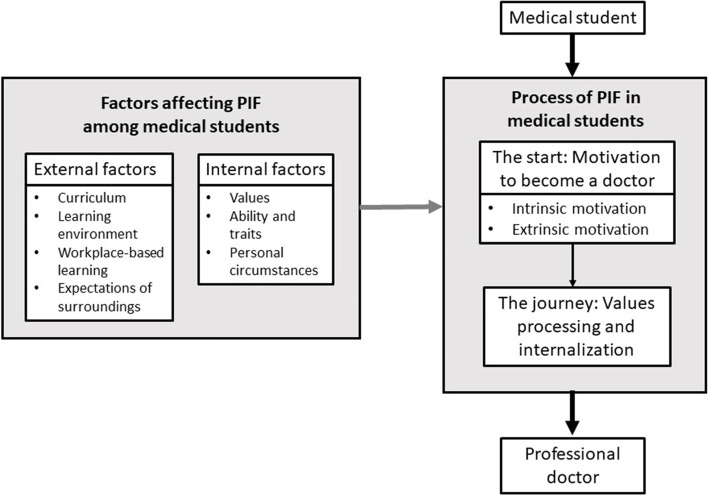
Results & discussion: A total of 433 respondents completed the questionnaire. There were statistically significant differences among subjects on the subscales "Recognition and internalization of professional roles" and "Self-control in professional behavior"; the more senior students had higher scores. We conducted 6 FGDs in total. The results characterize PIF as a complex, dynamic, and longitudinal journey to becoming a medical doctor that is closely related to a student's motivation. The FGDs also highlight the importance of both internal factors (students' values, attributes, and personal circumstances) and external factors (curriculum, the learning environment, workplace-based learning, and external expectations) for PIF in medical education.
Conclusion: Higher-level students show higher scores in some aspects of PIF, which further validates the potential use of the questionnaire to monitor PIF, a dynamic process influenced by internal and external factors. Generating awareness among medical students and encouraging reflection on their PIF stage may be crucial for PIF processes.
Keywords: Medical students; Mixed-methods study; Professional identity formation.
© 2022. The Author(s).
Conflict of interest statement
The authors report no competing interests.
Figures
References
MeSH terms
LinkOut - more resources
Full Text Sources
