


Historical overview and update on relapsing fever group Borrelia in Latin America
- PMID: 35676728
- PMCID: PMC9175325
- DOI: 10.1186/s13071-022-05289-5
Historical overview and update on relapsing fever group Borrelia in Latin America
Abstract
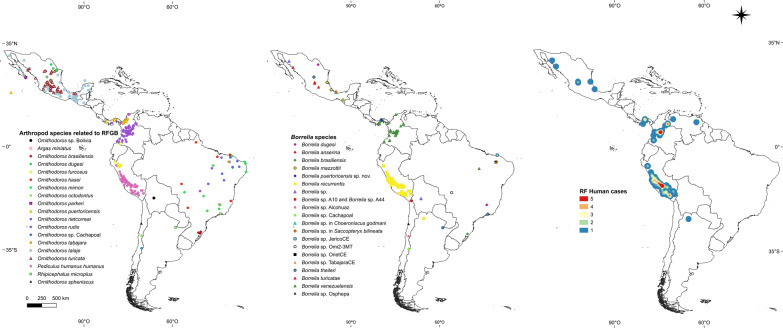
Relapsing fever group Borrelia (RFGB) are motile spirochetes transmitted to mammalian or avian hosts through the bite of hematophagous arthropods, such as soft ticks (Argasidae), hard ticks (Ixodidae) and the human clothing lice. RFGB can infect pets such as dogs and cats, as well as birds, cattle and humans. Borrelia recurrentis, B. anserina and B. theileri are considered to have worldwide distribution, affecting humans, domestic birds and ruminants, respectively. Borrelia spp. associated with soft ticks are transmitted mainly by Ornithodoros ticks and thrive in endemic foci in tropical and subtropical latitudes. Nowadays, human cases of soft tick-borne relapsing fever remain neglected diseases in several countries, and the impact these spirochetes have on the health of wild and domestic animals is largely understudied. Human infection with RFGB is difficult to diagnose, given the lack of distinguishing clinical features (undifferentiated febrile illness). Clinically, soft tick or louse-borne relapsing fever is often confused with other etiologies, such as malaria, typhoid or dengue. In Latin America, during the first half of the twentieth century historical documents elaborated by enlightened physicians were seminal, and resulted in the identification of RFGB and their associated vectors in countries such as Mexico, Panama, Colombia, Venezuela, Peru and Argentina. Almost 80 years later, research on relapsing fever spirochetes is emerging once again in Latin America, with molecular characterizations and isolations of novel RFGB members in Panama, Bolivia, Brazil and Chile. In this review we summarize historical aspects of RFGB in Latin America and provide an update on the current scenario regarding these pathogens in the region. To accomplish this, we conducted an exhaustive search of all the published literature for the region, including old medical theses deposited in libraries of medical academies. RFGB were once common pathogens in Latin America, and although unnoticed for many years, they are currently the focus of interest among the scientific community. A One Health perspective should be adopted to tackle the diseases caused by RFGB, since these spirochetes have never disappeared and the maladies they cause may be confused with etiologies with similar symptoms that prevail in the region.
Keywords: Borrelia; Clothing lice; Latin America; Ornithodoros; Relapsing fever; Soft ticks; Spirochetes; Tick-borne diseases.
© 2022. The Author(s).
Conflict of interest statement
The authors declare that the review was conducted in the absence of any commercial or financial relationships that could be construed as a potential conflict of interest.
Figures
References
-
- Barbour AG, Schwan TG. Borrelia. In: Bergey's manual of systematics of archaea and bacteria. 2018. p. 1–22. 10.1002/9781118960608.fbm00308.
-
- Margos G, Fingerle V, Cutler S, Gofton A, Stevenson B, Estrada-Peña A. Controversies in bacterial taxonomy: the example of the genus Borrelia. Ticks Tick Borne Dis. 2020;11:101335. - PubMed
-
- Barbour AG. Chapter 16. Relapsing fever. In: Goodman JL, editor. Tick-borne diseases of humans. Washington: ASM Press; 2005.
Publication types
MeSH terms
LinkOut - more resources
Full Text Sources
Miscellaneous
