


Mapping the global distribution of Strongyloides stercoralis and hookworms by ecological niche modeling
- PMID: 35676740
- PMCID: PMC9178904
- DOI: 10.1186/s13071-022-05284-w
Mapping the global distribution of Strongyloides stercoralis and hookworms by ecological niche modeling
Abstract
Background: The WHO has established a control strategy for Strongyloides stercoralis in school-aged children as well as targets and to maintain control programs for Ascaris lumbricoides, Trichuris trichiura and hookworms. For an efficient development of control programs, it is necessary to know the target countries around the world, as well as the areas within each country where efforts should be focused. Therefore, maps that provide information on the areas at risk for soil-transmitted helminth (STH) infections on a national and sub-national scale would allow for a better allocation of resources.
Methods: We used the ecological niche models MaxEnt and Kuenm R library to estimate the global distribution of S. stercoralis and hookworms. We used occurrence points of both species extracted from surveys of two literature reviews and from the Global Atlas of Helminth Infection database, together with 14 raster maps of environmental variables.
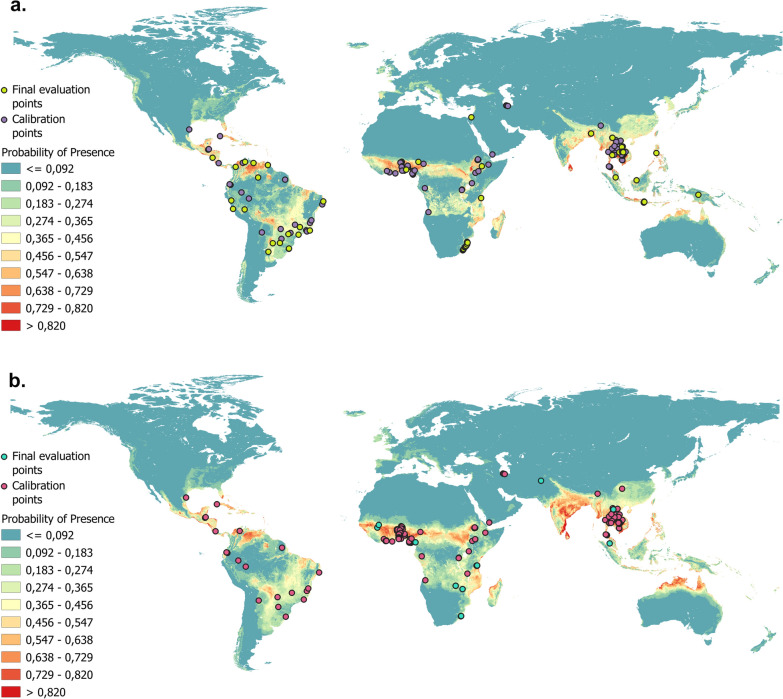
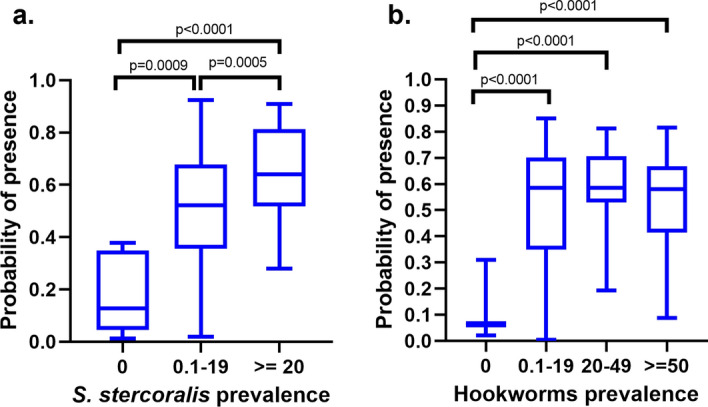
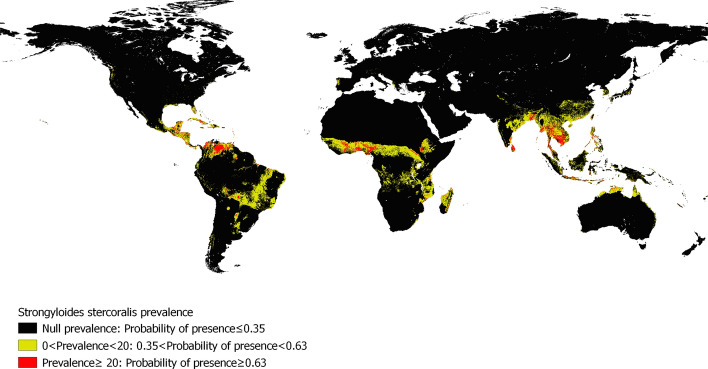
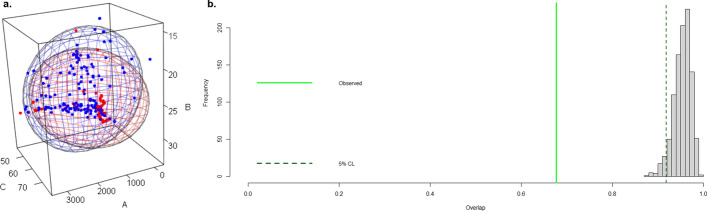
Results: We obtained two raster maps with the presence probability of S. stercoralis and hookworm infections at a global level and then estimated the global population at risk to be 2.6 and 3.4 billion, respectively. The population at risk was also estimated at the country level using estimations for areas as small as 25 km2. A relationship was found between the probability of the presence of S. stercoralis and its prevalence, and a raster map was generated. Annual precipitation, annual temperature, soil carbon content and land cover were the main associated environmental variables. The ecological niches of Strongyloides stercoralis and hookworms had an overlap of 68%.
Conclusions: Here we provide information that can be used for developing more efficient and integrated control strategies for S. stercoralis and hookworm infections. This information can be annexed to the study of other risk factors or even other diseases to assess the health status of a community. GRAPHICAL ABSTARCT.
Keywords: Ecological niche models; Environmental variables; Hookworms; Population at risk; Strongyloides stercoralis.
© 2022. The Author(s).
Conflict of interest statement
The authors declare that they have no competing interests.
Figures
References
-
- World Health Organization. Accelerating work to overcome the global impact of neglected tropical diseases: a roadmap for implementation: executive summary. 2012. https://apps.who.int/iris/handle/10665/70809. Accessed 18 May 2013.
-
- World Health Organization. 2030 Targets for soil-transmitted helminthiases control programmes. 2019. https://apps.who.int/iris/handle/10665/330611. Accessed 21 Jan 2020.
-
- Fleitas PE, Travacio M, Martí-Soler H, Socías ME, Lopez WR, Krolewiecki AJ. The Strongyloides stercoralis-hookworms association as a path to the estimation of the global burden of strongyloidiasis: a systematic review. PLoS Negl Trop Dis. 2020;14:e0008184. doi: 10.1371/journal.pntd.0008184. - DOI - PMC - PubMed
MeSH terms
Substances
LinkOut - more resources
Full Text Sources
