


Is There an Association in Young Patients Between Quadriceps or Hamstring Strength After ACL Reconstruction and Graft Rupture?
- PMID: 35677023
- PMCID: PMC9168858
- DOI: 10.1177/23259671221101003
Is There an Association in Young Patients Between Quadriceps or Hamstring Strength After ACL Reconstruction and Graft Rupture?
Abstract
Background: Younger patients who sustain anterior cruciate ligament (ACL) ruptures are at high risk for reinjury after ACL reconstruction. Restoring muscle strength before return to sports (RTS) is regarded as an important factor in reducing the reinjury risk, and quadriceps and hamstring strength assessment is commonly included in RTS testing. However, it is not clear whether reduced strength is a risk factor for subsequent graft rupture in this patient population.
Purpose: To investigate the association between quadriceps and hamstring strength at 12 months after primary ACL reconstruction and ACL graft rupture in young patients.
Study design: Case-control study; Level of evidence, 3.
Methods: The cohort consisted of 210 patients (100 men and 110 women) who were younger than 20 years at the time of primary ACL reconstruction with a hamstring tendon autograft and who had no previous contralateral ACL injury. Isokinetic strength testing (60 and 180 deg/s) of knee flexors and extensors was performed at 12 months postoperatively, and the limb symmetry index (LSI) for each strength outcome was calculated. RTS rates and the incidence of further ACL graft ruptures were recorded.
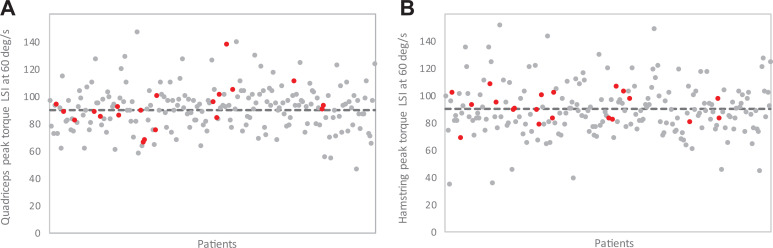
Results: Measures of central tendency (mean and median) of LSI values ranged from 88 to 98. The percentage of patients with LSI ≥90 was 57% to 69% for quadriceps strength and 45% to 47% for hamstring strength. Overall, 19 patients (9%) sustained an ACL graft rupture. No significant differences were found between the patients who sustained an ACL graft rupture and those who did not in terms of quadriceps and hamstring strength at 12 months. No significant associations were found between achieving LSI ≥90 for quadriceps peak torque and subsequent ACL graft rupture.
Conclusion: In young patients who underwent an ACL reconstruction, no association was noted between quadriceps and hamstring strength at 12 months postoperatively and subsequent graft ruptures. The role of strength testing as part of the RTS criteria after ACL reconstruction, and specifically the use of limb symmetry thresholds, warrants further investigation and clarification.
Keywords: anterior cruciate ligament (ACL); contralateral injury; graft rupture; reinjury; return to sport (RTS); strength testing; young patients.
© The Author(s) 2022.
Conflict of interest statement
One or more of the authors has declared the following potential conflict of interest or source of funding: J.A.F. has received consulting fees from Smith & Nephew and is a paid associate editor for Orthopaedic Journal of Sports Medicine. B.M.D. has received speaking fees from Arthrex and Stryker. T.S.W. has received consulting fees from Medacta; speaking fees from Arthrex, Medacta, and Stryker; and royalties from Medacta. AOSSM checks author disclosures against the Open Payments Database (OPD). AOSSM has not conducted an independent investigation on the OPD and disclaims any liability or responsibility relating thereto.
Figures
References
-
- Andernord D, Desai N, Bjornsson H, et al. Patient predictors of early revision surgery after anterior cruciate ligament reconstruction: a cohort study of 16,930 patients with 2-year follow-up. Am J Sports Med. 2015;43(1):121–127. - PubMed
-
- Barber-Westin SD, Noyes FR. Factors used to determine return to unrestricted sports activities after anterior cruciate ligament reconstruction. Arthroscopy. 2011;27(12):1697–1705. - PubMed
-
- Beischer S, Gustavsson L, Senorski EH, et al. Young athletes who return to sport before 9 months after anterior cruciate ligament reconstruction have a rate of new injury 7 times that of those who delay return. J Orthop Sports Phys Ther. 2020;50(2):83–90. - PubMed
LinkOut - more resources
Full Text Sources
