Predialysis Urea Nitrogen Is a Nutritional Marker of Hemodialysis Patients
- PMID: 35677952
- PMCID: PMC9163601
- DOI: 10.4068/cmj.2022.58.2.69
Predialysis Urea Nitrogen Is a Nutritional Marker of Hemodialysis Patients
Abstract
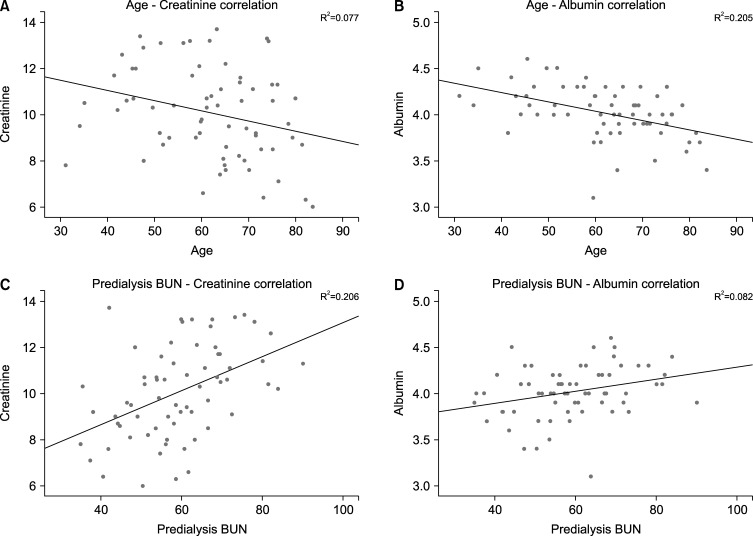
End-stage renal disease (ESRD) patients on hemodialysis have poor nutritional status and associated problems such as inflammation and sarcopenia. Blood urea nitrogen (BUN) is an important measure of uremic toxins, and urea reduction is a marker of hemodialysis efficacy. However, a low protein diet for lower BUN could aggravate malnutrition in patients, and optimal pre-dialysis BUN is not defined. We investigated the association of pre-dialysis BUN with patients' comorbidities and the relationship between pre-dialysis BUN and serum albumin as a nutrient marker. Among the 67 patients, the average pre- and post-dialysis BUN were 59.2 and 15.0 mg/dL, respectively, serum creatinine was 10.1 mg/dL, and the average serum albumin was 4.0 g/dL. Patients' age was negatively correlated with serum creatinine (r=-0.277, p<0.05) and albumin (r=-0.453, p<0.001). Predialysis BUN showed a significant positive correlation with serum albumin (r=0.287, p<0.05) and creatinine (r=0.454, p<0.001). However, the predialysis BUN was not significantly related to diabetes, coronary artery disease, congestive heart failure, or cerebrovascular disease. Hemodialysis patients with high pre-dialysis BUN and high serum creatinine could be regarded as having good nutritional status. The significance of this study lies in the potential utility of pre-dialysis blood urea nitrogen as an indicator of the nutritional status of patients. Liberal protein intake might be recommended to adequately dialyzed patients.
Keywords: Blood Urea Nitrogen; Malnutrition; Renal Dialysis.
© Chonnam Medical Journal, 2022.
Conflict of interest statement
CONFLICT OF INTEREST STATEMENT: None declared.
Figures
References
-
- Avram MM, Blaustein D, Fein PA, Goel N, Chattopadhyay J, Mittman N. Hemoglobin predicts long-term survival in dialysis patients: a 15-year single-center longitudinal study and a correlation trend between prealbumin and hemoglobin. Kidney Int Suppl. 2003;64:S6–S11. - PubMed
-
- Honda H, Qureshi AR, Axelsson J, Heimburger O, Suliman ME, Barany P, et al. Obese sarcopenia in patients with end-stage renal disease is associated with inflammation and increased mortality. Am J Clin Nutr. 2007;86:633–638. - PubMed
-
- Kim JK, Choi SR, Choi MJ, Kim SG, Lee YK, Noh JW, et al. Prevalence of and factors associated with sarcopenia in elderly patients with end-stage renal disease. Clin Nutr. 2014;33:64–68. - PubMed
-
- Ikizler TA, Cano NJ, Franch H, Fouque D, Himmelfarb J, Kalantar-Zadeh K, et al. Prevention and treatment of protein energy wasting in chronic kidney disease patients: a consensus statement by the International Society of Renal Nutrition and Metabolism. Kidney Int. 2013;84:1096–1107. - PubMed
-
- Cianciaruso B, Brunori G, Traverso G, Panarello G, Enia G, Strippoli P, et al. Nutritional status in the elderly patient with uraemia. Nephrol Dial Transplant. 1995;10 Suppl 6:65–68. - PubMed
LinkOut - more resources
Full Text Sources