


Convenient Access to Expert-Reviewed Health Information via an Alexa Voice Assistant Skill for Patients With Multiple Myeloma: Development Study
- PMID: 35679096
- PMCID: PMC9227649
- DOI: 10.2196/35500
Convenient Access to Expert-Reviewed Health Information via an Alexa Voice Assistant Skill for Patients With Multiple Myeloma: Development Study
Abstract
Background: Patients with multiple myeloma (MM) have high information needs due to the complexity of the disease and variety of treatments. Digital voice assistants provide support in daily life and can be a convenient tool that even older patients can use to access health information. Voice assistants may therefore be useful in providing digital health services to meet the information needs of patients with MM.
Objective: We aim to describe and report on the development, content, and functionality of the first Amazon Alexa voice assistant skill for patients with MM in Germany with the goal of empowering and educating patients. Further, we share data on skill usage and first learnings.
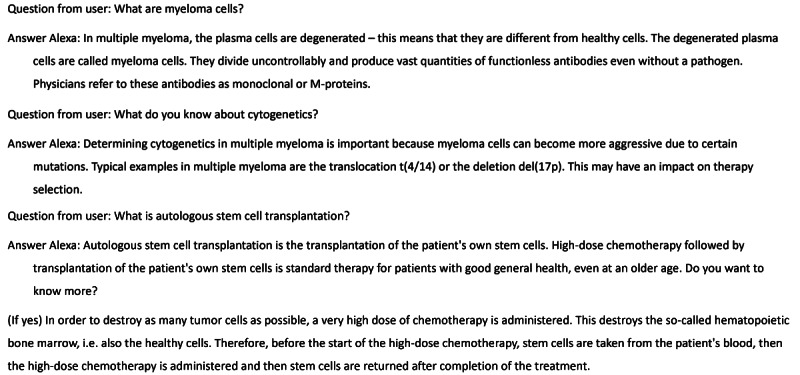
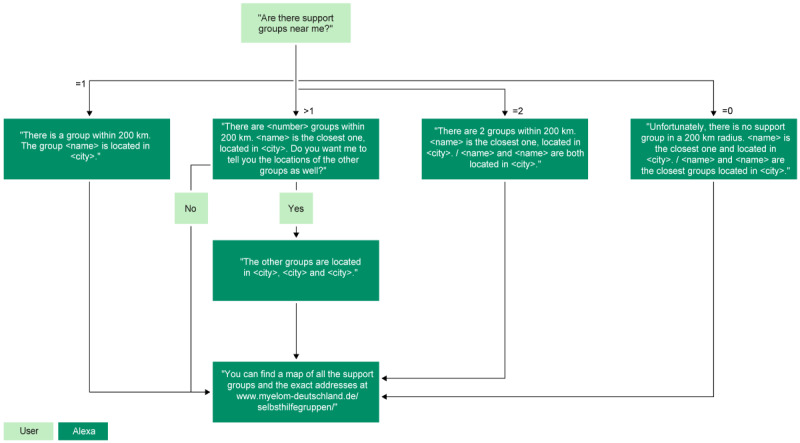
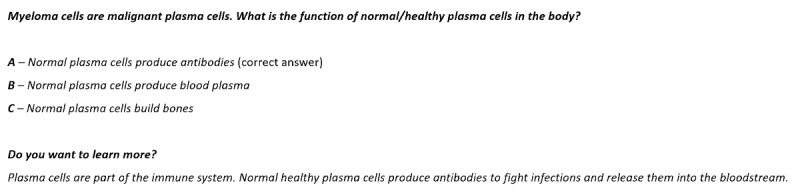
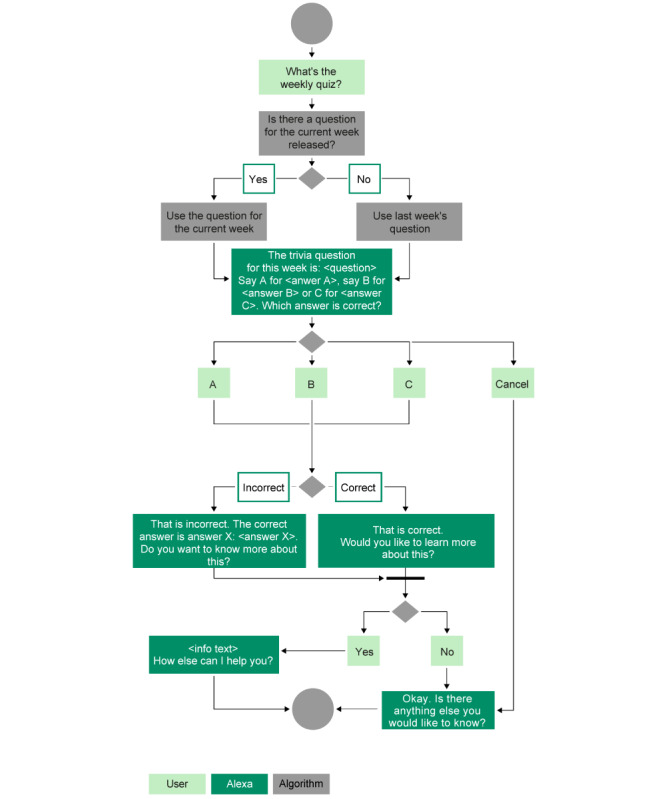
Methods: In a cocreation workshop with MM patient organizations and MM medical experts in Germany, Takeda Oncology discussed the development and content of the Alexa skill Multiple Myeloma. Patient information on MM disease, diagnostics, and therapy was presented in a question-and-answer format, reviewed by experts, and programmed into the skill. Additionally, a search function for finding patient support groups within a perimeter of 200 km around the users and a myeloma quiz functionality with multiple-choice questions were integrated into the skill. Aggregated retrospective data on the total number of skill installations and skill usage were retrieved from an Amazon Alexa developer account, and a web-based patient survey was conducted on the Takeda Oncology website.
Results: The Alexa skill Multiple Myeloma was launched in September 2019. It was available free of charge on the German Amazon Alexa skill store between September 2019 and March 2022 and could be used with devices featuring the Amazon Alexa voice assistant. Since the launch in September 2019 and up to July 2021, a total of 141 users have installed the skill. Between July 2020 and July 2021, a total of 189 skill sessions with 797 utterances were analyzed. The most popular inquiries were searches for patient support groups near the users (58/797, 7.3%), followed by inquiries about information on MM disease (53/797, 6.6%) and the quiz (43/797, 5.4%). The web-based survey on voice assistant usage and the feedback on the Alexa skill Multiple Myeloma were collected from 24 participants and showed that 46% (11/24) of participants would recommend the Alexa skill. Nonusers of voice assistants (11/24, 46%) stated that data protection concerns (7/11, 64%) and a lack of need (6/11, 55%) were the most important factors of not using voice assistants.
Conclusions: The Alexa skill Multiple Myeloma offers patient-friendly and expert-reviewed answers and explanations for medical terms related to MM disease, diagnostics, and therapy, as well as connections to patient support groups and a quiz functionality. In the future, the skill can be extended with new content and functionalities, such as medication adherence support.
Keywords: Alexa; Alexa voice assistant; Europe; German; cancer; digital health; medical education; mobile phone; multiple myeloma; oncology; patient support; patient support group; support group; virtual assistant; voice assistant.
©Marc-Andrea Baertsch, Sarah Decker, Leona Probst, Stefan Joneleit, Hans Salwender, Franziska Frommann, Hartwig Buettner. Originally published in JMIR Cancer (https://cancer.jmir.org), 09.06.2022.
Conflict of interest statement
Conflicts of Interest: SD, LP, SJ, HB are full-time employees of Takeda Pharma Vertrieb GmbH & Co. KG, Berlin, Germany. This publication is not directly related to and does not deal with any marketed product of Takeda or any product of Takeda in development; the work on the manuscript was carried out without any fiscal support from the company. MAB consults for Takeda and Novartis; receives honoraria from Takeda (except for the work on this manuscript); receives research funding from Novartis; and receives travel grants from Celgene, Amgen, and Janssen. HS receives honoraria from Janssen Cilag, Takeda, Amgen, Bristol Myers Squibb (BMS), Celgene, Sanofi, Oncopeptides, Abbvie, Glaxo Smith Kline (GSK), Chugai, and Pfizer. HS also receives travel grants, accommodations, and expenses from Janssen, Takeda, Amgen, BMS, Celgene, Sanofi, and GSK. FF consults for and receives honoraria from AstraZeneca, Roche, Pfizer, Takeda, Medac, Incyte, BMS, GSK, Janssen, Novartis, Amgen, Servier, and Kedrion.
Figures
References
-
- Cancer stat facts: Myeloma. National Cancer Institute Surveillance, Epidemiology, and End Results Program. [2020-09-24]. https://seer.cancer.gov/statfacts/html/mulmy.html .
LinkOut - more resources
Full Text Sources
