


Is Bigger Better?: A Closer Look at Small Health Systems in the United States
- PMID: 35679174
- PMCID: PMC9186448
- DOI: 10.1097/MLR.0000000000001727
Is Bigger Better?: A Closer Look at Small Health Systems in the United States
Abstract
Background: Research on US health systems has focused on large systems with at least 50 physicians. Little is known about small systems.
Objectives: Compare the characteristics, quality, and costs of care between small and large health systems.
Research design: Retrospective, repeated cross-sectional analysis.
Subjects: Between 468 and 479 large health systems, and between 608 and 641 small systems serving fee-for-service Medicare beneficiaries, yearly between 2013 and 2017.
Measures: We compared organizational, provider and beneficiary characteristics of large and small systems, and their geographic distribution, using multiple Medicare and Internal Revenue Service administrative data sources. We used mixed-effects regression models to estimate differences between small and large systems in claims-based Healthcare Effectiveness Data and Information Set (HEDIS) quality measures and HealthPartners' Total Cost of Care measure using a 100% sample of Medicare fee-for-service claims. We fit linear spline models to examine the relationship between the number of a system's affiliated physicians and its quality and costs.
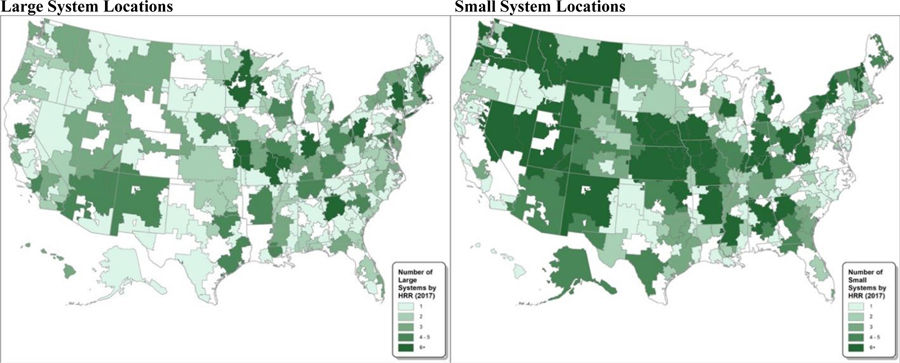
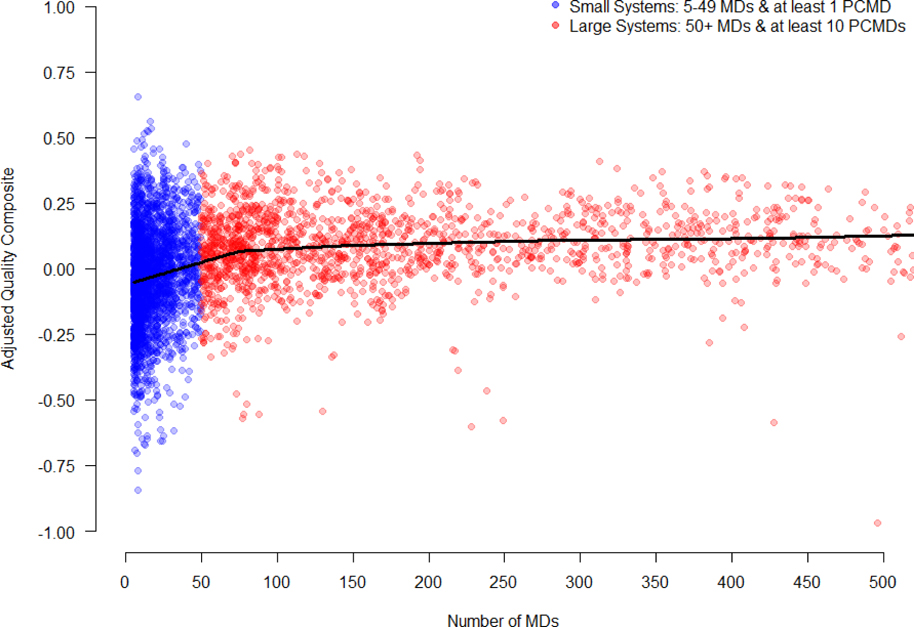
Results: The number of both small and large systems increased from 2013 to 2017. Small systems had a larger share of practice sites (43.1% vs. 11.7% for large systems in 2017) and beneficiaries (51.4% vs. 15.5% for large systems in 2017) in rural areas or small towns. Quality performance was lower among small systems than large systems (-0.52 SDs of a composite quality measure) and increased with system size up to ∼75 physicians. There was no difference in total costs of care.
Conclusions: Small systems are a growing source of care for rural Medicare populations, but their quality performance lags behind large systems. Future studies should examine the mechanisms responsible for quality differences.
Copyright © 2022 Wolters Kluwer Health, Inc. All rights reserved.
Conflict of interest statement
The authors declare no conflict of interest.
Figures
Comment in
-
Socioeconomic Factors, Urological Epidemiology and Practice Patterns.J Urol. 2023 Jan;209(1):286-287. doi: 10.1097/JU.0000000000003020. Epub 2022 Oct 21. J Urol. 2023. PMID: 36268617 No abstract available.
References
-
- Agency for Healthcare Research and Quality . Defining health systems. Agency for Healthcare Research and Quality. Accessed August 20, 2021. https://www.ahrq.gov/chsp/chsp-reports/resources-for-understanding-healt...
-
- Buttorff C, Ridgely MS. What have we learned about health systems? RAND Corporation. Accessed August 20, 2021. https://www.rand.org/health-care/centers/health-system-performance/what-...
-
- LaPointe J How hospital merger and acquisition activity is changing healthcare. Xtelligent Healthcare Media. Accessed August 20, 2021. https://revcycleintelligence.com/features/how-hospital-merger-and-acquis...
-
- Physicians Advocacy Institute. Updated physician practice acquisition study: National and regional changes in physician employment 2012–2018. Physicians Advocacy Institute. Accessed August 20, 2021. http://www.physiciansadvocacyinstitute.org/Portals/0/assets/docs/021919-...
Publication types
MeSH terms
Grants and funding
LinkOut - more resources
Full Text Sources
Medical
