


Humoral response to mRNA vaccines against SARS-CoV-2 in patients with humoral immunodeficiency disease
- PMID: 35679232
- PMCID: PMC9182562
- DOI: 10.1371/journal.pone.0268780
Humoral response to mRNA vaccines against SARS-CoV-2 in patients with humoral immunodeficiency disease
Abstract
Objectives: Although mRNA-based vaccines against SARS-CoV-2 induce a robust immune response and prevent infections and hospitalizations, there are limited data on the antibody response in individuals with humoral immunodeficiency. The aim of this study was to evaluate the humoral immune response after two vaccine doses with BNT162b2 or mRNA-1273 in patients with humoral immunodeficiency disease.
Methods: This cross-sectional study assessed 39 individuals with hypogammaglobulinemia under immunoglobulin replacement therapy. IgG anti-SARS-CoV-2 spike protein antibodies (anti-S) were measured 4 weeks to 4 months after two doses of an mRNA vaccine against SARS-CoV-2. The proportion of patients, who developed a humoral immune response to the spike protein were evaluated and compared to 19 healthy controls.
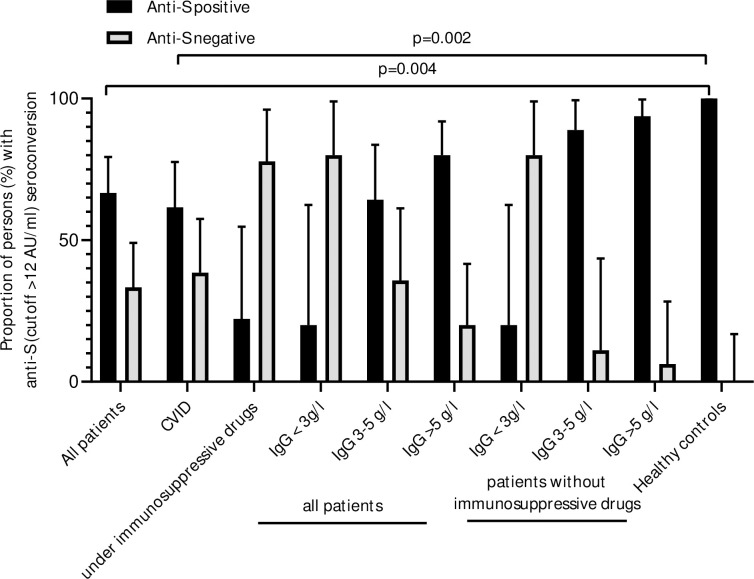
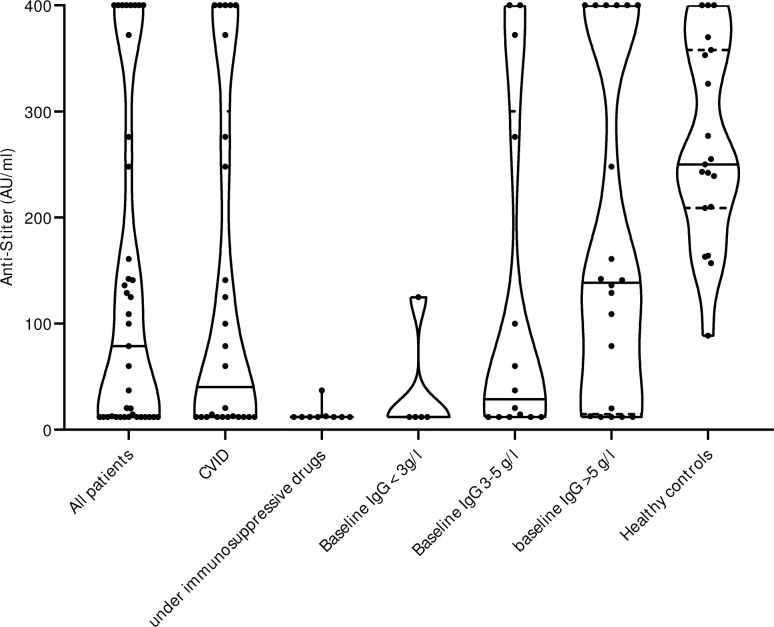
Results: After vaccination with two vaccine doses, 26/39 patients (66.7%) with humoral immunodeficiency disease and all healthy controls developed anti-S. In subjects with baseline IgG <3 g/l, only 1/5 (20%) showed a humoral immune response. 10 out of 26 with CVID (38.5%) and 7/9 under immunosuppressive drugs (77.8%) developed no immune response (13 subjects with no response) compared to 0/19 in healthy controls. Subgroup analysis in patients without immunosuppressive drugs revealed lower anti-S in patients with moderate to severe humoral immunodeficiency disease: baseline IgG <3 g/l: 12.0 AU/ml (95%CI 12.0-125.0), baseline IgG 3-5 g/l: 99.9 AU/ml (95%CI 14.4-400.0), baseline IgG >5 g/l: 151.5 AU/ml (95%CI 109.0-400.0), healthy controls 250.0 AU/ml (95%CI 209.0-358.0), p = 0.007.
Conclusion: In most patients with mild to moderate humoral immunodeficiency we found only slightly lower anti-S antibodies compared with healthy controls after two vaccine doses with BNT162b2 and mRNA-1273. However, in patients with a decreased baseline IgG below 3 g/l and/or under immunosuppressive drugs, we found severely impaired humoral immune responses.
Conflict of interest statement
Andri Rauch received advisory board and travel fees from Pfizer. All other authors have declared that no competing interests exist.
Figures
References
-
- Griffin JB, Haddix M, Danza P, Fisher R, Koo TH, Traub E et al. SARS-CoV-2 Infections and Hospitalizations Among Persons Aged ≥16 Years, by Vaccination Status—Los Angeles County, California, May 1-July 25, 2021. MMWR Morb Mortal Wkly Rep. 2021. Aug 27;70(34):1170–1176. doi: 10.15585/mmwr.mm7034e5 - DOI - PMC - PubMed
Publication types
MeSH terms
Substances
LinkOut - more resources
Full Text Sources
Medical
Miscellaneous
