


"COVID just kind of opened a can of whoop-ass": The rapid growth of safer supply prescribing during the pandemic documented through an environmental scan of addiction and harm reduction services in Canada
- PMID: 35679695
- PMCID: PMC9170132
- DOI: 10.1016/j.drugpo.2022.103742
"COVID just kind of opened a can of whoop-ass": The rapid growth of safer supply prescribing during the pandemic documented through an environmental scan of addiction and harm reduction services in Canada
Abstract
Objectives: In the context of the ongoing overdose crisis, a stark increase in toxic drug deaths from the unregulated street supply accompanied the onset of the COVID-19 pandemic. Injectable opioid agonist treatment (iOAT - hydromorphone or medical-grade heroin), tablet-based iOAT (TiOAT), and safer supply prescribing are emerging interventions used to address this crisis in Canada. Given rapid clinical guidance and policy change to enable their local adoption, our objectives were to describe the state of these interventions before the pandemic, and to document and explain changes in implementation during the early pandemic response (March-May 2020).
Methods: Surveys and interviews with healthcare providers comprised this mixed methods national environmental scan of iOAT, TiOAT, and safer supply across Canada at two time points. Quantitative data were summarized using descriptive statistics; interview data were coded and analyzed thematically.
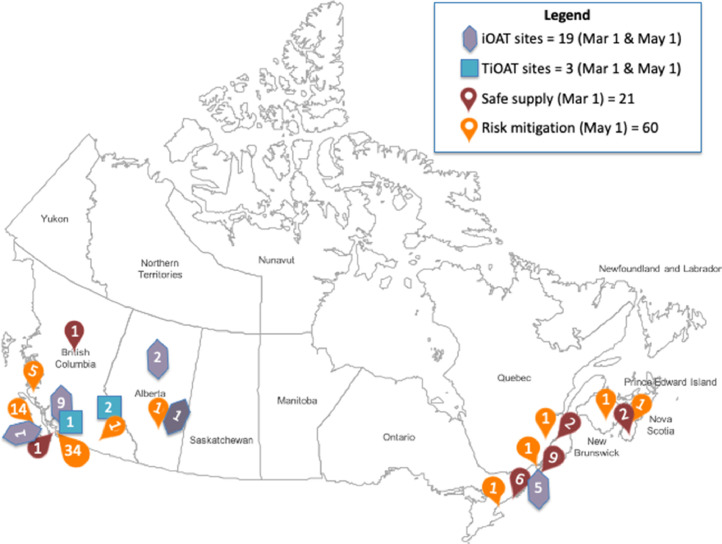
Results: 103 sites in 6 Canadian provinces included 19 iOAT, 3 TiOAT and 21 safer supply sites on March 1, 2020; 60 new safer supply sites by May 1 represented a 285% increase. Most common substances were opioids, available at all sites; most common settings were addiction treatment programs and primary care clinics, and onsite pharmacies models. 79% of safer supply services were unfunded. Diversity in service delivery models demonstrated broad adaptability. Qualitative data reinforced the COVID-19 pandemic as the driving force behind scale-up.
Discussion: Data confirmed the capacity for rapid scale-up of flexible, community-based safer supply prescribing during dual public health emergencies. Geographical, client demographic, and funding gaps highlight the need to target barriers to implementation, service delivery and sustainability.
Keywords: Addiction; COVID-19 pandemic; Canada; Harm reduction; Injectable opioid agonist treatment; Safer supply; Service delivery models; Substance use.
Copyright © 2022. Published by Elsevier B.V.
Conflict of interest statement
Declarations of Interest Dr. Le Foll has obtained funding from Pfizer (GRAND Awards, including salary support) for investigator-initiated projects. Dr. Le Foll has some in-kind donations of cannabis products from Aurora, a medication donation from Pfizer and Bioprojet, was provided a coil for TMS study from Brainsway, and has been a consultant for Shionogi. Dr. Le Foll has obtained industry funding from Canopy (through research grants handled by CAMH or University of Toronto), Bioprojet, ACS and Alkermes, and in-kind donations of nabiximols from GW Pharma for past studies funded by CIHR and the National Institutes of Health (NIH). The other authors have no competing interests to declare.
References
-
- Ahamad K., Bach P., Brar R., Chow N., Coll N., Compton M., Yau S. British Columbia Centre on Substance Use.; 2020. Risk mitigation in the context of dual health emergencies v1.5; p. 25. Retrieved from https://www.bccsu.ca/risk-mitigation-in-the-context-of-dual-public-healt...
-
- Ahmad F.B., Rossen L.M., Sutton P. National Center for Health Statistics.; 2021. Provisional drug overdose death counts. Retrieved October 4, 2021, from website https://www.cdc.gov/nchs/nvss/vsrr/drug-overdose-data.htm.
-
- Bardwell G., Anderson S., Richardson L., Bird L., Lampkin H., Small W., McNeil R. The perspectives of structurally vulnerable people who use drugs on volunteer stipends and work experiences provided through a drug user organization: Opportunities and limitations. International Journal of Drug Policy. 2018;55(1):40–46. - PMC - PubMed
-
- Berglöf E. Vol. 1. Project Syndicate.; 2020. (A pandemic strategy as global as COVID-19). Retrieved from https://www.project-syndicate.org/commentary/covid19-pandemic-g20-cooper....
-
- Bonn M., Palayew A., Bartlett S., Brothers T.D., Touesnard N., Tyndall M. Addressing the syndemic of hiv, hepatitis c, overdose, and covid-19 among people who use drugs: The potential roles for decriminalization and safe supply. Journal of Studies on Alcohol and Drugs. 2020;81(5):556–560. doi: 10.15288/jsad.2020.81.556. - DOI - PubMed
Publication types
MeSH terms
Grants and funding
LinkOut - more resources
Full Text Sources
Medical
Miscellaneous
