


Behavioral and neural responses during fear conditioning and extinction in a large transdiagnostic sample
- PMID: 35679785
- PMCID: PMC9189200
- DOI: 10.1016/j.nicl.2022.103060
Behavioral and neural responses during fear conditioning and extinction in a large transdiagnostic sample
Abstract
Background: Dysregulation of fear learning has been associated with psychiatric disorders that have altered positive and negative valence domain function. While amygdala-insula-prefrontal circuitry is considered important for fear learning, there have been inconsistencies in neural findings in healthy and clinical human samples. This study aimed to delineate the neural substrates and behavioral responses during fear learning in a large, transdiagnostic sample with predominantly depressive and/or anxious dysfunction.
Methods: Two-hundred and eighty-two individuals (52 healthy participants; 230 participants with depression and/or anxiety-related problems) from the Tulsa 1000 study, an ongoing, naturalistic longitudinal study based on a dimensional psychopathological framework, completed a Pavlovian fear learning task during functional magnetic resonance imaging. Linear mixed-effects analyses examined condition-by-time effects on brain activation (CS+, CS- across familiarization, conditioning, and extinction trials). A data-driven latent profile analysis (LPA) examined distinct patterns of behavioral and neural responses to threat across fear conditioning and extinction, while logistic regression analyses evaluated cognitive-affective predictors of latent profiles.
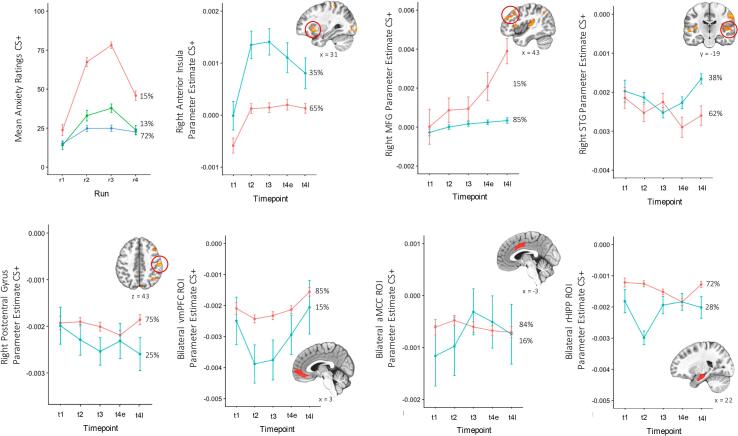
Results: Whole-brain analyses revealed a condition-by-time interaction in the anterior insula, postcentral gyrus, superior temporal gyrus, middle frontal gyrus, and cerebellum but not amygdala. The LPA identified distinct latent profiles across subjective and neural levels of measurement. Anterior insula profiles were characterized by marginal differences in age and state anxiety.
Conclusions: Our findings demonstrate that human fear learning recruits a distributed network of regions involved in interoceptive, cognitive, motivational, and psychomotor processes. Data-driven analyses identified distinct profiles of subjective and neural responses during fear learning that transcended clinical diagnoses, but no robust relationships to demographic or cognitive-affective variable were identified.
Trial registration: ClinicalTrials.gov NCT02450240.
Copyright © 2022 The Author(s). Published by Elsevier Inc. All rights reserved.
Conflict of interest statement
The authors declare that they have no known competing financial interests or personal relationships that could have appeared to influence the work reported in this paper.
Figures


References
-
- Acheson D.T., Eyler L.T., Resovsky J., Tsan E., Risbrough V.B. Fear extinction memory performance in a sample of stable, euthymic patients with bipolar disorder. J. Affect. Disord. 2015;185:230–238. - PubMed
-
- Ball T.M., Knapp S.E., Paulus M.P., Stein M.B. Brain activation during fear extinction predicts exposure success. Depression Anxiety. 2017;34(3):257–266. - PubMed
Publication types
MeSH terms
Associated data
Grants and funding
LinkOut - more resources
Full Text Sources
Medical
Miscellaneous
