


Distinct functional roles for the M4 α-helix from each homologous subunit in the heteropentameric ligand-gated ion channel nAChR
- PMID: 35679899
- PMCID: PMC9260303
- DOI: 10.1016/j.jbc.2022.102104
Distinct functional roles for the M4 α-helix from each homologous subunit in the heteropentameric ligand-gated ion channel nAChR
Abstract
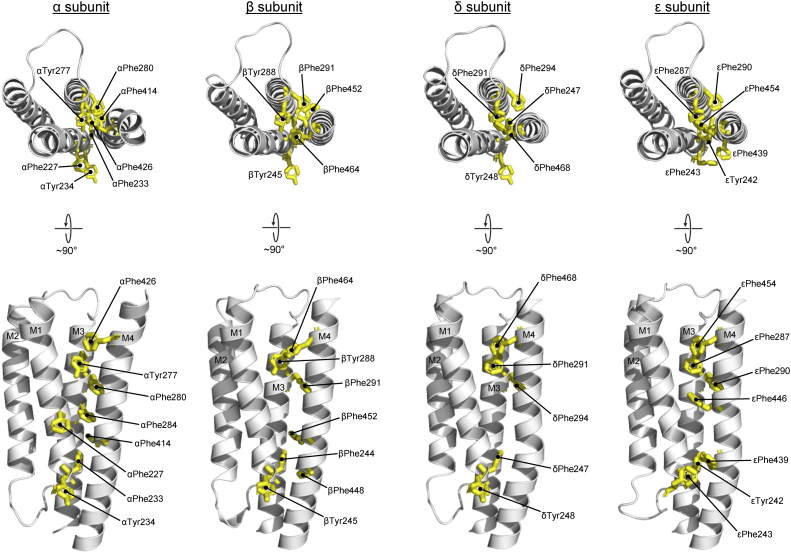
The outermost lipid-exposed α-helix (M4) in each of the homologous α, β, δ, and γ/ε subunits of the muscle nicotinic acetylcholine receptor (nAChR) has previously been proposed to act as a lipid sensor. However, the mechanism by which this sensor would function is not clear. To explore how the M4 α-helix from each subunit in human adult muscle nAChR influences function, and thus explore its putative role in lipid sensing, we functionally characterized alanine mutations at every residue in αM4, βM4, δM4, and εM4, along with both alanine and deletion mutations in the post-M4 region of each subunit. Although no critical interactions involving residues on M4 or in post-M4 were identified, we found that numerous mutations at the M4-M1/M3 interface altered the agonist-induced response. In addition, homologous mutations in M4 in different subunits were found to have different effects on channel function. The functional effects of multiple mutations either along M4 in one subunit or at homologous positions of M4 in different subunits were also found to be additive. Finally, when characterized in both Xenopus oocytes and human embryonic kidney 293T cells, select αM4 mutations displayed cell-specific phenotypes, possibly because of the different membrane lipid environments. Collectively, our data suggest different functional roles for the M4 α-helix in each heteromeric nAChR subunit and predict that lipid sensing involving M4 occurs primarily through the cumulative interactions at the M4-M1/M3 interface, as opposed to the alteration of specific interactions that are critical to channel function.
Keywords: M4; channel gating; lipid sensing; lipid–protein interactions; nAChR; pentameric ligand-gated ion channels.
Copyright © 2022 The Authors. Published by Elsevier Inc. All rights reserved.
Conflict of interest statement
Conflict of interest The authors declare that they have no conflicts of interest with the contents of this article.
Figures


References
-
- Baenziger J.E., Hénault C.M., Therien J.P.D., Sun J. Nicotinic acetylcholine receptor–lipid interactions: mechanistic insight and biological function. Biochim. Biophys. Acta. 2015;1848:1806–1817. - PubMed
-
- Barrantes F.J. Phylogenetic conservation of protein–lipid motifs in pentameric ligand-gated ion channels. Biochim. Biophys. Acta. 2015;1848:1796–1805. - PubMed
-
- Thompson M.J., Baenziger J.E. Structural basis for the modulation of pentameric ligand-gated ion channel function by lipids. Biochim. Biophys. Acta Biomembr. 2020;1862 - PubMed
Publication types
MeSH terms
Substances
LinkOut - more resources
Full Text Sources
