. 2022 Jun 9;20(1):137.
doi: 10.1186/s12915-022-01334-y.

A unique self-truncation of bacterial GH5 endoglucanases leads to enhanced activity and thermostability

Affiliations

A unique self-truncation of bacterial GH5 endoglucanases leads to enhanced activity and thermostability

Mei-Huey Wu et al. BMC Biol. .

Abstract

Background: β-1,4-endoglucanase (EG) is one of the three types of cellulases used in cellulose saccharification during lignocellulosic biofuel/biomaterial production. GsCelA is an EG secreted by the thermophilic bacterium Geobacillus sp. 70PC53 isolated from rice straw compost in southern Taiwan. This enzyme belongs to glycoside hydrolase family 5 (GH5) with a TIM-barrel structure common among all members of this family. GsCelA exhibits excellent lignocellulolytic activity and thermostability. In the course of investigating the regulation of this enzyme, it was fortuitously discovered that GsCelA undergoes a novel self-truncation/activation process that appears to be common among GH5 enzymes.

Results: Three diverse Gram-positive bacterial GH5 EGs, but not a GH12 EG, undergo an unexpected self-truncation process by removing a part of their C-terminal region. This unique process has been studied in detail with GsCelA. The purified recombinant GsCelA was capable of removing a 53-amino-acid peptide from the C-terminus. Natural or engineered GsCelA truncated variants, with up to 60-amino-acid deletion from the C-terminus, exhibited higher specific activity and thermostability than the full-length enzyme. Interestingly, the C-terminal part that is removed in this self-truncation process is capable of binding to cellulosic substrates of EGs. The protein truncation, which is pH and temperature dependent, occurred between amino acids 315 and 316, but removal of these two amino acids did not stop the process. Furthermore, mutations of E142A and E231A, which are essential for EG activity, did not affect the protein self-truncation process. Conversely, two single amino acid substitution mutations affected the self-truncation activity without much impact on EG activities. In Geobacillus sp. 70PC53, the full-length GsCelA was first synthesized in the cell but progressively transformed into the truncated form and eventually secreted. The GsCelA self-truncation was not affected by standard protease inhibitors, but could be suppressed by EDTA and EGTA and enhanced by certain divalent ions, such as Ca2+, Mg2+, and Cu2+.

Conclusions: This study reveals novel insights into the strategy of Gram-positive bacteria for directing their GH5 EGs to the substrate, and then releasing the catalytic part for enhanced activity via a spontaneous self-truncation process.

Keywords: Endoglucanase; GH family 5; Geobacillus; Self-truncation.


Conflict of interest statement

The authors declare that they have no competing interests.

Figures
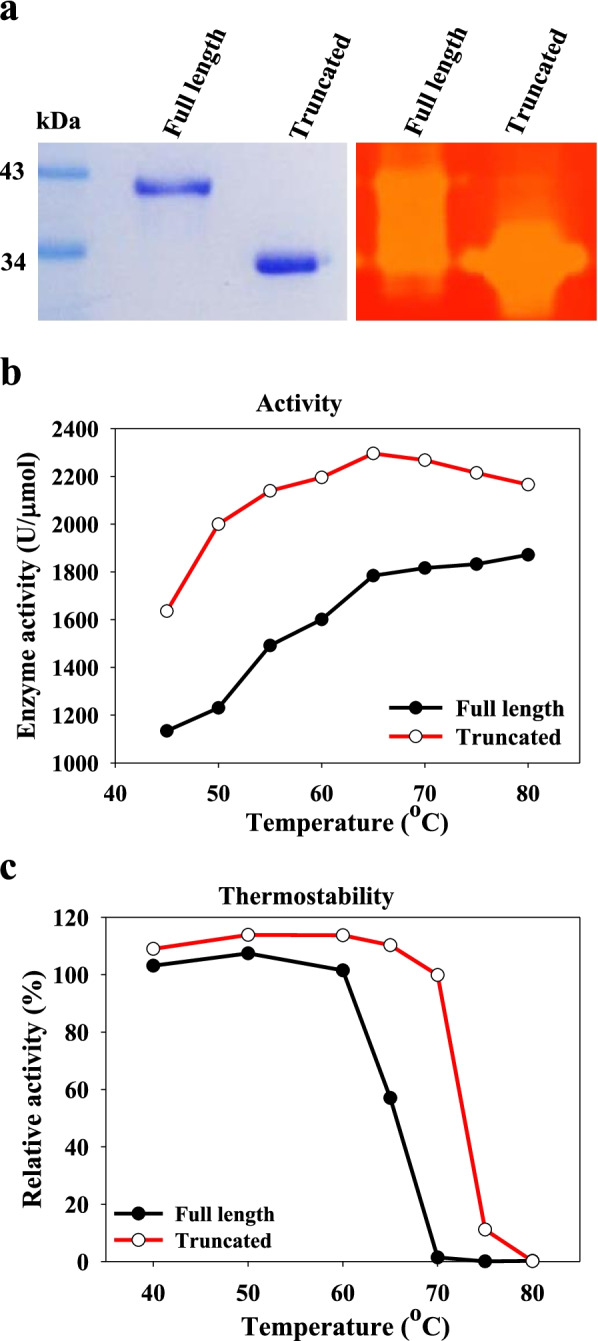
Fig. 1
Fig. 1
GsCelA becomes more active after spontaneous truncation. a Purified GsCelA becomes truncated form after a long-term storage in 50 mM sodium phosphate, pH 7 at 4 °C (in left). CMC zymography of truncated and full-length GsCelA (in right). b Test tube assays of enzyme activity using CMC as substrate at different temperatures in 50 mM sodium acetate, pH 5 at 65 °C. c Thermostability assays with full-length and truncated forms GsCelA pre-incubated 6 h at different temperatures (45 to 80 °C. One enzyme unit (U) is defined as 1 μmol reducing sugar, i.e., glucose equivalent, produced per minute
Fig. 2
Fig. 2
GH5 endoglucanase secreted from Gram-positive bacteria show similar self-truncation process. GH5 endoglucanases Geobacillus sp. 70PC53 GsCelA, Streptococcus sp. SgEGV and Bacillus subtilis strain 168 BsCel5A and Micromonospora (or Thermobispora) GH12 endoglucanase RSC EG1 were incubated in 50 mM sodium acetate, pH 5 at 4 °C for 120 h to assay their self-truncation ability. Four micrograms of purified enzymes were applied to each lane of the gel
Fig. 3
Fig. 3
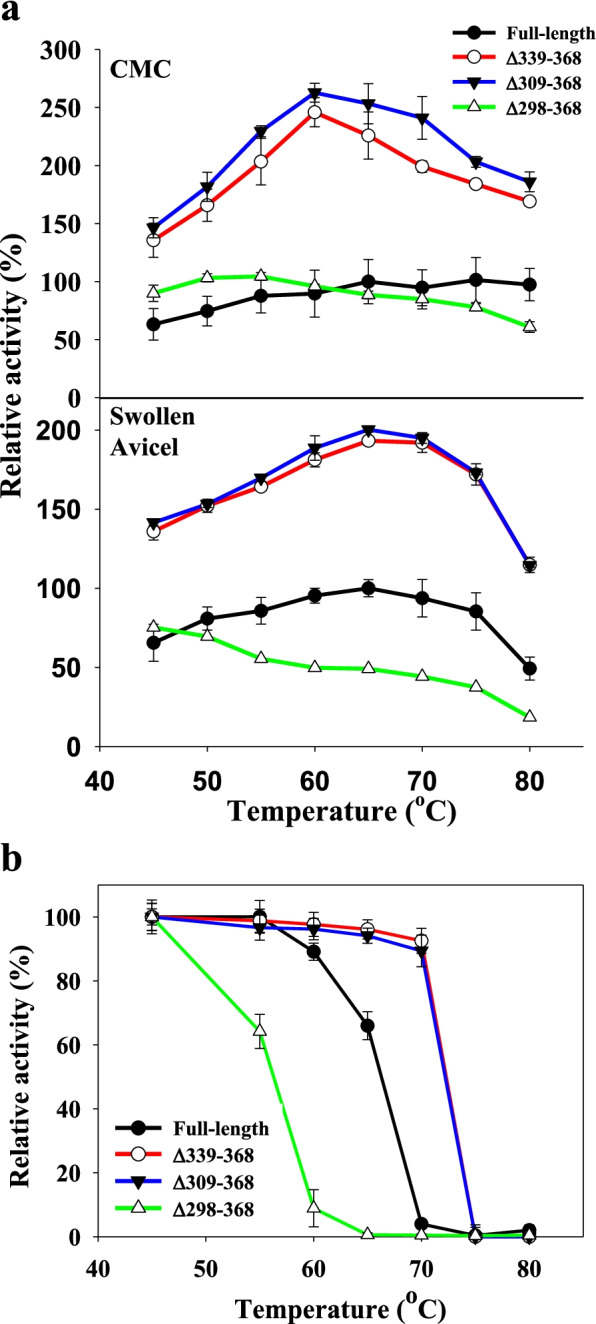
Engineered truncation of up to 60 amino acid residues from C-terminus improved GsCelA activity and thermostability. a Enzyme activities at different temperatures with CMC or swollen Avicel used as substrate in 50 mM sodium acetate, pH 5. b Thermostability assays with samples pre-incubated at different temperatures. Data are mean ± SD. One enzyme unit (U) is defined as 1 μmole reducing sugar, i.e., equivalent to glucose, produced per minute. All experiments were performed in triplicate
Fig. 4
Fig. 4
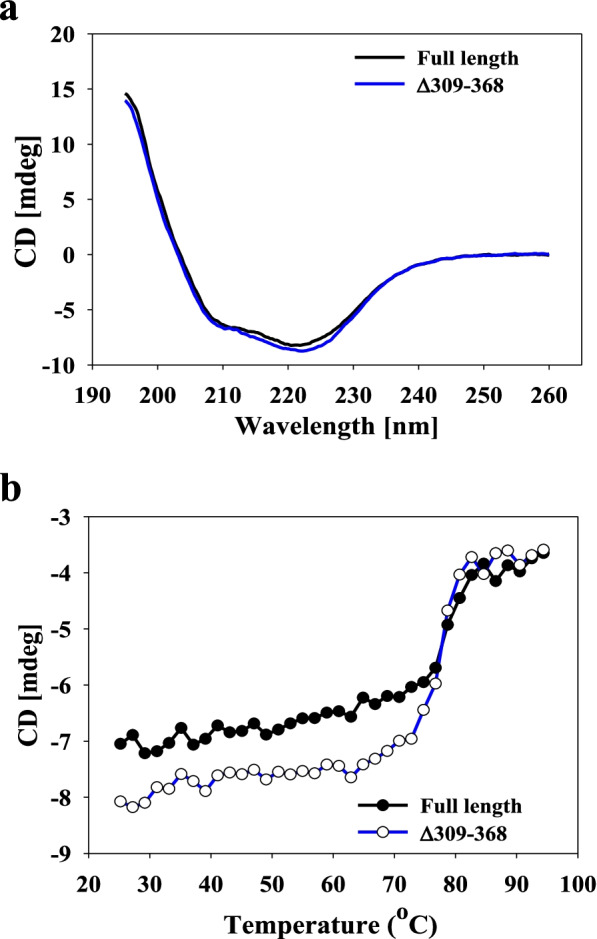
Comparison of circular dichroism (CD) profiles between FL-GsCelA and the C-terminal ∆309-368 mutant. CD analysis of a secondary structure and b melting temperature
Fig. 5
Fig. 5
GsCelA self-truncation still takes place with different C-terminal mutants. a The truncation process was assayed with GsCelA mutants carrying partial deletion at C-terminus after incubation at 25 °C for 120 h. b Δ339-368 mutant with 30 amino acids near the C-terminus removed was still capable of truncation. c Single mutation of K315A, the truncation site, did not affect the truncation process after incubation at 25 °C for 120 h. Labels of “+” and “−” indicate samples with or without self-truncation, respectively. Full-length and truncated GsCelA, which correspond to samples before and after incubation, were used as positive and negative controls, respectively. Marker and protein profiles in b and c were cut from the same SDS-PAGE gel
Fig. 6
Fig. 6
GsCelA self-truncation process is not dependent on endoglucanase activity. Self-truncation assays were carried with wild-type and mutants GsCelA at 25 a for 120 h. Enzyme activity was measured by CMC assay in 50 mM sodium acetate, pH 5 at 65 °C
Fig. 7
Fig. 7
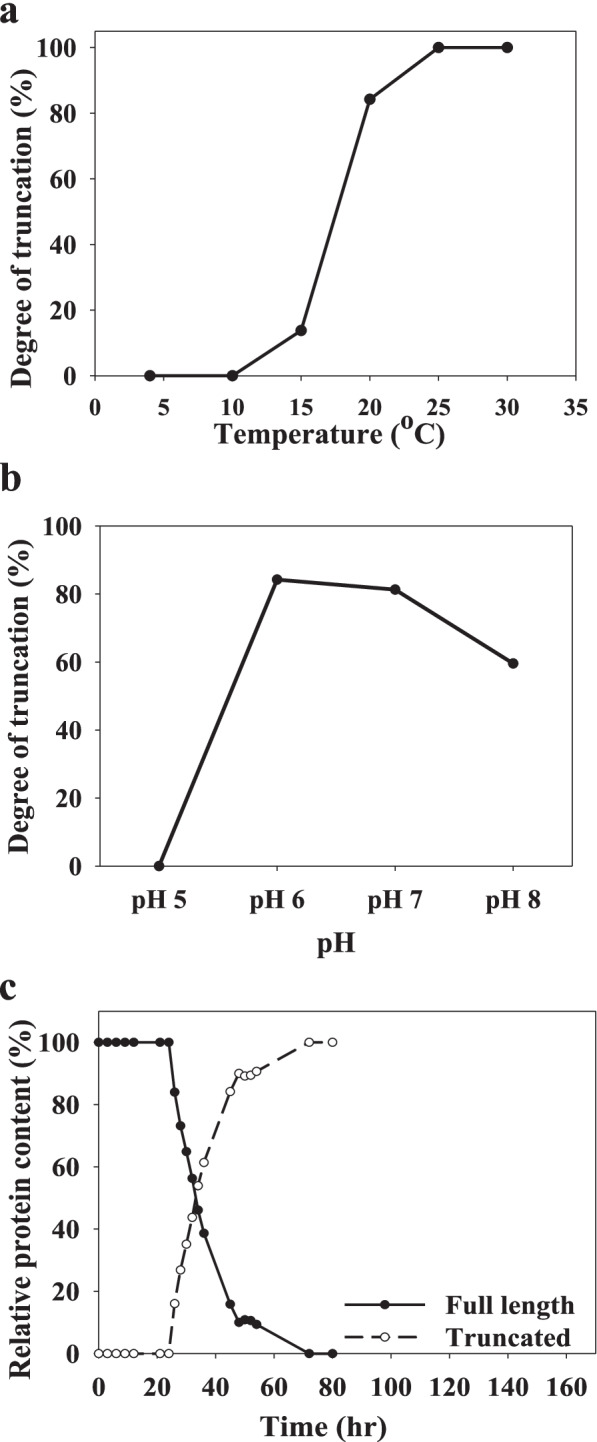
GsCelA self-truncation is temperature- and pH-dependent. a GsCelA self-truncation at different temperatures and b at different pH for 48 h incubation. c Time course of self-truncation process at 25 °C and pH 7. Error bars represented standard deviation values
Fig. 8
Fig. 8
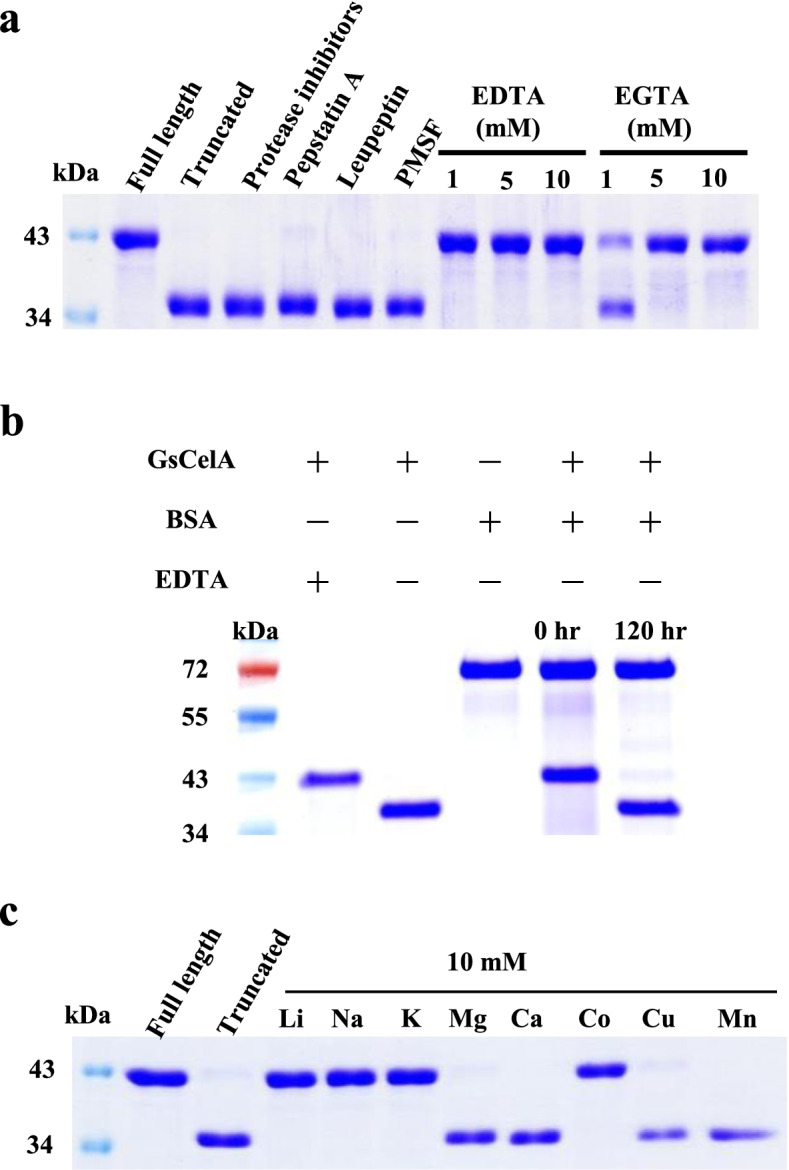
GsCelA truncation process is inhibited by metal chelators but can be recovered with divalent metal ions. a FL-GsCelA was incubated in the presence of different protease inhibitors, EDTA and EGTA, at 25 °C for 120 h. EDTA-pretreated GsCelA (i.e., full length) was a negative control. b Purified GsCelA does not have general protease activity. GsCelA was co-incubated with BSA at 25 °C for 120 h. Note that BSA did not get degraded yet GsCelA showed self-truncation. Lane 1: protein marker; lane 2: GsCelA pretreated with 10 mM EDTA; lane 3: self-truncated GsCelA; lane 4: BSA only; lane 5 and 6: BSA co-incubated with GsCelA for 0 and 120 h. c Effect of presence of divalent ions (i.e., Mg2+, Ca2+, Cu2+, Mn2+, or Co2+) and monovalent ions (i.e., Li+, Na+ or K+) on recovering GsCelA’s truncation ability. Different metal ions were added to EDTA-pretreated GsCelA to a final concentration of 10 mM, and the incubation was performed at 25 a for 120 h
Fig. 9
Fig. 9
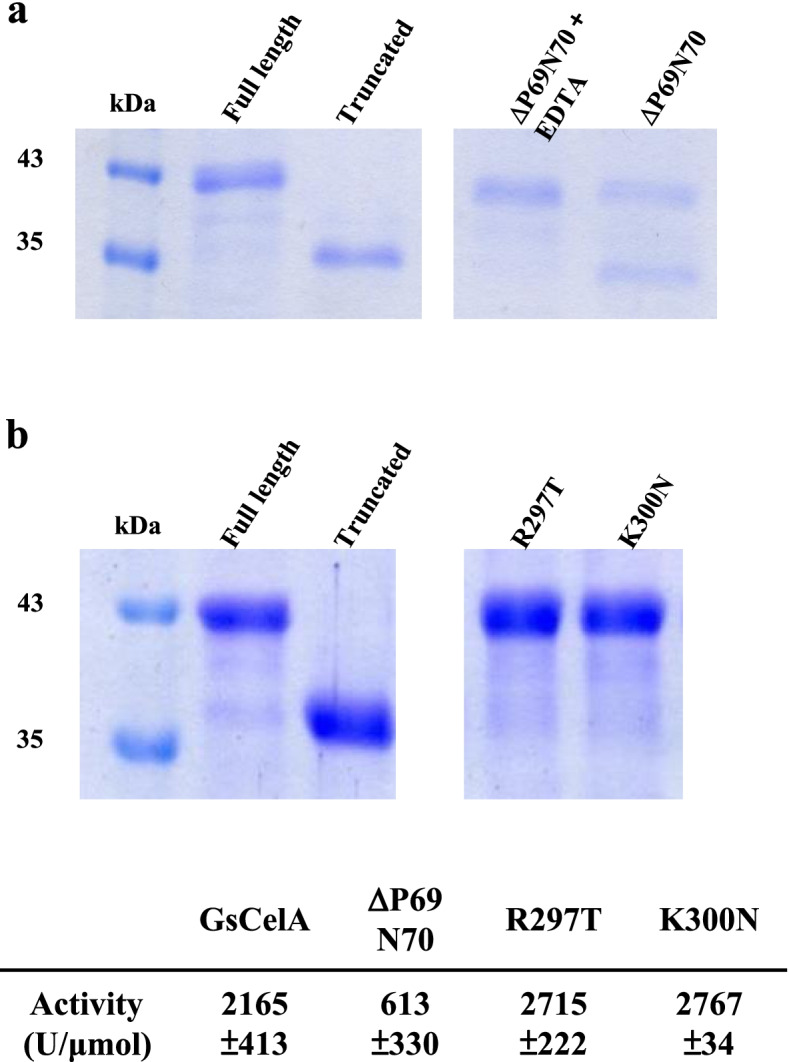
The GsCelA self-truncation process is affected negatively in ΔP69T70, R297T, and K300N mutants. a The truncation process was slowed down in the GsCelA mutant with deletion of amino acids P69 and N70 (ΔP69N70). b Single-amino-acid substitution R297T or K300N abolishes the self-truncation process. Full-length and truncated GsCelA were used as positive control. The marker lane and protein profiles were cut from the same SDS-PAGE gel
Fig. 10
Fig. 10
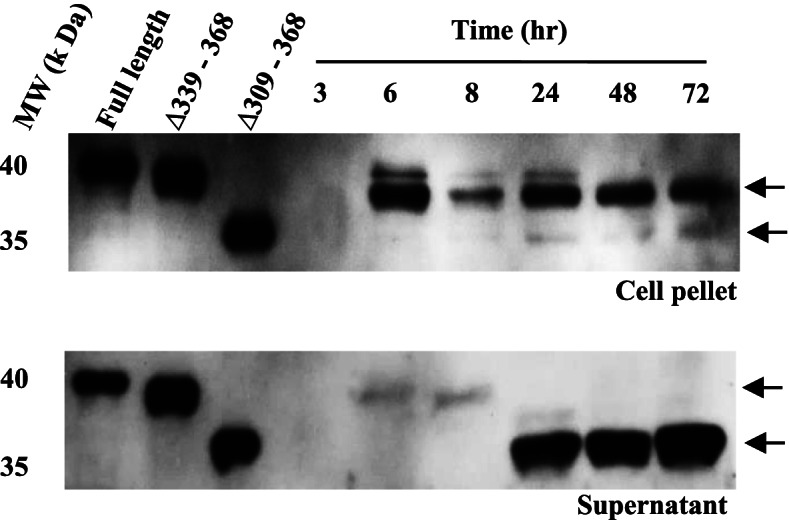
Geobacillus sp. 70PC53 secretes native GsCelA in truncated form into culture medium. Identification of native GsCelA using Western blotting with specific antibody against GsCelA. Samples were collected from bacteria pellet and culture medium fractions of Geobacillus sp. 70PC53. Recombinant wild-type and mutant enzymes (∆339–368 and ∆309–368) were applied as indicators for full-length and truncated GsCelA, respectively
Fig. 11
Fig. 11
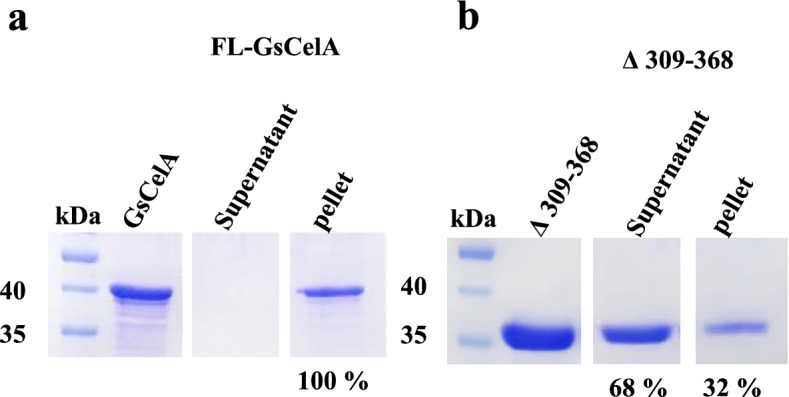
FL-GsCelA is capable of binding to swollen Avicel. a FL-GsCelA and b ∆309–368 were tested for their ability to bind the swollen Avicel (i.e., amorphous cellulose). Lane 1: purified GsCelA used in this binding assay; lane 2: supernatant collected after test; lane 3: pellet collected at the end of the test. Protein profiles of FL-GsCelA or ∆309–368 in this figure were cut from the same SDS-PAGE gel. The relative amounts of protein bands, i.e., percentage numbers underneath the gel lanes, were estimated from stained gel by using the image processing program ImageJ

References

    1. Lynd LR, Weimer PJ, van Zyl WH, Pretorius IS. Microbial cellulose utilization: fundamentals and biotechnology. Microbiol Mol Biol R. 2002;66(4):739. doi: 10.1128/MMBR.66.4.739.2002. - DOI - PMC - PubMed
    1. Steen EJ, Kang YS, Bokinsky G, Hu ZH, Schirmer A, McClure A, del Cardayre SB, Keasling JD. Microbial production of fatty-acid-derived fuels and chemicals from plant biomass. Nature. 2010;463(7280):559–U182. doi: 10.1038/nature08721. - DOI - PubMed
    1. Masran R, Zanirun Z, Bahrin EK, Ibrahim MF, Lai Yee P, Abd-Aziz S. Harnessing the potential of ligninolytic enzymes for lignocellulosic biomass pretreatment. Appl Microbiol Biot. 2016;100(12):5231–5246. doi: 10.1007/s00253-016-7545-1. - DOI - PubMed
    1. Balan V. Current challenges in commercially producing biofuels from lignocellulosic biomass. ISRN Biotechnology. 2014;2014:31. doi: 10.1155/2014/463074. - DOI - PMC - PubMed
    1. Aspeborg H, Coutinho PM, Wang Y, Brumer H, Henrissat B. Evolution, substrate specificity and subfamily classification of glycoside hydrolase family 5 (GH5) Bmc Evol Biol. 2012;12:186. doi: 10.1186/1471-2148-12-186. - DOI - PMC - PubMed

Publication types

LinkOut - more resources