Review
. 2022 May 25;14(11):2603.
doi: 10.3390/cancers14112603.

Tumor Necrosis Factor Receptor 2 (TNFR2): An Emerging Target in Cancer Therapy

Affiliations
Review

Tumor Necrosis Factor Receptor 2 (TNFR2): An Emerging Target in Cancer Therapy

Juliane Medler et al. Cancers (Basel). .

Abstract

Despite the great success of TNF blockers in the treatment of autoimmune diseases and the identification of TNF as a factor that influences the development of tumors in many ways, the role of TNFR2 in tumor biology and its potential suitability as a therapeutic target in cancer therapy have long been underestimated. This has been fundamentally changed with the identification of TNFR2 as a regulatory T-cell (Treg)-stimulating factor and the general clinical breakthrough of immunotherapeutic approaches. However, considering TNFR2 as a sole immunosuppressive factor in the tumor microenvironment does not go far enough. TNFR2 can also co-stimulate CD8+ T-cells, sensitize some immune and tumor cells to the cytotoxic effects of TNFR1 and/or acts as an oncogene. In view of the wide range of cancer-associated TNFR2 activities, it is not surprising that both antagonists and agonists of TNFR2 are considered for tumor therapy and have indeed shown overwhelming anti-tumor activity in preclinical studies. Based on a brief summary of TNFR2 signaling and the immunoregulatory functions of TNFR2, we discuss here the main preclinical findings and insights gained with TNFR2 agonists and antagonists. In particular, we address the question of which TNFR2-associated molecular and cellular mechanisms underlie the observed anti-tumoral activities of TNFR2 agonists and antagonists.

Keywords: NFkappaB; TNF receptor 2 (TNFR2); TNF receptor associated factor 1 and 2 (TRAF1, TRAF2); regulatory T-cell (Treg); tumor necrosis factor (TNF).


Conflict of interest statement

The University of Würzburg has submitted a patent application covering novel TNFR2 agonists with H.W. and J.M. as coinventors and receives funding from Dulayx NV for the development of TNFR2 agonists.

Figures
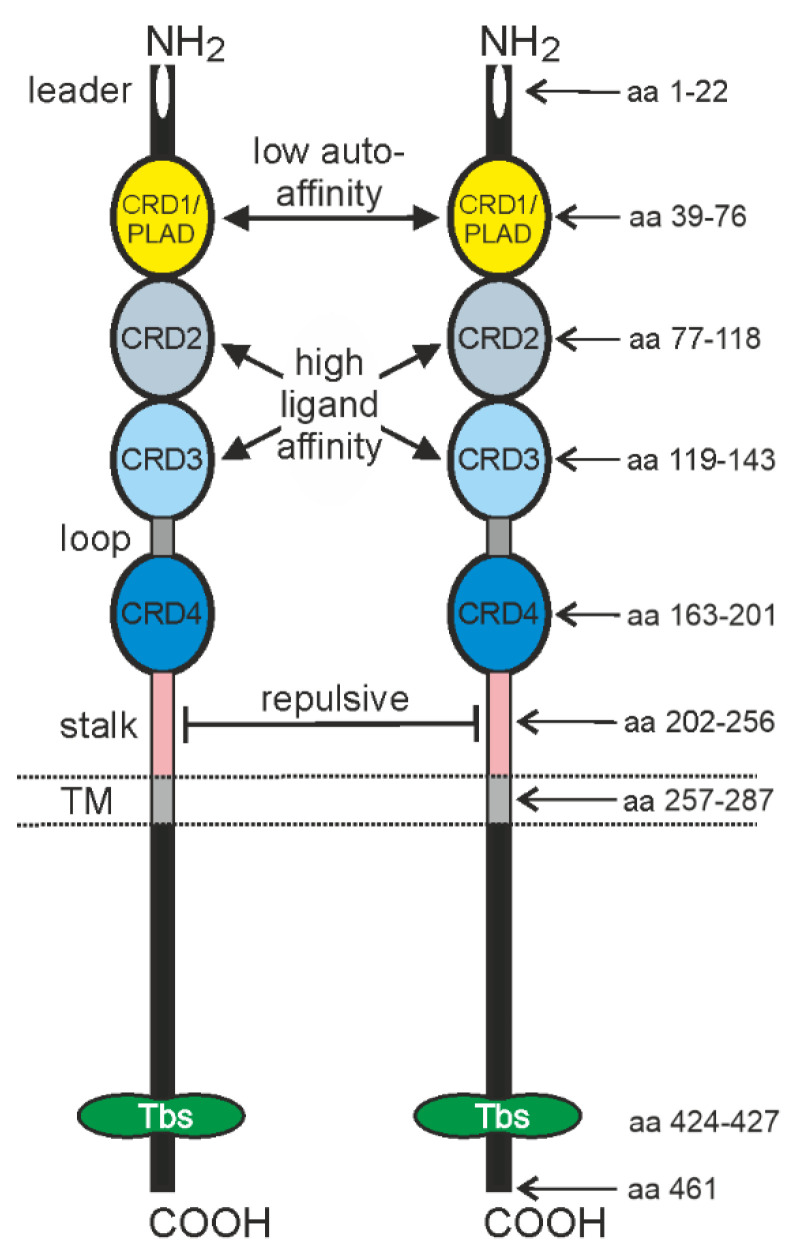
Figure 1
Figure 1
Domain architecture of TNFR2. CRD1–CRD4 of TNFR2 define the affiliation to the TNFRSF. Structurally poorly defined parts of CRD1, designated as pre-ligand binding assembly domain (PLAD), mediate low-affinity TNFR2 self-assembly in the absence of TNF. CRD2 and CRD3 mediate high-affinity binding of TNF while the function of CRD4 is largely unclear. The stalk region has repulsive features and antagonize PLAD action. TRAF2 binding site (Tbs) indicates a short amino acid motif interacting with the C-TRAF domain of a TRAF2 protomer.
Figure 2
Figure 2
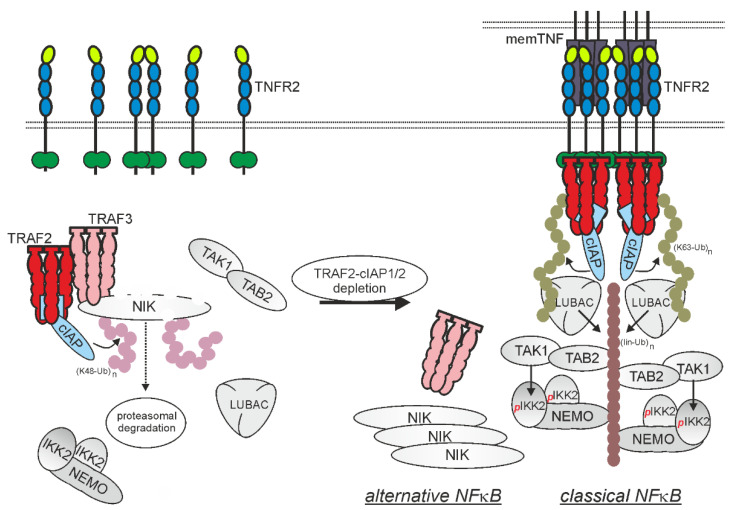
Membrane TNF-induced NFκB signaling. In the absence of memTNF, TRAF3-cIAP1/2-NIK complexes interact with TRAF2-cIAP1/2 complexes in the cytoplasm resulting in cIAP1/2-mediated K48 ubiquitination of NIK and proteasomal degradation of NIK (left panel). In memTNF-stimulated cells trimeric memTNF-TNFR2 complexes recruit TRAF2-cIAP1/2 complex and thus reduces their availability for triggering NIK degradation. As a consequence, NIK accumulates and drive alternative NFκB signaling. The trimeric memTNF-TNFR2 complexes aggregates secondarily to clusters enabling proximity of two or more TRAF2-cIAP1/2 complexes. cIAP transactivation then leads to K63-ubiquitination of TRAF2 generating docking sites for classical NFκB signaling-stimulating kinases.
Figure 3
Figure 3
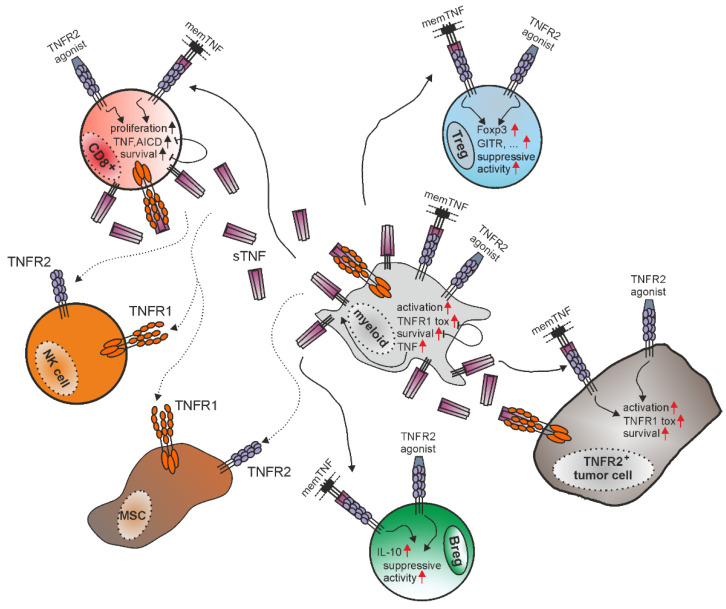
The biology of TNFR2, e.g., in the tumor microenvironment, is determined by the mutual influence of various TNF and TNF receptor expressing cell-types and a complex intracellular signaling network of the two TNF receptors. TNFR2 is expressed by various immune cells with partly opposing functions, e.g., immune suppressive Tregs but also CD8+ T-cells and various types of myeloid cells. Due to its ability to modulate the quality of TNFR1 signaling (inflammation versus cell death), TNFR2 furthermore elicits, in a context-dependent manner, quite contrasting effects on the same type of immune cell (survival versus death, e.g., in CD8+ T-cells and macrophages). In fact, for Tregs, macrophages and CD8+ T-cells, comprehensive literature is available describing partly counteracting activities of TNFR2 at the cellular level. This also applies for other cell types in which TNFR2 activities are less well investigated, such as, for example, NK cells and mesenchymal stem cells (MSCs) or even TNFR2-expressing tumor cells. For further details, see main text.

References

    1. Bodmer J.L., Schneider P., Tschopp J. The molecular architecture of the TNF superfamily. Trends Biochem. Sci. 2002;27:19–26. doi: 10.1016/S0968-0004(01)01995-8. - DOI - PubMed
    1. Locksley R.M., Killeen N., Lenardo M.J. The TNF and TNF receptor superfamilies: Integrating mammalian biology. Cell. 2001;104:487–501. doi: 10.1016/S0092-8674(01)00237-9. - DOI - PubMed
    1. Medler J., Wajant H. Tumor necrosis factor receptor-2 (TNFR2): An overview of an emerging drug target. Expert Opin. Ther. Targets. 2019;23:295–307. doi: 10.1080/14728222.2019.1586886. - DOI - PubMed
    1. Mukai Y., Nakamura T., Yoshikawa M., Yoshioka Y., Tsunoda S., Nakagawa S., Yamagata Y., Tsutsumi Y. Solution of the structure of the TNF-TNFR2 complex. Sci. Signal. 2010;3:ra83. doi: 10.1126/scisignal.2000954. - DOI - PubMed
    1. Richter C., Messerschmidt S., Holeiter G., Tepperink J., Osswald S., Zappe A., Branschädel M., Boschert V., Mann D.A., Scheurich P., et al. The tumor necrosis factor receptor stalk regions define responsiveness to soluble versus membrane-bound ligand. Mol. Cell. Biol. 2012;32:2515–2529. doi: 10.1128/MCB.06458-11. - DOI - PMC - PubMed