Review
. 2022 May 25;14(11):2608.
doi: 10.3390/cancers14112608.

Repurposing Vitamin C for Cancer Treatment: Focus on Targeting the Tumor Microenvironment

Affiliations
Review

Repurposing Vitamin C for Cancer Treatment: Focus on Targeting the Tumor Microenvironment

Wen-Ning Li et al. Cancers (Basel). .

Abstract

Based on the enhanced knowledge on the tumor microenvironment (TME), a more comprehensive treatment landscape for targeting the TME has emerged. This microenvironment provides multiple therapeutic targets due to its diverse characteristics, leading to numerous TME-targeted strategies. With multifaced activities targeting tumors and the TME, vitamin C is renown as a promising candidate for combination therapy. In this review, we present new advances in how vitamin C reshapes the TME in the immune, hypoxic, metabolic, acidic, neurological, mechanical, and microbial dimensions. These findings will open new possibilities for multiple therapeutic avenues in the fight against cancer. We also review the available preclinical and clinical evidence of vitamin C combined with established therapies, highlighting vitamin C as an adjuvant that can be exploited for novel therapeutics. Finally, we discuss unresolved questions and directions that merit further investigation.

Keywords: anti-immunity; dietary intervention; drug repurposing; tumor microenvironment; vitamin C.


Conflict of interest statement

The authors declare that they have no competing interest.

Figures
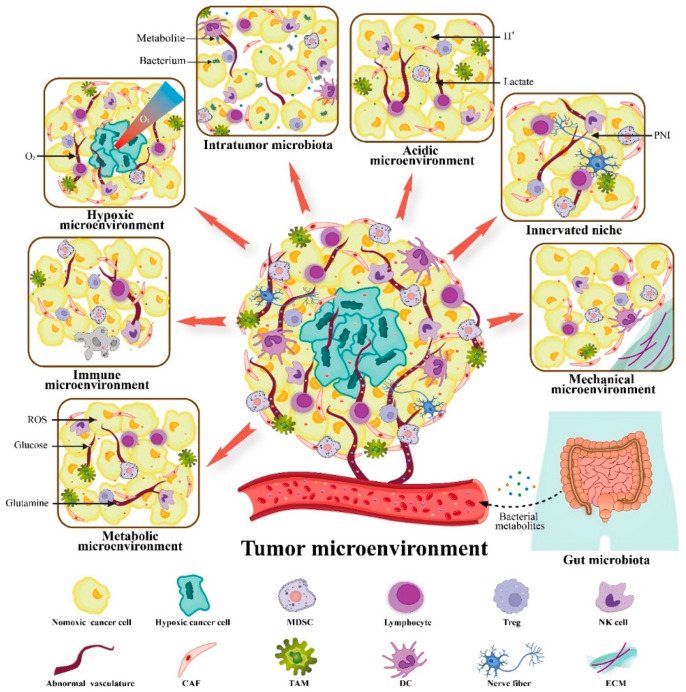
Figure 1
Figure 1
Sources of tumor microenvironment (TME). The TME has been divided into seven specialized microenvironments to investigate the tumor–stroma interactions: metabolic microenvironment, immune microenvironment, hypoxic microenvironment, acidic microenvironment, innervated niche, mechanical microenvironment, and microbial microenvironment (containing gut and intra-tumor microbiota). These specialized microenvironments engage in crosstalk to work together on the tumor and the entire organism. Adapted from reference [2]. MDSC, myeloid-derived suppressor cell; CAF, cancer-associated fibroblast; TAM, tumor-associated macrophage; DC, dendritic cell; ECM, extracellular matrix; PNI, perineural invasion.
Figure 2
Figure 2
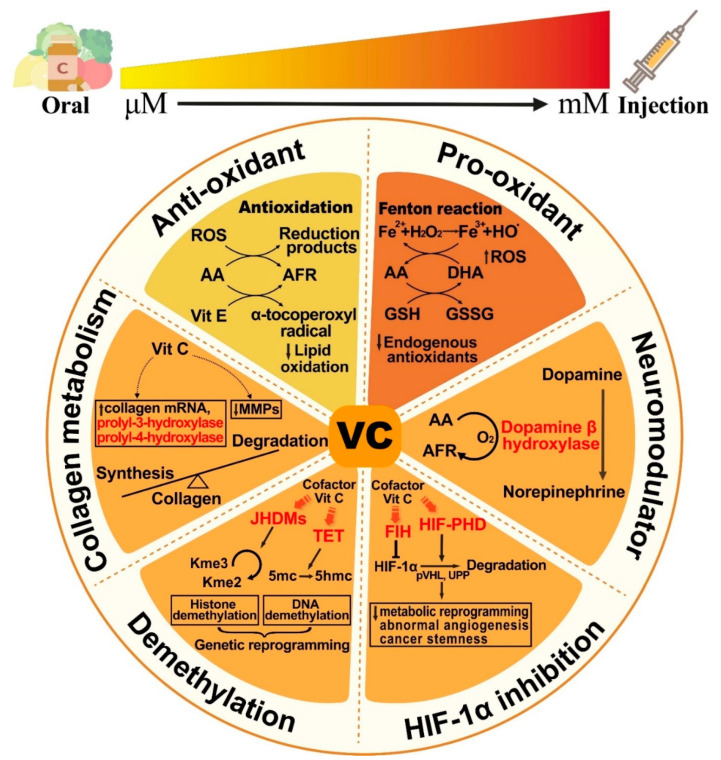
Vitamin C is a multifunctional natural nutrient that exhibits dose-dependent effects. Vitamin C (VitC) at the physiological dose (μM) is known to exhibit antioxidant properties. However, it functions as a prooxidant at the pharmacological dose (mM) achieved by intravenous administration. VitC also enhances a range of intracellular enzymatic reactions by serving as a cofactor of monooxygenases (e.g., dopamine β hydroxylase) and Fe (II)- and 2-oxoglutarate (2-OG)-dependent dioxygenases (e.g., HIF, TET, JHDMs, P-3-H, and P-4-H). Possible anticancer mechanisms include triggering oxidative damage, regulating epigenetics, blunting adaptive responses to hypoxia, and synthesizing collagen and neurotransmitters. AFR, ascorbate free radical; DHA, dehydroascorbic acid; MMPs, matrix metalloproteinases; GSH, glutathione; GSSG, glutathione disulfide; P-3-H, prolyl-4-hydroxylases; P-4-H, prolyl-4-hydroxylases; JHDMs, Jumonji-C domain-containing histone demethylases; TET, ten-eleven translocation; Kme3, trimethyl lysine; Kme2, dimethyl lysine; 5mc, 5-methylcytosine; 5hmc, 5-hydroxymethylcytosine; FIH, factor inhibiting HIF; HIF-PHD, HIF-prolyl hydroxylase; pVHL, VHL tumor suppressor protein; UPP, ubiquitin–proteasome pathway.
Figure 3
Figure 3
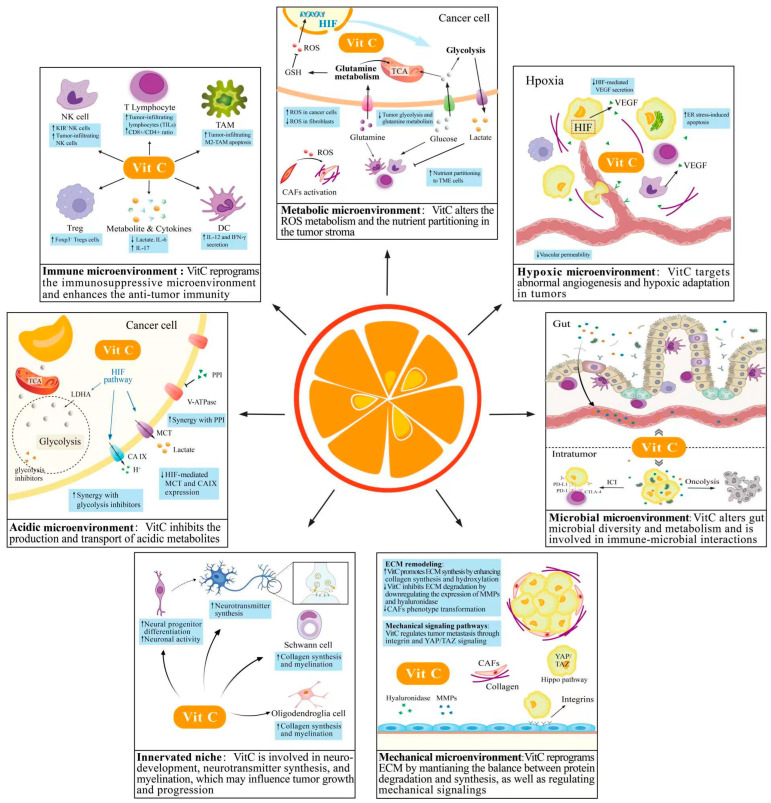
Underlying mechanisms of Vitamin C targeting the specialized tumor microenvironments. The interplay between tumor cells and the TME promotes an aggressive phenotype in various ways, including immune tolerance, metabolic reprogramming, angiogenesis, and tumor innervation. Vitamin C (VitC) with multi-targeted effects may reverse the tumor-promoting microenvironments, displaying a wide range of anticancer activities.

References

    1. Whiteside T.L. The tumor microenvironment and its role in promoting tumor growth. Oncogene. 2008;27:5904–5912. doi: 10.1038/onc.2008.271. - DOI - PMC - PubMed
    1. Jin M.-Z., Jin W.-L. The updated landscape of tumor microenvironment and drug repurposing. Signal Transduct. Target. Ther. 2020;5:166. doi: 10.1038/s41392-020-00280-x. - DOI - PMC - PubMed
    1. Hanahan D. Hallmarks of Cancer: New Dimensions. Cancer Discov. 2022;12:31–46. doi: 10.1158/2159-8290.CD-21-1059. - DOI - PubMed
    1. Cameron E., Pauling L. Supplemental ascorbate in the supportive treatment of cancer: Prolongation of survival times in terminal human cancer. Proc. Natl. Acad. Sci. USA. 1976;73:3685–3689. doi: 10.1073/pnas.73.10.3685. - DOI - PMC - PubMed
    1. Creagan E.T., Moertel C.G., O’Fallon J.R., Schutt A.J., O’Connell M.J., Rubin J., Frytak S. Failure of High-Dose Vitamin C (Ascorbic Acid) Therapy to Benefit Patients with Advanced Cancer: A controlled trial. N. Engl. J. Med. 1979;301:687–690. doi: 10.1056/NEJM197909273011303. - DOI - PubMed

LinkOut - more resources