


Early Steps of Resistance to Targeted Therapies in Non-Small-Cell Lung Cancer
- PMID: 35681591
- PMCID: PMC9179469
- DOI: 10.3390/cancers14112613
Early Steps of Resistance to Targeted Therapies in Non-Small-Cell Lung Cancer
Abstract
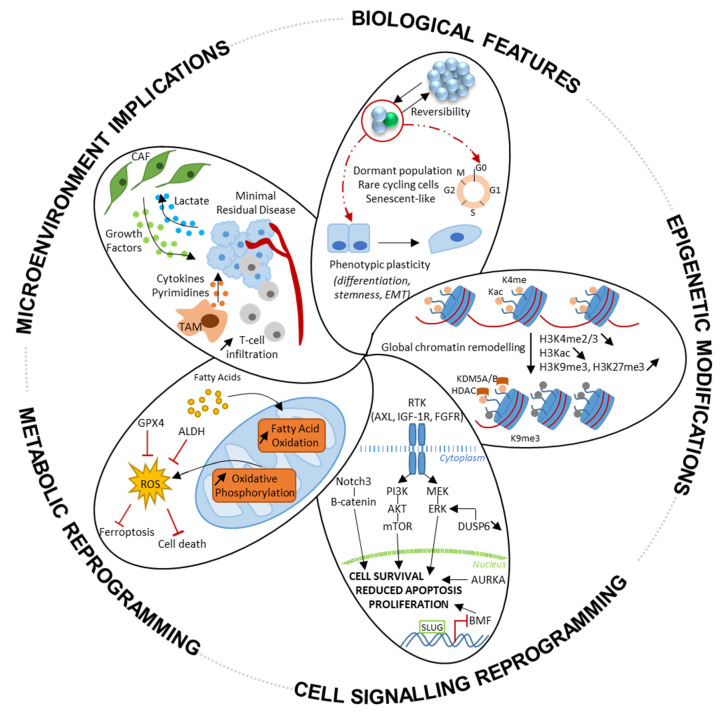
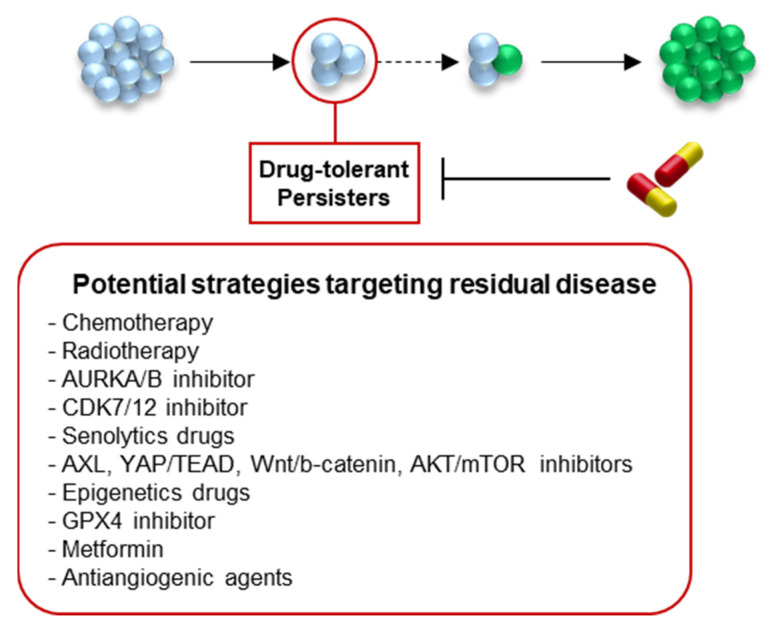
Lung cancer is the leading cause of cancer-related deaths among men and women worldwide. Epidermal growth factor receptor-tyrosine kinase inhibitors (EGFR-TKIs) are effective therapies for advanced non-small-cell lung cancer (NSCLC) patients harbouring EGFR-activating mutations, but are not curative due to the inevitable emergence of resistances. Recent in vitro studies suggest that resistance to EGFR-TKI may arise from a small population of drug-tolerant persister cells (DTP) through non-genetic reprogramming, by entering a reversible slow-to-non-proliferative state, before developing genetically derived resistances. Deciphering the molecular mechanisms governing the dynamics of the drug-tolerant state is therefore a priority to provide sustainable therapeutic solutions for patients. An increasing number of molecular mechanisms underlying DTP survival are being described, such as chromatin and epigenetic remodelling, the reactivation of anti-apoptotic/survival pathways, metabolic reprogramming, and interactions with their micro-environment. Here, we review and discuss the existing proposed mechanisms involved in the DTP state. We describe their biological features, molecular mechanisms of tolerance, and the therapeutic strategies that are tested to target the DTP.
Keywords: EGFR-TKI; drug-tolerant persisters; lung cancer; targeted therapies.
Conflict of interest statement
Julien Mazieres reports personal fees from Astra Zeneca, BMS, MSD, Novartis, Amgen, and grants from Roche, Astra Zeneca, Pierre Fabre, BMS. The other authors declare no conflict of interest.
Figures
References
-
- Allemani C., Matsuda T., Di Carlo V., Harewood R., Matz M., Nikšić M., Bonaventure A., Valkov M., Johnson C.J., Estève J., et al. Global surveillance of trends in cancer survival 2000–14 (CONCORD-3): Analysis of individual records for 37 513 025 patients diagnosed with one of 18 cancers from 322 population-based registries in 71 countries. Lancet. 2018;391:1023–1075. doi: 10.1016/S0140-6736(17)33326-3. - DOI - PMC - PubMed
-
- Barlesi F., Mazieres J., Merlio J.-P., Debieuvre D., Mosser J., Lena H., Ouafik L.H., Besse B., Rouquette I., Westeel V., et al. Routine molecular profiling of patients with advanced non-small-cell lung cancer: Results of a 1-year nationwide programme of the French Cooperative Thoracic Intergroup (IFCT) Lancet. 2016;387:1415–1426. doi: 10.1016/S0140-6736(16)00004-0. - DOI - PubMed
-
- Jordan E.J., Kim H.R., Arcila M.E., Barron D., Chakravarty D., Gao J., Chang M.T., Ni A., Kundra R., Jonsson P., et al. Prospective Comprehensive Molecular Characterization of Lung Adenocarcinomas for Efficient Patient Matching to Approved and Emerging Therapies. Cancer Discov. 2017;7:596–609. doi: 10.1158/2159-8290.CD-16-1337. - DOI - PMC - PubMed
-
- Rosell R., Carcereny E., Gervais R., Vergnenegre A., Massuti B., Felip E., Palmero R., Garcia-Gomez R., Pallares C., Sanchez J.M., et al. Erlotinib versus standard chemotherapy as first-line treatment for European patients with advanced EGFR mutation-positive non-small-cell lung cancer (EURTAC): A multicentre, open-label, randomised phase 3 trial. Lancet Oncol. 2012;13:239–246. doi: 10.1016/S1470-2045(11)70393-X. - DOI - PubMed
Publication types
LinkOut - more resources
Full Text Sources
Research Materials
Miscellaneous
