Review
. 2022 May 27;14(11):2667.
doi: 10.3390/cancers14112667.

Systematic Review of Available CAR-T Cell Trials around the World

Affiliations
Review

Systematic Review of Available CAR-T Cell Trials around the World

Luciana Rodrigues Carvalho Barros et al. Cancers (Basel). .

Abstract

In this systematic review, we foresee what could be the approved scenario in the next few years for CAR-T cell therapies directed against hematological and solid tumor malignancies. China and the USA are the leading regions in numbers of clinical studies involving CAR-T. Hematological antigens CD19 and BCMA are the most targeted, followed by mesothelin, GPC3, CEA, MUC1, HER2, and EGFR for solid tumors. Most CAR constructs are second-generation, although third and fourth generations are being largely explored. Moreover, the benefit of combining CAR-T treatment with immune checkpoint inhibitors and other drugs is also being assessed. Data regarding product formulation and administration, such as cell phenotype, transfection technique, and cell dosage, are scarce and could not be retrieved. Better tracking of trials' status and results on the ClinicalTrials.gov database should aid in a more concise and general view of the ongoing clinical trials involving CAR-T cell therapy.

Keywords: cancer; clinical trial; hematological malignancy; immunotherapy; solid malignancy.


Conflict of interest statement

The funders had no role in the design of the study; in the collection, analyses, or interpretation of data; in the writing of the manuscript, or in the decision to publish the results.

Figures
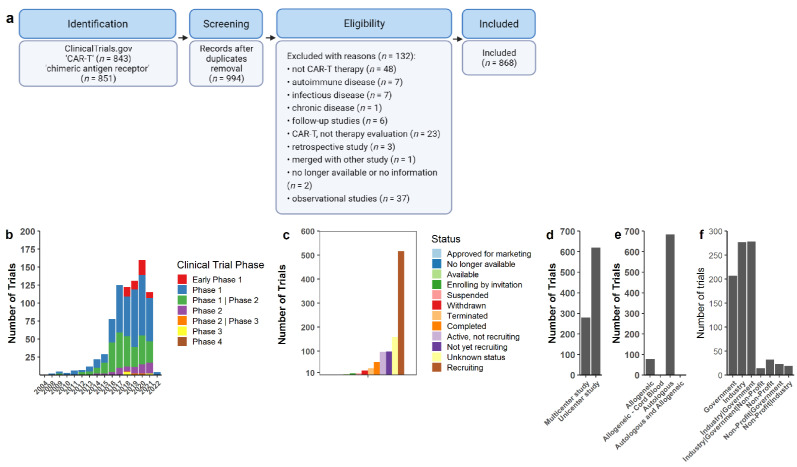
Figure 1
Figure 1
CAR-T cells on clinical trials. (a) Flow chart of the systematic review methodology showing the keywords, duplicate removal, and eligibility criteria applied as filters. (b) Number of trials by design type along the years. (c) Overall status of clinical trials applying CAR-T cells. (d) Multicenter or unicenter studies as described by each trial or observed by locations. (e) CAR-T cell source used in trials. The majority of trials described autologous, allogeneic cord blood (n = 1), and allogeneic or autologous T cells (n = 2). (f) Funding support described for clinical trials.
Figure 2
Figure 2
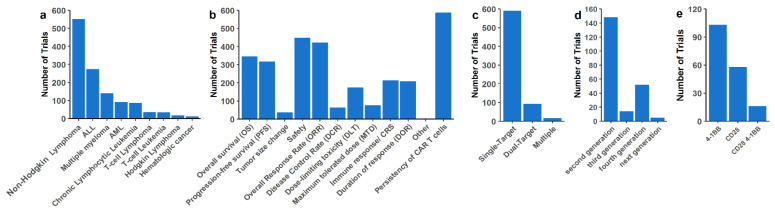
CAR-T cell strategy for hematological malignancies under clinical trial evaluation. (a) Hematological malignancies treated by CAR-T cells under clinical trials (non-Hodgkin’s lymphomas including DLBCL, MCL, Follicular lymphoma, mediastinal large B cell lymphoma, B cell lymphoma, CLL, and Small Lymphocytic Lymphoma). (b) Primary and secondary endpoints of clinical trials. All endpoints for a given trial are presented in this graph. (c) Number of simultaneous targets by one CAR or combination of different CAR-T cells delivered at once or in sequence for the patients. Multiple includes three or more targets at once. Several targets for multiple patients were considered as single-target therapy. (d) CAR generation used in clinical trials. (e) Number of clinical trials with CD28 and/or 4-1BB costimulatory signal on CAR constructs.
Figure 3
Figure 3
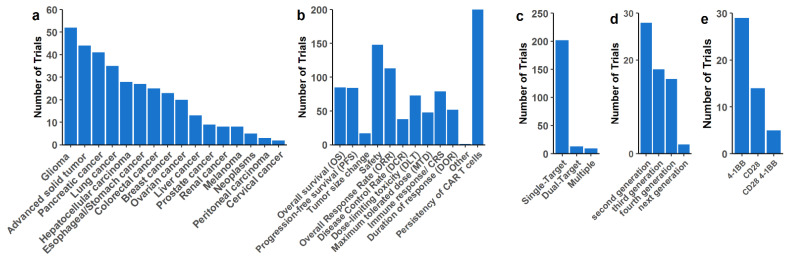
CAR-T cell strategies for solid tumors under clinical trial evaluation. (a) Solid tumors treated by CAR-T cells under clinical trials. The term “Advanced solid tumors” was applied when the trial description used the same terminology, and the tumor origin could not be accessed. If the trials described several tumors, all of them were marked as separated entities. (b) Primary and secondary endpoints of clinical trials. All endpoints for a given trial are presented in this graph. (c) Number of simultaneous targets by one CAR or combination of different CAR-T cells delivered at once or in sequence for the patients. ‘Multiple’ includes three or more targets at once. Several targets for multiple patients were considered as single-target therapy. (d) CAR generation used in clinical trials. (e) Number of clinical trials with CD28 and/or 4-1BB costimulatory signal on CAR constructs.
Figure 4
Figure 4
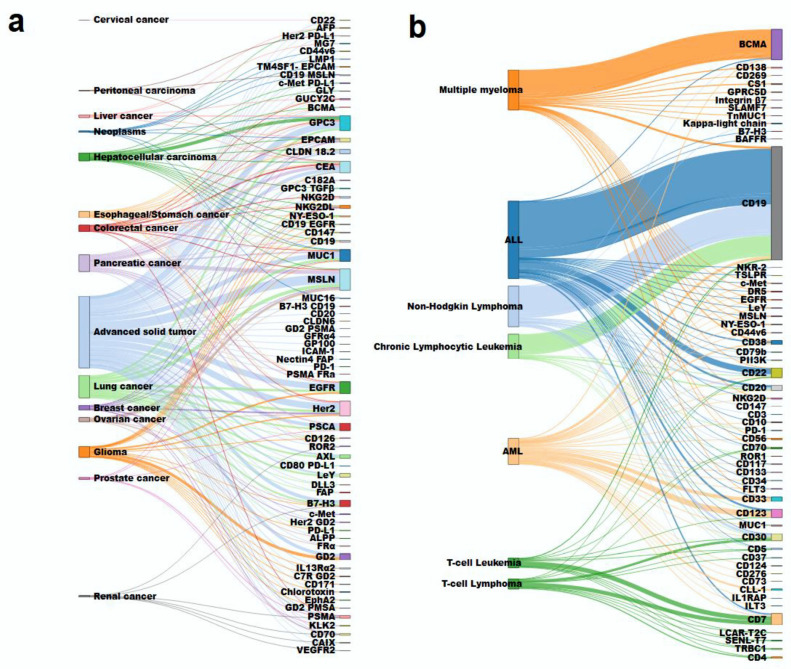
Disease and target antigen combination for CAR-T cell clinical trials. (a) Solid tumors are depicted on the left and the target on their right. The term “Advanced solid tumors” was attributed when the malignancy was not described in the trial. (b) Hematologic malignancies and the corresponding targets used in CAR-T cell trials. The line colors are according to the tumors, each line representing one study. The bar thickness is according to the number of studies of tumor or target.

References

    1. Cann S.A.H., Van Netten J.P., Netten C. Van Dr William Coley an tumor regression: A place in history or in the future. Postgr. Med. J. 2003;79:672–680. - PMC - PubMed
    1. Dunn G.P., Old L.J., Schreiber R.D. Cancer immunoediting: From immunosurveillance to tumor escape. Annu. Rev. Immunol. 2004;22:329–360. doi: 10.1146/annurev.immunol.22.012703.104803. - DOI - PubMed
    1. Van Barren N., Chambost H., Ferrant A., Michaux L., Ikeda H., Millard I., Olive D., Boon T., Coulie P.G. A gene encoding an antigen recognized by cytolytic T cells on a human melanoma by. Br. J. Haematol. 1991;102:1643–1647. doi: 10.1046/j.1365-2141.1998.00982.x. - DOI - PubMed
    1. Quezada S.A., Peggs K.S., Simpson T.R., Allison J. Shifting the equilibrium in cancer immunoediting: From tumor tolerance to eradication. Immunol Rev. 2011;241:104–118. doi: 10.1111/j.1600-065X.2011.01007.x. - DOI - PMC - PubMed
    1. Gross G., Waks T., Eshhar Z. Expression of immunoglobulin-T-cell receptor chimeric molecules as functional receptors with antibody-type specificity. Proc. Natl. Acad. Sci. USA. 1989;86:10024–10028. doi: 10.1073/pnas.86.24.10024. - DOI - PMC - PubMed