


Current Evidence on Immunotherapy for Gestational Trophoblastic Neoplasia (GTN)
- PMID: 35681761
- PMCID: PMC9179472
- DOI: 10.3390/cancers14112782
Current Evidence on Immunotherapy for Gestational Trophoblastic Neoplasia (GTN)
Abstract
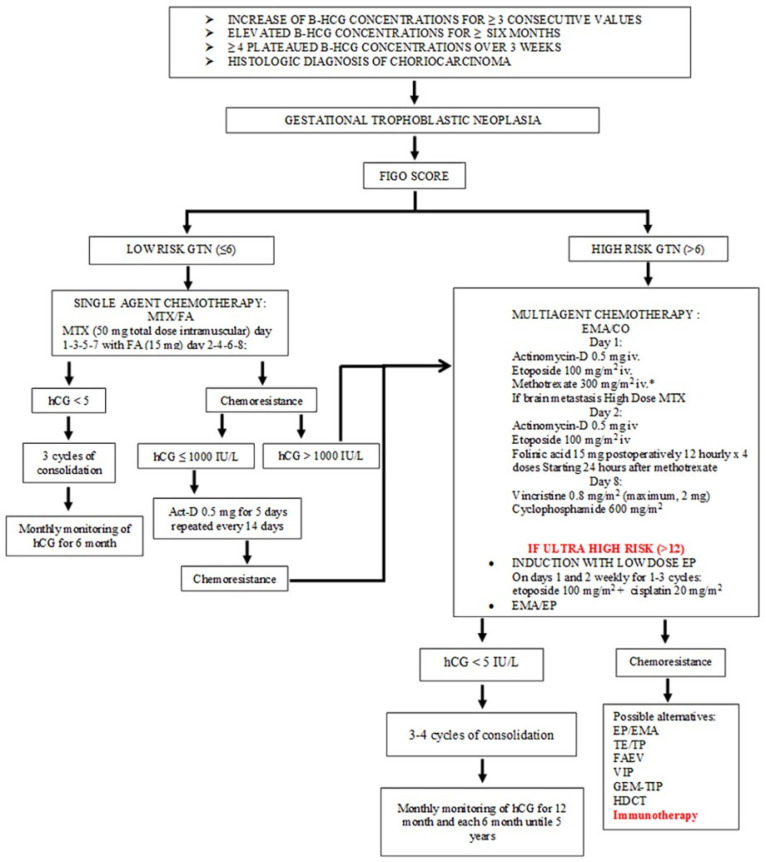
Background: Gestational trophoblastic disease includes a rare group of benign and malignant tumors derived from abnormal trophoblastic proliferation. Malignant forms are called gestational trophoblastic neoplasia (GTN) and include invasive mole, choriocarcinoma, placental site trophoblastic tumor and epithelioid trophoblastic tumor. Standard treatment of GTN is chemotherapy. The regimen of choice mainly depends on the FIGO prognostic score. Low-risk and high-risk GTN is treated with single-agent or multiagent chemotherapy, respectively. In the case of chemoresistance, immunotherapy may represent a new therapeutic strategy.
Methods: Literature obtained from searches on PubMed concerning GTN and immunotherapy was reviewed.
Results: Programmed cell death 1 (PD-1) and its ligands (PD-L1/2) are expressed in GTN. Published data on PD-1/PD-L1 inhibitors alone in GTN were available for 51 patients. Pembrolizumab is an anti-PD-1 inhibitor used in chemoresistant forms of GTN. In the TROPHIMMUN trial, Avelumab, a monoclonal antibody inhibiting PD-L1, showed promising results only in patients with GTN resistant to monochemotherapy. Conversely, in patients with resistance to multiagent chemotherapy, treatment with Avelumab was discontinued due to severe toxicity and disease progression. The association of Camrelizumab and Apatinib could represent a different treatment for forms of GTN refractory to polychemotherapy or for relapses.
Conclusions: Anti-PD-1 or anti-PD-L1 might represent an important new treatment strategy for the management of chemoresistant/refractory GTN.
Keywords: Apatinib; Avelumab; Camrelizumab; PD-1/PD-L1 inhibitors; Pembrolizumab; gestational trophoblastic neoplasia; immunotherapy.
Conflict of interest statement
A.B. and G.M. received honoraria and lectures fees from MSD, AstraZeneca, Clovis Oncology, GSK. Other authors declare no conflict of interest.
Figures
References
-
- Mangili G., Lorusso D., Brown J., Pfisterer J., Massuger L., Vaughan M., Ngan H.Y., Golfier F., Sekharan P.K., Charry R.C., et al. Trophoblastic disease review for diagnosis and management: A joint report from the International Society for the Study of Trophoblastic Disease, European Organisation for the Treatment of Trophoblastic Disease, and the Gynecologic Cancer InterGroup. Int. J. Gynecol. Cancer. 2014;24((Suppl. S3)):S109–S116. doi: 10.1097/IGC.0000000000000294. - DOI - PubMed
Publication types
LinkOut - more resources
Full Text Sources
Research Materials
