


Unraveling the Role of Guanylate-Binding Proteins (GBPs) in Breast Cancer: A Comprehensive Literature Review and New Data on Prognosis in Breast Cancer Subtypes
- PMID: 35681772
- PMCID: PMC9179834
- DOI: 10.3390/cancers14112794
Unraveling the Role of Guanylate-Binding Proteins (GBPs) in Breast Cancer: A Comprehensive Literature Review and New Data on Prognosis in Breast Cancer Subtypes
Abstract
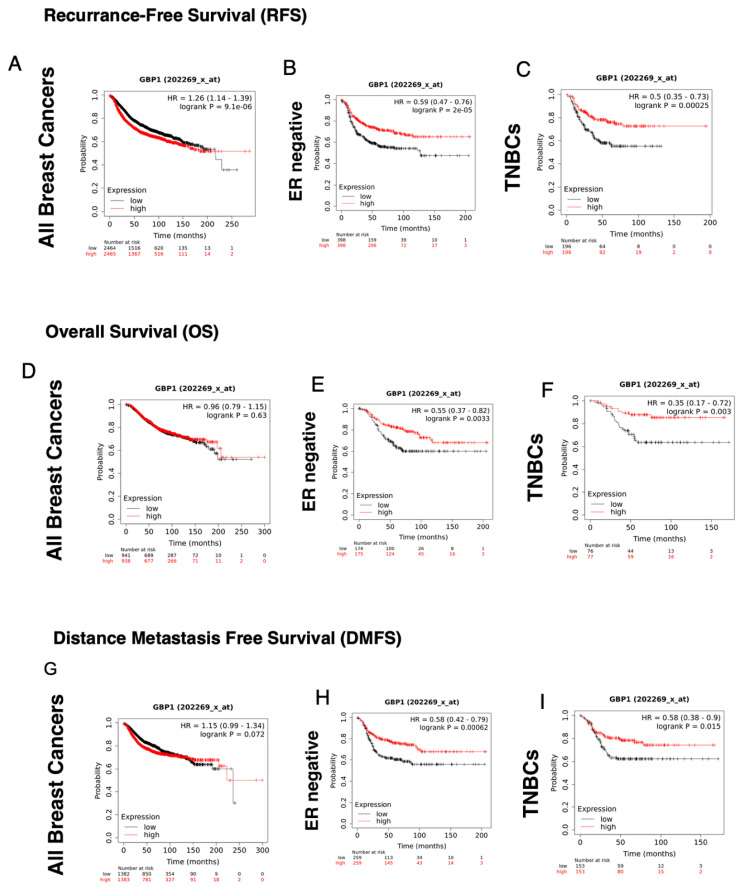
At least one member of the Guanylate-Binding Protein (GBP) family of large interferon-induced GTPases has been classified as both a marker of good prognosis and as a potential drug target to treat breast cancers. However, the activity of individual GBPs appears to not just be tumor cell type-specific but dependent on the growth factor and/or cytokine environment in which the tumor cells reside. To clarify what we do and do not know about GBPs in breast cancer, the current literature on GBP-1, GBP-2, and GBP-5 in breast cancer has been assembled. In addition, we have analyzed the role of each of these GBPs in predicting recurrence-free survival (RFS), overall survival (OS), and distance metastasis-free survival (DMFS) as single gene products in different subtypes of breast cancers. When a large cohort of breast cancers of all types and stages were examined, GBP-1 correlated with poor RFS. However, it was the only GBP to do so. When smaller cohorts of breast cancer subtypes grouped into ER+, ER+/HER2-, and HER2+ tumors were analyzed, none of the GBPs influenced RFS, OS, or DMSF as single agents. The exception is GBP-5, which correlated with improved RFS in HER2+ breast cancers. All three GBPs individually predicted improved RFS, OS, and DMSF in ER- breast cancers, regardless of the PR or HER2 status, and TNBCs.
Keywords: GTPase; distant metastasis-free survival (DMFS); estrogen receptor (ER); guanylate-binding protein (GBP); interferon-γ (IFN-γ); overall survival (OS); progesterone receptor (PR); recurrence-free survival (RFS); signal transducer and activator of transcription 1 (STAT1); triple negative breast cancer (TNBC).
Conflict of interest statement
The authors declare no conflict of interest.
Figures


References
LinkOut - more resources
Full Text Sources
Research Materials
Miscellaneous
