. 2022 May 24;19(11):6397.
doi: 10.3390/ijerph19116397.

Environmental Impact of Feeding with Infant Formula in Comparison with Breastfeeding

Affiliations

Environmental Impact of Feeding with Infant Formula in Comparison with Breastfeeding

Ellen Cecilie Andresen et al. Int J Environ Res Public Health. .

Abstract

Young children have unique nutritional requirements, and breastfeeding is the best option to support healthy growth and development. Concerns have been raised around the increasing use of milk-based infant formulas in replacement of breastfeeding, in regards to health, social, economic and environmental factors. However, literature on the environmental impact of infant formula feeding and breastfeeding is scarce. In this study we estimated the environmental impact of four months exclusive feeding with infant formula compared to four months exclusive breastfeeding in a Norwegian setting. We used life-cycle assessment (LCA) methodology, including the impact categories global warming potential, terrestrial acidification, marine and freshwater eutrophication, and land use. We found that the environmental impact of four months exclusive feeding with infant formula was 35-72% higher than that of four months exclusive breastfeeding, depending on the impact category. For infant formula, cow milk was the main contributor to total score for all impact categories. The environmental impact of breastfeeding was dependant on the composition of the lactating mother's diet. In conclusion, we found that breastfeeding has a lower environmental impact than feeding with infant formula. A limitation of the study is the use of secondary LCA data for raw ingredients and processes.

Keywords: acidification; breastfeeding; eutrophication; global warming potential; infant formula; land use; life-cycle assessment.


Conflict of interest statement

The authors declare no conflict of interest.

Figures
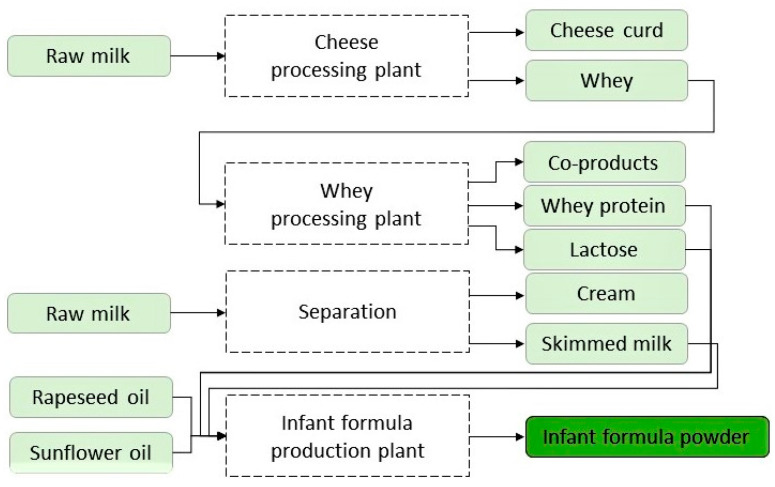
Figure 1
Figure 1
The processes involved in the production of infant formula included in the life-cycle assessment, adapted from Karlsson et al., 2019 [27]. The amount of raw ingredients (raw milk, rapeseed oil, and sunflower oil) and energy used for processing of 1 kg infant formula powder is provided in Table S1.
Figure 2
Figure 2
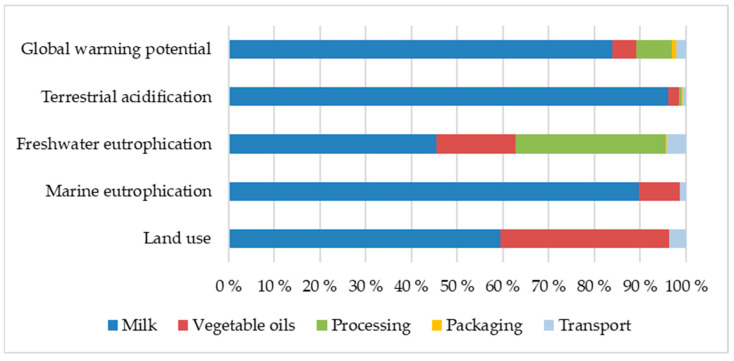
Percentage contribution to environmental impacts from production and distribution of 1 kg infant formula powder.
Figure 3
Figure 3
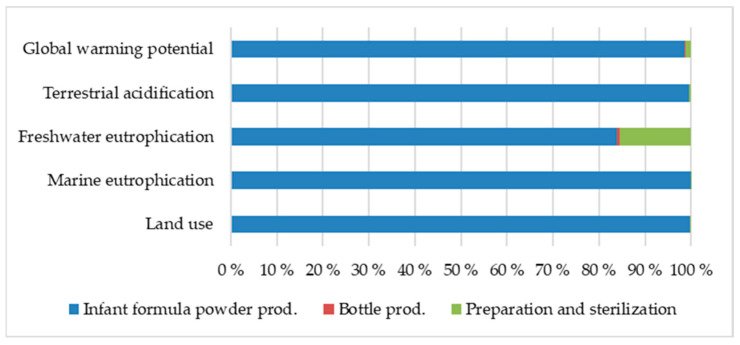
Percentage contribution to environmental impacts from 1 kg prepared infant formula ready for consumption.
Figure 4
Figure 4
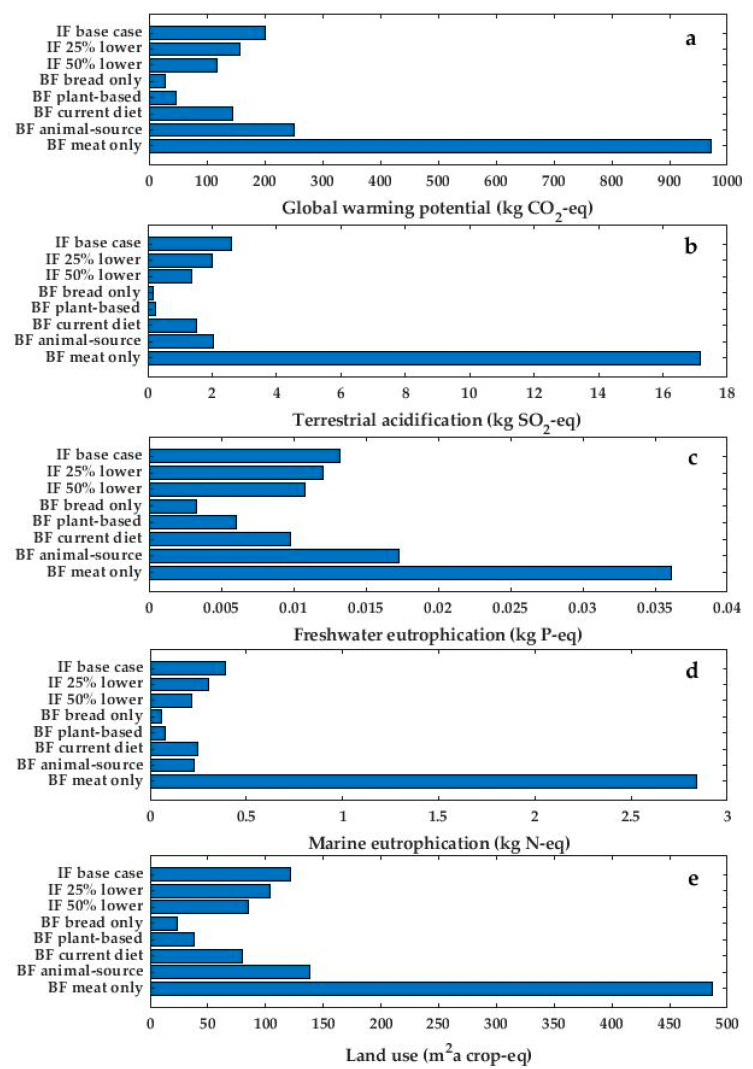
Impact from (a) global warming potential, (b) terrestrial acidification, (c) freshwater eutrophication, (d) marine eutrophication, and (e) land use, from four months feeding of infant formula base case and with 25% and 50% lower impact from cow milk compared to different dietary scenarios for breastfeeding. IF = infant formula; BF = breastfeeding; IF 25% lower refers to infant formula produced with 25% lower impact from cow milk; and IF 50% refers to infant formula produced with 50% lower impact from cow milk.

References

    1. Mameli C., Mazzantini S., Zuccotti G.V. Nutrition in the First 1000 Days: The Origin of Childhood Obesity. Int J. Environ. Res. Public Health. 2016;13:838. doi: 10.3390/ijerph13090838. - DOI - PMC - PubMed
    1. Victora C.G., Bahl R., Barros A.J., Franca G.V., Horton S., Krasevec J., Murch S., Sankar M.J., Walker N., Rollins N.C., et al. Breastfeeding in the 21st century: Epidemiology, mechanisms, and lifelong effect. Lancet. 2016;387:475–490. doi: 10.1016/S0140-6736(15)01024-7. - DOI - PubMed
    1. Grummer-Strawn L.M., Rollins N. Summarising the health effects of breastfeeding. Acta Paediatr. 2015;104:1–2. doi: 10.1111/apa.13136. - DOI - PubMed
    1. Horta B.L., Loret de Mola C., Victora C.G. Breastfeeding and intelligence: A systematic review and meta-analysis. Acta Paediatr. 2015;104:14–19. doi: 10.1111/apa.13139. - DOI - PubMed
    1. Horta B.L., Loret de Mola C., Victora C.G. Long-term consequences of breastfeeding on cholesterol, obesity, systolic blood pressure and type 2 diabetes: A systematic review and meta-analysis. Acta Paediatr. 2015;104:30–37. doi: 10.1111/apa.13133. - DOI - PubMed

Publication types