


Infectious Diseases Associated with Desert Dust Outbreaks: A Systematic Review
- PMID: 35682493
- PMCID: PMC9180817
- DOI: 10.3390/ijerph19116907
Infectious Diseases Associated with Desert Dust Outbreaks: A Systematic Review
Abstract
Background: Desert dust outbreaks and dust storms are the major source of particulate matter globally and pose a major threat to human health. We investigated the microorganisms transported with desert dust particles and evaluated their potential impact on human health.
Methods: A systematic review of all reports on the association between non-anthropogenic desert dust pollution, dust microorganisms and human health is conducted.
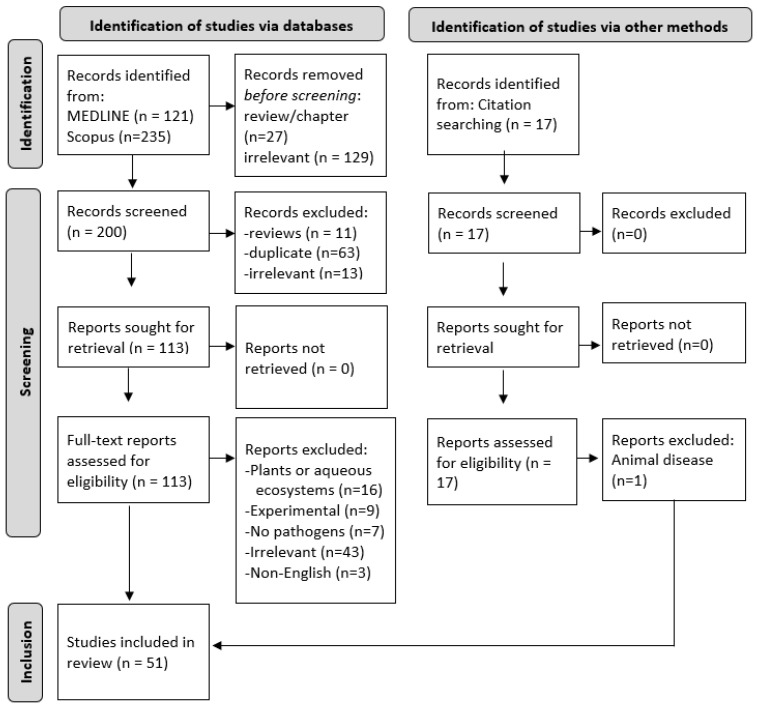
Results: In total, 51 articles were included in this review. The affected regions studied were Asia (32/51, 62.7%) followed by Europe (9/51, 17.6%), America (6/51, 11.8%), Africa (4/51, 7.8%) and Australia (1/51, 2.0%). The Sahara Desert was the most frequent source of dust, followed by Asian and American deserts. In 39/51 studies the dust-related microbiome was analyzed, while, in 12/51 reports, the association of desert dust with infectious disease outbreaks was examined. Pathogenic and opportunistic agents were isolated from dust in 24/39 (61.5%) and 29/39 (74.4%) of the studies, respectively. A significant association of dust events with infectious disease outbreaks was found in 10/12 (83.3%) reports. The infectious diseases that were mostly investigated with dust outbreaks were pneumonia, respiratory tract infections, COVID-19, pulmonary tuberculosis and coccidioidomycosis.
Conclusions: Desert dust outbreaks are vehicles of a significant number of pathogenic or opportunistic microorganisms and limited data indicate an association between dust events and infectious disease outbreaks. Further research is required to strengthen the correlation between dust events and infectious diseases and subsequently guide preventive public health measures.
Keywords: airborne pathogens; climate change; desert dust; ecosystem and public health; global warming; human health; infectious diseases; microorganisms; pollution.
Conflict of interest statement
The authors declare no conflict of interest.
Figures
References
Publication types
MeSH terms
Substances
LinkOut - more resources
Full Text Sources
Medical
