. 2022 May 25;23(11):5912.
doi: 10.3390/ijms23115912.

Expanding the Molecular Spectrum of ANKRD11 Gene Defects in 33 Patients with a Clinical Presentation of KBG Syndrome

Affiliations

Expanding the Molecular Spectrum of ANKRD11 Gene Defects in 33 Patients with a Clinical Presentation of KBG Syndrome

Ilaria Bestetti et al. Int J Mol Sci. .

Abstract

KBG syndrome (KBGS) is a neurodevelopmental disorder caused by the Ankyrin Repeat Domain 11 (ANKRD11) haploinsufficiency. Here, we report the molecular investigations performed on a cohort of 33 individuals with KBGS clinical suspicion. By using a multi-testing genomic approach, including gene sequencing, Chromosome Microarray Analysis (CMA), and RT-qPCR gene expression assay, we searched for pathogenic alterations in ANKRD11. A molecular diagnosis was obtained in 22 out of 33 patients (67%). ANKRD11 sequencing disclosed pathogenic or likely pathogenic variants in 18 out of 33 patients. CMA identified one full and one terminal ANKRD11 pathogenic deletions, and one partial duplication and one intronic microdeletion, with both possibly being pathogenic. The pathogenic effect was established by RT-qPCR, which confirmed ANKRD11 haploinsufficiency only for the three deletions. Moreover, RT-qPCR applied to six molecularly unsolved KBGS patients identified gene downregulation in a clinically typical patient with previous negative tests, and further molecular investigations revealed a cryptic deletion involving the gene promoter. In conclusion, ANKRD11 pathogenic variants could also involve the regulatory regions of the gene. Moreover, the application of a multi-test approach along with the innovative use of RT-qPCR improved the diagnostic yield in KBGS suspected patients.

Keywords: ANKRD11 gene expression analysis; ANKRD11 variations; KBG syndrome; diagnostic flow chart.


Conflict of interest statement

The authors declare no conflict of interest.

Figures
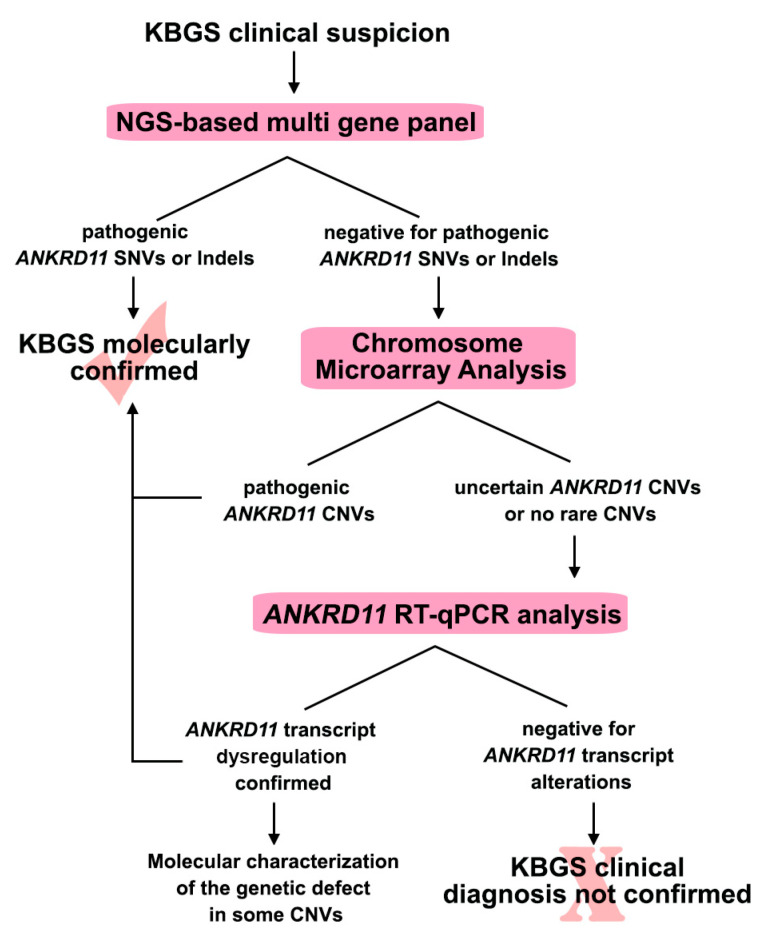
Figure 1
Figure 1
The KBGS flowchart. The figure summarizes the molecular diagnostic work-up that was used in the present study and which led to the molecular diagnosis in our KBGS patients. SNV: Single Nucleotide Variation; CNV: Copy Number Variations.
Figure 2
Figure 2
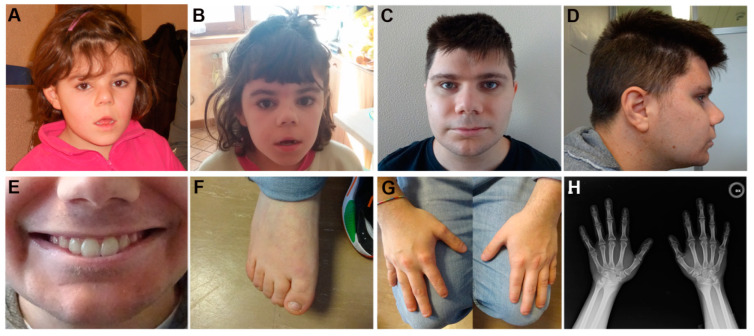
Clinical features of patients PT4 and PT33. (A,B) Facial features of PT4 at 3 and 9 years of age. (C,D) Frontal and profile facial features of PT33 at age 23 years. (E) Secondary dentition of PT33 showing wide upper central incisors (11 mm). (F) Foot of PT33 with large hallux. (G,H) Small hands of PT33 with hypoplasia of the 1st and 5th metacarpal bones and of the intermediate phalanx of the 2nd finger, bilaterally.
Figure 3
Figure 3
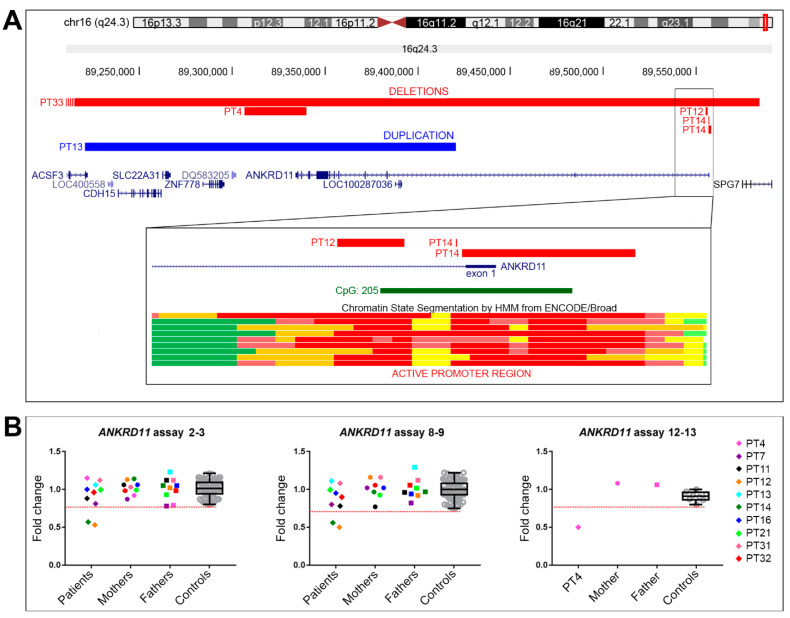
ANKRD11 structural variants detected by CMA and gene expression analysis (RT-qPCR). (A) Physical map of the 16q24.3 region showing deletions of patients PT4 and PT33 as horizontal red bars, while the duplication of PT13 as a horizontal blue bar. Deletions of PT12 and PT14 are shown enlarged in the box. The genes mapping in this region are in blue characters, the CpG island in green characters, the predicted regulatory elements identified by ENCODE are represented by bars of different colors based on their function, with the active promoters depicted in red. The images are a modified version obtained from the UCSC Genome Browser (human genome assembly GRCh37/hg19). (B) RT-qPCR experiments performed on 10 patients (PT4, PT7, PT11, PT12, PT13, PT14, PT16, PT21, PT31, and PT32) with TaqMan probes for exon junctions 2–3 (all patients), 8–9 (all patients except PT4), and 12–13 (only PT4). Patients’ expression levels are shown as colored triangles, mothers and fathers as colored circles and squares, respectively. The transcript levels of healthy controls are shown as grey circles, and a boxplot sums up the ANKRD11 expression variability. The dotted red line indicates the lower normal range cut-off.
Figure 4
Figure 4
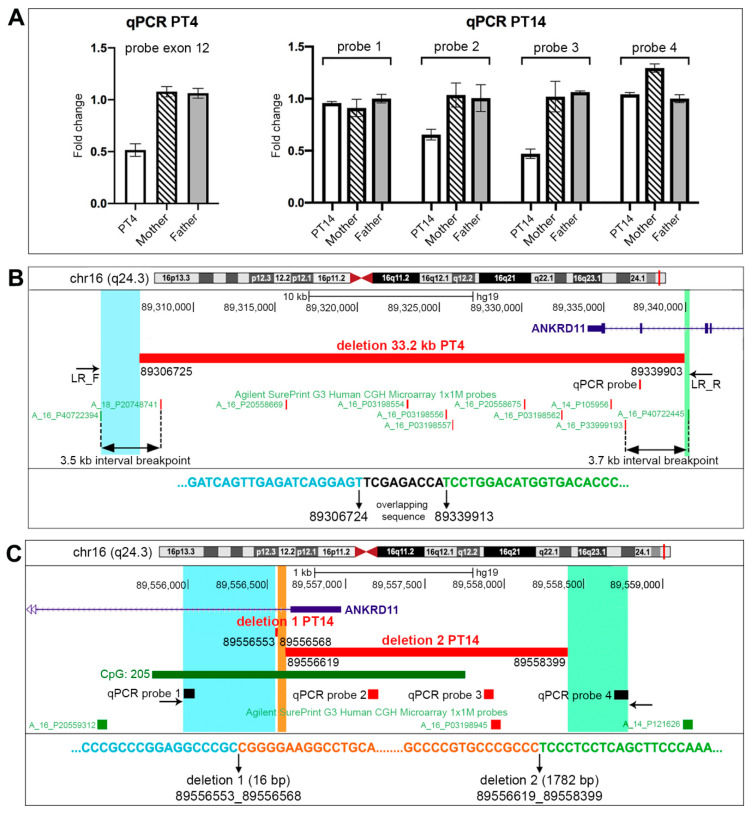
CNV characterization of PT4 and PT14. (A) Quantitative PCR on gDNA. qPCR results for PT4 and PT14, using probes spanning specific ANKRD11 genomic regions to characterize the CNVs. The mother and father of each patient were used as normal controls. (B) Physical map of PT4’s deletion. The specific deletion of 33.2 kb with the relative nucleotide position is shown as a horizontal red bar. The qPCR probe on exon 12 and the Long-Range primers LR_F and LR_R used to redefine the CNV at the nucleotide level are shown. Interval breakpoints (black double-end arrows) are delimited by the CMA probes, which are shown in green if not deleted, and in red if deleted. The sequenced regions are highlighted in light blue and light green, with the breakpoint corresponding to the nucleotide sequence depicted below; a micro-homology region is indicated in black characters. (C) Physical map of PT14’s deletions. The specific deletions with the corresponding nucleotide breakpoint positions are shown as red bars. The CMA probes are shown in green if not deleted, and in red if deleted. qPCR probes are depicted in black or in red if deleted. The sequenced regions using qPCR probe 1 forward and qPCR probe 4 reverse are highlighted in light blue, orange, and light green. The corresponding nucleotide sequence is depicted below, and the breakpoints leading to the formation of the two 16 bp and 1782 bp adjacent deletions involving the promoter region of ANKRD11 are indicated by the arrows.

References

    1. Herrmann J., Pallister P.D., Tiddy W., Opitz J.M. The KBG syndrome-a syndrome of short stature, characteristic facies, mental retardation, macrodontia and skeletal anomalies. Birth Defects. Orig. Artic. Ser. 1975;11:7–18. - PubMed
    1. Sirmaci A., Spiliopoulos M., Brancati F., Powell E., Duman D., Abrams A., Bademci G., Agolini E., Guo S., Konuk B., et al. Mutations in ANKRD11 cause KBG syndrome, characterized by intellectual disability, skeletal malformations, and macrodontia. Am. J. Hum. Genet. 2011;89:289–294. doi: 10.1016/j.ajhg.2011.06.007. - DOI - PMC - PubMed

    1. Crippa M., Rusconi D., Castronovo C., Bestetti I., Russo S., Cereda A., Selicorni A., Larizza L., Finelli P. Familial intragenic duplication of ANKRD11 underlying three patients of KBG syndrome. Mol. Cytogenet. 2015;8:20. doi: 10.1186/s13039-015-0126-7. - DOI - PMC - PubMed
    1. Parenti I., Mallozzi M.B., Hüning I., Gervasini C., Kuechler A., Agolini E., Albrecht B., Baquero-Montoya C., Bohring A., Bramswig N.C., et al. ANKRD11 variants: KBG syndrome and beyond. Clin. Genet. 2021;100:187–200. doi: 10.1111/cge.13977. - DOI - PubMed
    1. Low K., Ashraf T., Canham N., Clayton-Smith J., Deshpande C., Donaldson A., Fisher R., Flinter F., Foulds N., Fryer A., et al. Clinical and genetic aspects of KBG syndrome. Am. J. Med. Genet. A. 2016;170:2835–2846. doi: 10.1002/ajmg.a.37842. - DOI - PMC - PubMed

Supplementary concepts