Review
. 2022 May 26;22(11):4035.
doi: 10.3390/s22114035.

An Overview of the Sensors for Heart Rate Monitoring Used in Extramural Applications

Affiliations
Review

An Overview of the Sensors for Heart Rate Monitoring Used in Extramural Applications

Alessandra Galli et al. Sensors (Basel). .

Abstract

This work presents an overview of the main strategies that have been proposed for non-invasive monitoring of heart rate (HR) in extramural and home settings. We discuss three categories of sensing according to what physiological effect is used to measure the pulsatile activity of the heart, and we focus on an illustrative sensing modality for each of them. Therefore, electrocardiography, photoplethysmography, and mechanocardiography are presented as illustrative modalities to sense electrical activity, mechanical activity, and the peripheral effect of heart activity. In this paper, we describe the physical principles underlying the three categories and the characteristics of the different types of sensors that belong to each class, and we touch upon the most used software strategies that are currently adopted to effectively and reliably extract HR. In addition, we investigate the strengths and weaknesses of each category linked to the different applications in order to provide the reader with guidelines for selecting the most suitable solution according to the requirements and constraints of the application.

Keywords: electrocardiogram; extramural monitoring; heart rate; mechanocardiogram; non-invasive monitoring; photoplethysmogram; sensors.


Conflict of interest statement

The authors have no conflict of interest to declare.

Figures

Figure 1
Figure 1
Illustrative ECG signal recorded during one cardiac cycle. The main components are highlighted.
Figure 2
Figure 2
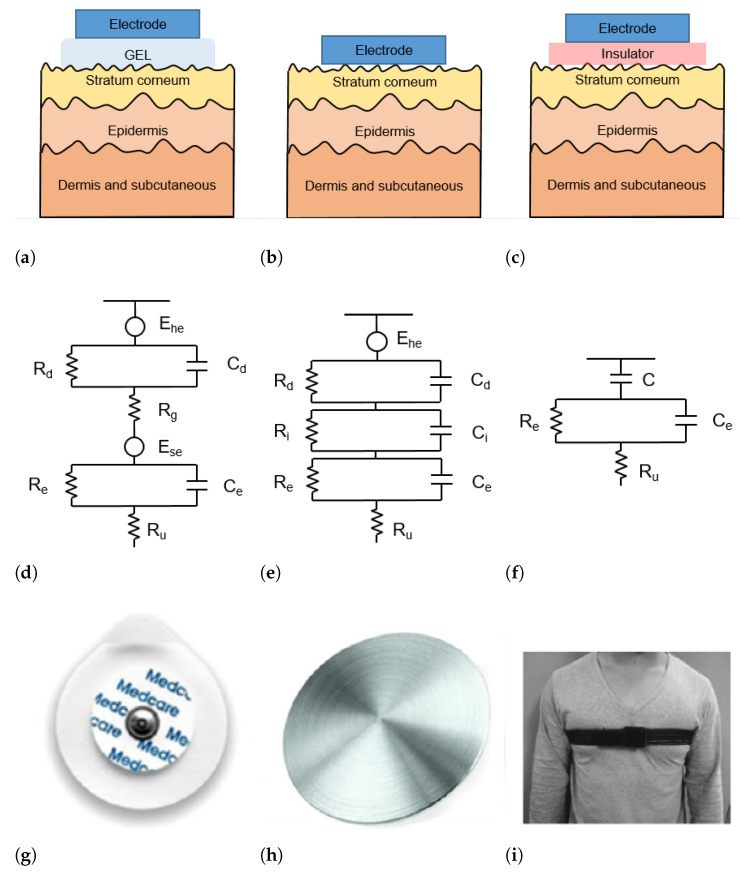
(ac) Schematic representation of skin-electrode interface for wet (a), dry (b), and capacitive (c) electrodes; (df) equivalent circuit model of skin–electrode interface for wet (d), dry (e), and capacitive (f) electrodes; (gi) example of wet (g), dry (h), and capacitive (i) electrodes.
Figure 3
Figure 3
Main steps of the well-known Pan–Tompkins [46] algorithm to detect R-peaks.
Figure 4
Figure 4
Composition of the PPG signal where different tissue layers cause the absorption of light. Figure reproduced from [64].
Figure 5
Figure 5
An illustrative PPG wave for one pulse, with the pulse start, systolic, and diastolic peaks, the dicrotic notch, and the pulse to pulse (P-P) interval indicated. The P-P interval is the time between to consecutive systolic peaks. Note that with respect to Figure 4, the signal is flipped along the vertical axis, to represent the volume instead of the detected light intensity.
Figure 6
Figure 6
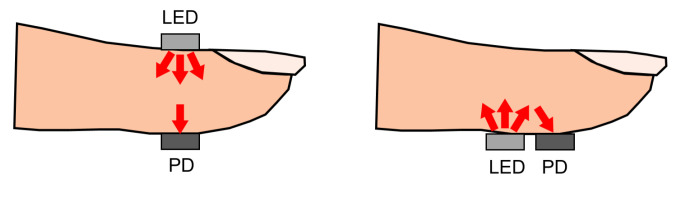
Schematic overview of transmissive (left) and reflective (right) PPG using an LED and a photodetector (PD). For the transmissive PPG, LED and PD are placed on opposite sides of the finger. For reflective PPG, the LED and PD are placed on the same side. Figure reproduced from [64].
Figure 7
Figure 7
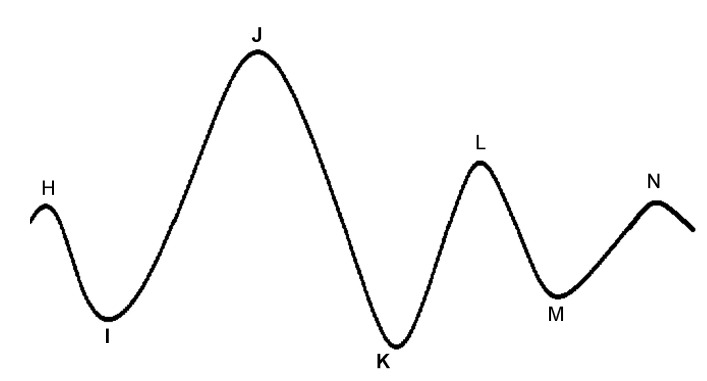
A characteristic ballistocardiogram waveform for one heartbeat. Each peak is denoted with letters H-N. The most relevant peaks related to physiological functions are denoted as I, J, and K.
Figure 8
Figure 8
Characteristic seismocardiogram (SCG) and gyrocardiogram (GCG) measurements from the sternum, co-currently collected and annotated according to the ECG. Inside the SCG waveform, the identified systolic events include mitral valve closure (MC), isovolumic movement (IM), aortic valve opening (AO), rapid systolic ejection (RE), and aortic valve closure (AC). Identified diastolic events include mitral valve opening (MO) and early rapid filling (RF). Inside the GCG waveform, the gI,gJ,gK, and gL points of the waveform along the x-axis of the GCG are annotated and used to estimate cardiac time intervals, including isovolumetric contraction time (IVCT), isovolumetric relaxation time (IVRT), the total electromechanical systole (QS2), the left ventricular ejection time (LVET), and the pre-ejection period (PEP) [115].

References

    1. Venes D. Taber’s Cyclopedic Medical Dictionary. FA Davis; Philadelphia, PA, USA: 2017.
    1. Rajendra Acharya U., Paul Joseph K., Kannathal N., Lim C.M., Suri J.S. Heart rate variability: A review. Med. Biol. Eng. Comput. 2006;44:1031–1051. doi: 10.1007/s11517-006-0119-0. - DOI - PubMed
    1. Betts J.G., Young K.A., Wise J.A., Johnson E., Poe B., Kruse D.H., Korol O., Johnson J.E., Womble M., DeSaix P. Anatomy and Physiology. Open Stax College; Houston, TX, USA: 2013.
    1. Saeed M., Villarroel M., Reisner A.T., Clifford G., Lehman L.W., Moody G., Heldt T., Kyaw T.H., Moody B., Mark R.G. Multiparameter Intelligent Monitoring in Intensive Care II (MIMIC-II): A public-access intensive care unit database. Crit. Care Med. 2011;39:952. doi: 10.1097/CCM.0b013e31820a92c6. - DOI - PMC - PubMed
    1. Fidler R.L., Pelter M.M., Drew B.J., Palacios J.A., Bai Y., Stannard D., Aldrich J.M., Hu X. Understanding heart rate alarm adjustment in the intensive care units through an analytical approach. PLoS ONE. 2017;12:e0187855. doi: 10.1371/journal.pone.0187855. - DOI - PMC - PubMed

LinkOut - more resources